Soil Doctor Brings AI-Powered Soil Testing to Farms Across Multiple Indian States
India | Agritech, Artificial Intelligence & Innovation
Information checked on 4 October 2026.
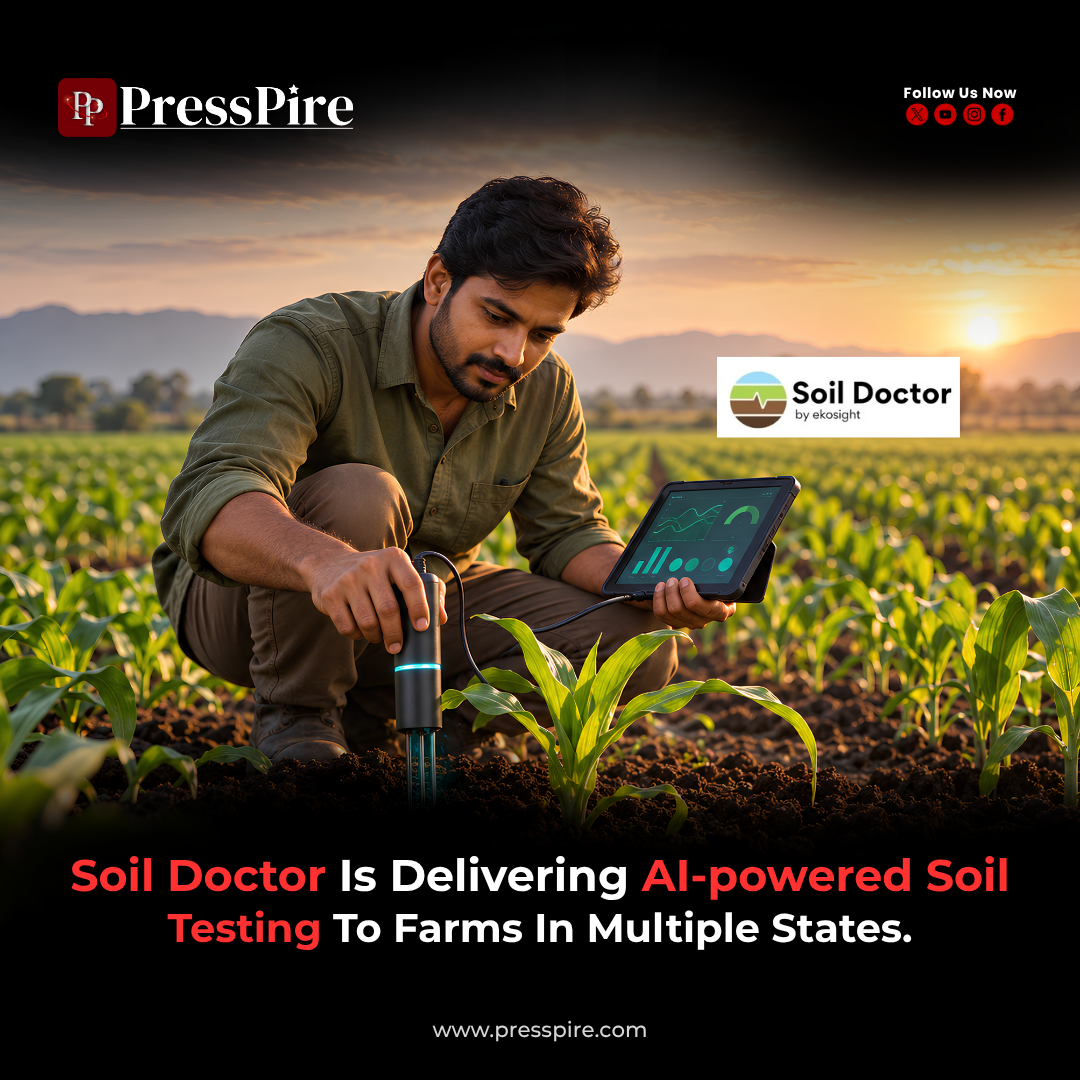
Soil Doctor, developed by Ekosight Technologies, is bringing portable soil testing and AI-supported crop advice closer to farmers across India. The company says its services operate in more than 40 districts across nine states, combining testing equipment with village-level clinics and trained local operators.
The service addresses a practical farming decision: understanding what a field needs before spending money on fertilisers and other inputs. By connecting soil measurements with crop-specific recommendations, Soil Doctor aims to make testing useful at the point where farmers plan cultivation.
Its approach brings together hardware, digital analysis and people who can explain the results. That combination is central to the business: a report becomes more useful when a farmer understands what it means for the next crop.
The Company Behind Soil Doctor
Ekosight’s company history dates its incorporation to 29 September 2021. Its founders, Dhiraj Choudhary and Saumya Rawat, built the business around improving access to soil information and practical agricultural advice.
The company describes a development phase in 2022 that included work on portable testing equipment and powdered reagent sachets. Its first on-ground pilot followed in Punjab in 2023.
That progression helps explain the product’s design. Soil Doctor combines a physical testing system with an advisory service, giving local operators a role in collecting samples, conducting tests and helping farmers interpret the findings.
A Service Operating Across Different Farming Regions
A startup compendium hosted by the Research and Innovation Circle of Hyderabad, or RICH, lists Ekosight’s operations in Uttar Pradesh, Haryana, Punjab, Karnataka, Andhra Pradesh and Telangana.
The company’s current website reports a broader nine-state footprint. These figures describe its reported presence; they do not mean that every farmer or district within those states has access to a nearby clinic.
Serving different regions creates an important operational challenge. The advice must remain relevant to local crops, growing conditions and farming practices. A recommendation that is useful for one field may need adjustment elsewhere.
For a business expanding through local operators, consistent training and dependable support become as important as the number of locations reached.
How Soil Doctor’s Portable Testing System Works
Ekosight describes its kit as a portable, semi-automatic system using optical spectroscopy and connected technology. Its product listing includes the testing device, reagents, a shaker, sample containers and other accessories.
The equipment therefore works with physical samples and a testing procedure. The company says its on-field service can provide results in approximately 45–60 minutes, followed by recommendations.
Its advertised measurements include nitrogen-related indicators, phosphorus, potassium, pH, electrical conductivity, organic carbon and several micronutrients. Product pages describe different testing packages, so the precise scope of a service should be confirmed with the operator.
Several of these measurements answer distinct questions:
| Soil indicator | What it helps explain |
|---|---|
| pH | Whether the soil is acidic or alkaline, which affects nutrient availability |
| Electrical conductivity | The concentration of soluble salts and potential salinity concerns |
| Organic carbon | An aspect of soil organic matter, relevant to fertility and soil function |
| Nitrogen, phosphorus and potassium | Nutrient status that can inform a crop’s fertiliser plan |
| Micronutrients | Whether elements such as zinc, iron or boron may need closer attention |
A soil report brings these findings together. Their interpretation needs to account for the crop, local conditions and the methods used to obtain the measurements.
Where Artificial Intelligence Fits Into the Service
According to the company, its Soil Intelligence platform combines test results with satellite imagery and AI models to generate recommendations suited to particular crops and regions. Its platform description also includes weather information and seasonal monitoring.
The intended role of AI is to help turn several sources of information into advice that a farmer can use. Location-tagged samples can connect a result to a particular plot, while subsequent records can help track changes.
For example, an assessment might indicate that a field already has adequate levels of one nutrient but needs attention in another area. An appropriate advisory service could use that information to revise the input plan. This is an illustration of the decision process, rather than a claim about a particular farmer’s results.
The usefulness of the recommendation still depends on the quality of the underlying measurements and its suitability for local farming conditions.
Village Clinics Bring Testing Closer to Farmers
Soil Doctor Clinics provide a local service model for testing and advice. The company invites agricultural graduates, rural entrepreneurs, input retailers, progressive farmers and farmer producer organisation leaders to operate clinics.
Its advertised support includes training, access to the advisory platform and tools for tracking samples, locations and crops.
For farmers, a shared service offers access to equipment without requiring each household to buy and maintain a testing kit. A local operator can also explain unfamiliar readings and help arrange follow-up support.
From a business perspective, a clinic needs enough demand to cover equipment, consumables, travel and staff time. Its ability to attract repeat customers will depend on whether farmers find the service understandable, timely and useful.
Soil Didi Creates a Role for Rural Women Entrepreneurs
The company’s Soil Didi programme trains rural women to provide testing and advisory services in their communities. It describes support covering soil testing, business management, marketing and continued operational assistance.
Its programme page identifies activity in Uttar Pradesh, Bihar, Maharashtra and Madhya Pradesh, with expansion into additional states.
The model creates an opportunity to build local expertise alongside the technology. Someone available within or near a village may be better placed to explain a report, organise appointments and maintain contact through a growing season.
The commercial outcome will vary by location. Local demand, service costs and the number of customers returning for advice will influence whether an operator can build a sustainable income.
How the Model Fits India’s Wider Soil Health Efforts
Soil Doctor operates within a broader national effort to improve nutrient management. India launched its Soil Health Card scheme in 2015 to help farmers understand soil conditions and make better-informed fertiliser decisions.
The National Informatics Centre describes the Soil Health Card platform as connecting sample collection, testing, recommendations and report generation. Its reports provide nutrient information alongside guidance on fertilisers and soil amendments, with local-language access.
That existing system highlights the practical challenge for private agritech services: making reliable information easier to obtain and apply. Availability, turnaround time, clear explanations and follow-up advice can all affect whether a farmer uses a test result when making a purchase or cultivation decision.
Reliable Sampling Will Matter as the Network Grows
Fast analysis is useful when the sample represents the field accurately. Soil properties can vary within a plot, while recent fertiliser application, management history and the timing of collection can influence results.
USDA Natural Resources Conservation Service guidance emphasises evaluating measurements in the context of soil properties, climate and management. It also explains that soil health involves physical, chemical and biological indicators, so a single result cannot describe every aspect of a field’s condition.
For Soil Doctor, meaningful evidence of progress would include consistent testing, comparisons with reference laboratory methods and recommendations that remain useful across different crops and regions.
The business case will also depend on measurable farm outcomes. Input costs, crop performance, repeat usage and service quality would provide a clearer picture of value than geographic reach alone. Those outcomes need to be assessed over time, with weather and other farming decisions taken into account.
As its network develops, the central task is to make each test part of a dependable local service: accessible before an important decision, clearly explained and supported when the farmer needs further guidance.
For more insights navigate: PressPire | Stories That Shape the Future
Read previous article here: takeme2space-ai-satellite-moi-1a/
Follow PressPire on Facebook | Instagram | LinkedIn | YouTube
PressPire | Stories That Shape the Future