
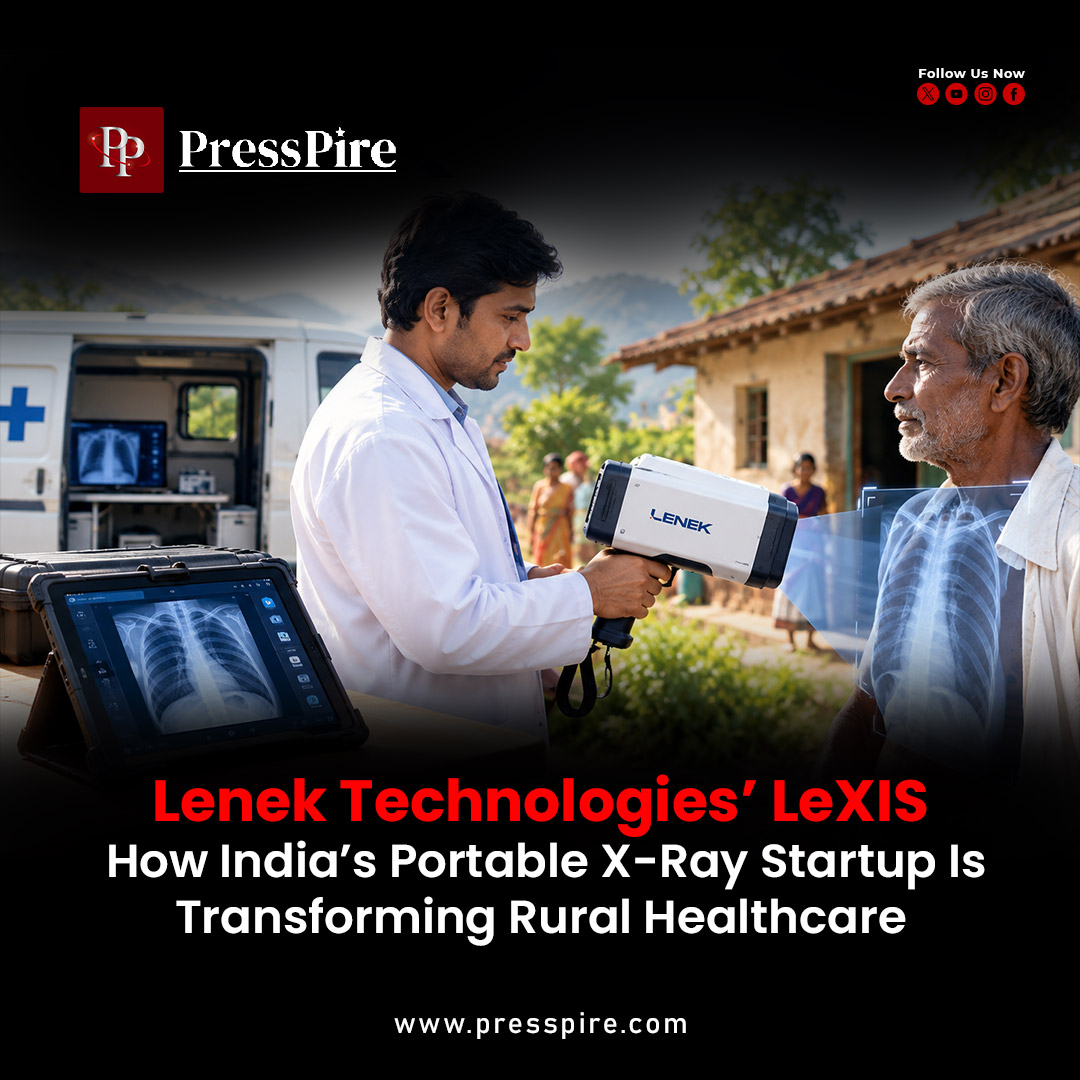
Lenek Technologies’ LeXIS: How India’s Portable X-Ray Startup Is Transforming Rural Healthcare
Lenek Technologies’ LeXIS is changing the way diagnostic imaging can reach remote and underserved communities in India. The Kanpur-based healthcare technology startup has developed an ultraportable X-ray imaging system designed to make diagnostic services more accessible, affordable, and deployable in locations where traditional medical infrastructure remains limited.
Access to timely medical imaging remains a major challenge in many rural regions. Conventional X-ray machines often require dedicated rooms, stable electricity infrastructure, and trained personnel, making deployment difficult in remote healthcare centres. Portable diagnostic technologies are emerging as a solution by bringing imaging capabilities closer to patients.
Lenek Technologies’ LeXIS focuses on solving this accessibility gap through compact hardware innovation combined with digital healthcare capabilities. The startup’s approach reflects a broader transformation in Indian healthcare, where technology companies are developing solutions to improve early diagnosis and strengthen healthcare delivery beyond major cities.
Lenek Technologies’ LeXIS Addresses the Challenge of Rural Healthcare Access
Healthcare accessibility remains one of the biggest challenges in geographically diverse countries like India. While urban hospitals often have advanced diagnostic facilities, rural and remote areas frequently face difficulties in accessing timely imaging services.
Diagnostic delays can impact the early detection and treatment of several health conditions. Patients living in remote locations may need to travel long distances to reach hospitals or diagnostic centres equipped with imaging facilities.
Lenek Technologies developed LeXIS with the objective of bringing X-ray imaging closer to the point of care. The portable X-ray system is designed for use in locations where traditional imaging infrastructure may not be easily available.
The company highlights accessibility, affordability, portability, and interoperability as important elements of its healthcare technology mission.
Lenek Technologies’ LeXIS Introduces Portable X-Ray Imaging Technology
Traditional X-ray systems are typically installed in fixed healthcare facilities because they require supporting infrastructure. This limits their use in mobile healthcare camps, rural clinics, emergency situations, and field environments.
Lenek Technologies’ LeXIS aims to overcome these limitations through a compact and battery-powered design. The system is developed as an ultraportable X-ray imaging solution that can support point-of-care diagnostic applications.
According to the company, LeXIS is designed to enable mobile and accessible X-ray imaging while reducing dependence on large infrastructure setups. The technology can support healthcare professionals working in different environments, including remote healthcare facilities and outreach programs.
The development of portable medical devices represents an important shift in healthcare technology. Instead of bringing every patient to a central diagnostic facility, healthcare providers can increasingly bring diagnostic capabilities closer to communities.
Lenek Technologies’ LeXIS Combines Hardware Innovation With AI Healthcare Solutions
Medical imaging is not only about capturing images but also about interpreting them effectively. This is where artificial intelligence is becoming increasingly important in healthcare.
Alongside LeXIS, Lenek Technologies has developed LIRA, an AI-powered radiology platform designed to assist with chest X-ray analysis. The company’s ecosystem combines portable imaging hardware with AI-based tools to support faster screening workflows.
The combination of portable X-ray devices and artificial intelligence reflects a growing trend in healthcare technology. AI tools can assist healthcare professionals by helping analyse medical images and supporting clinical decision-making.
However, AI-based healthcare solutions are designed to support medical professionals rather than replace doctors. The goal is to improve efficiency, reduce delays, and increase access to diagnostic support.
Lenek Technologies’ LeXIS Supports Point-of-Care Healthcare Delivery
One of the major advantages of portable medical technology is its ability to support point-of-care healthcare.
Point-of-care diagnostics allow healthcare providers to perform tests closer to where patients receive treatment. This approach can be especially valuable in rural areas, emergency situations, and healthcare camps.
LeXIS has been positioned for applications where mobility and accessibility are important factors. Portable imaging systems can support healthcare workers by allowing diagnostic procedures in locations that may not have conventional X-ray infrastructure.
The technology aligns with the growing demand for decentralised healthcare models, where diagnosis and treatment move closer to communities.
This approach can help reduce dependence on large hospitals for basic diagnostic requirements and support faster healthcare decisions.
Lenek Technologies’ LeXIS Reflects India’s Growing MedTech Innovation Ecosystem
India’s healthcare technology sector has been experiencing rapid growth as startups focus on developing affordable and locally designed medical solutions.
Lenek Technologies is an IIT Kanpur-incubated startup working in the medical imaging and healthcare technology space. The company was founded with a mission to develop diagnostic imaging solutions that improve healthcare accessibility.
The growth of Indian MedTech startups reflects a larger movement toward indigenous healthcare innovation. Companies are increasingly developing products designed specifically for local healthcare challenges, including infrastructure limitations and accessibility barriers.
Portable diagnostic devices represent one area where Indian startups are attempting to create solutions that can address both domestic healthcare needs and global markets.
Lenek Technologies’ LeXIS Could Transform Rural Diagnostic Infrastructure
The future of healthcare increasingly depends on technologies that improve accessibility without compromising quality.
Portable X-ray systems like LeXIS demonstrate how medical devices can be redesigned for environments where traditional healthcare infrastructure is difficult to establish.
Rural healthcare facilities, mobile medical units, emergency response teams, and community health programs can benefit from technologies that reduce the distance between patients and diagnostic services.
The ability to deploy imaging technology in diverse environments can become increasingly important as healthcare systems focus on early detection and preventive care.
Lenek Technologies’ LeXIS Highlights the Future of Accessible Medical Imaging
The development of portable healthcare technologies represents a major change in how medical services can be delivered. Instead of relying only on centralised healthcare infrastructure, modern solutions are enabling more flexible and distributed healthcare systems.
Lenek Technologies’ LeXIS represents this shift by focusing on portable X-ray imaging and improving access to diagnostic capabilities. Combined with AI-enabled healthcare platforms like LIRA, the company is working toward creating a more connected approach to medical diagnosis.
As healthcare technology continues to evolve, innovations that combine mobility, artificial intelligence, and affordability will play an important role in expanding access to quality healthcare.
For more insights navigate: PressPire | Stories That Shape the Future
Read previous article here: Aheesa Targets $10 Million Funding as Indian Fabless Chip Startup Moves Toward FY27 Commercial Launch
Follow PressPire on Facebook | Instagram | LinkedIn | YouTube
PressPire | Stories That Shape the Future