
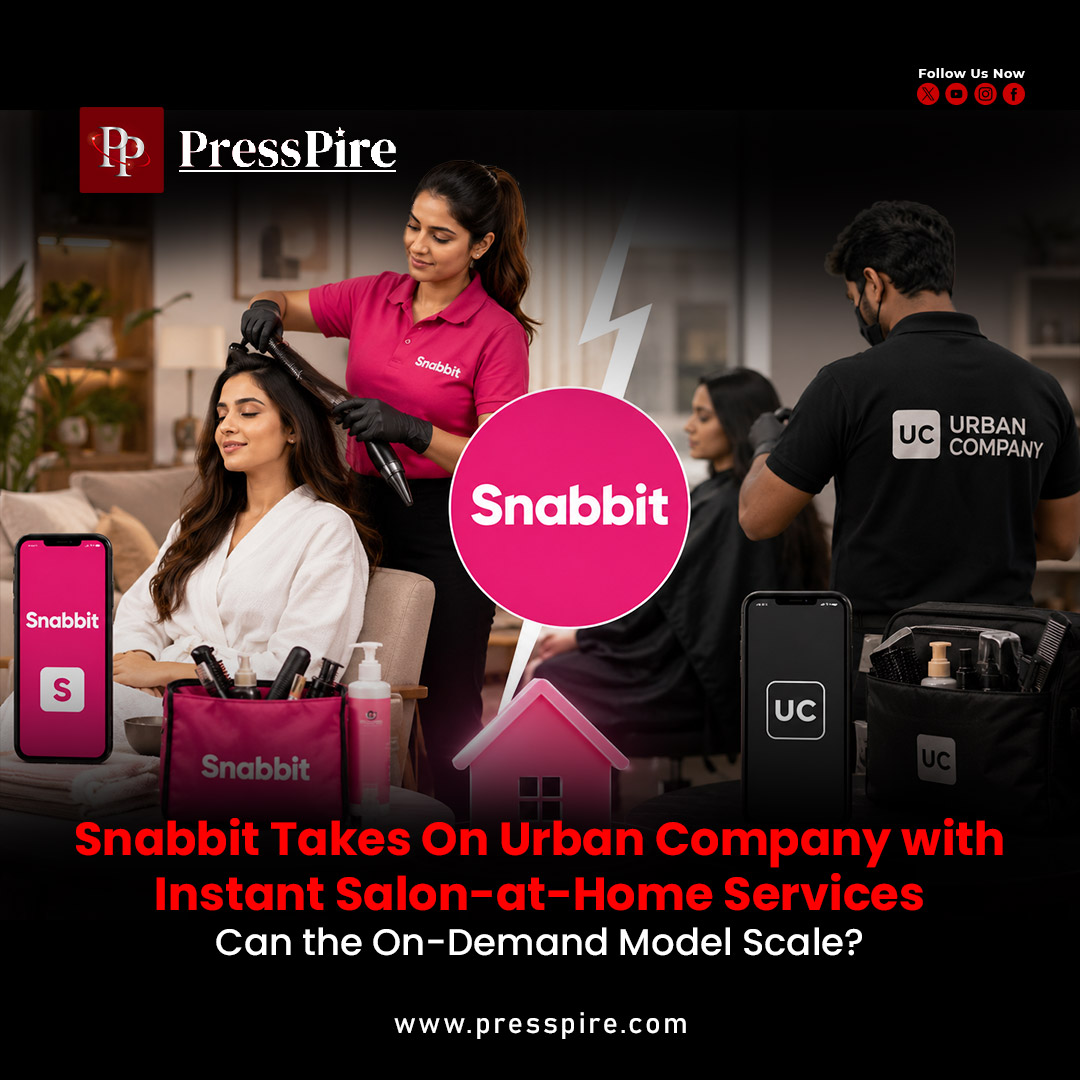
Snabbit Takes On Urban Company with Instant Salon-at-Home Services: Can the On-Demand Model Scale?
Snabbit salon-at-home services are challenging Urban Company’s appointment-led model. Can instant beauty services scale while maintaining quality and trust?
Snabbit Salon-at-Home Services: A New Beauty Race
The Indian home-services market is entering a new phase where convenience is no longer measured in hours or days, but in minutes. Snabbit, which built its business around instant household help, is now taking that promise into the beauty industry with Snabbit salon-at-home services. The move puts the Bengaluru-based startup directly against established players such as Urban Company, which has spent years building consumer trust in at-home salon and beauty services.
The timing is significant. Urban consumers are increasingly comfortable bringing professional services into their homes, whether for cleaning, personal grooming or beauty treatments. Snabbit believes the next opportunity lies in making salon services available almost as spontaneously as other on-demand services. Its beauty push therefore represents more than a category expansion; it is a test of whether the instant-service model can move from household chores into a category where skill, hygiene, personal comfort and customer trust matter even more. Snabbit’s challenge is straightforward but difficult: can a company built around speed persuade customers that faster beauty services can still deliver the quality expected from a professional salon?
Snabbit’s Journey Into Instant Services
Founded in 2024 by a team of IIT and IIM alumni, Snabbit began with a simple observation: urban households often need reliable domestic help but struggle to find it quickly. The company built a technology-led model around verified and trained female workers, scheduling, payments and rapid fulfilment. Snabbit says it now operates across 11 Indian cities and serves more than 10 lakh families, underlining how quickly the instant home-services model has expanded.
The company has also attracted substantial investor confidence. In April 2026, Snabbit raised $56 million in a Series D round co-led by Susquehanna Venture Capital, Mirae Asset Venture Investments and other investors. The funding valued the startup at around $350 million and took its total capital raised to approximately $112 million.
That capital gives Snabbit room to experiment with new categories. Beauty is particularly attractive because salon services can generate higher-value transactions than routine household tasks. If the company can successfully transfer its instant-service infrastructure into beauty, it could create a much broader platform for urban consumers.
Why Snabbit Entered Salon-at-Home Services
The decision to enter beauty is rooted in a change in consumer behaviour. Customers increasingly want services that fit around their schedules instead of planning their lives around appointments. A salon visit can involve travelling, waiting and spending several hours outside the home. Snabbit salon-at-home services attempt to remove that friction by bringing beauty professionals directly to the customer.
The company began testing its beauty offering in Bengaluru, positioning instant salon services as a new use case for its quick-service infrastructure. The strategy is aimed at creating what could be called “impulse beauty”—services that consumers can book when the need arises rather than days in advance.
This distinction matters. Traditional home salon services have already solved the problem of travel. Snabbit is attempting to solve the problem of waiting. That makes speed the central proposition and potentially gives the company a different position in a market where Urban Company already has considerable brand recognition.
How Snabbit Challenges Urban Company
Urban Company has a significant head start in India’s salon-at-home market. Its platform offers services including waxing, facials, manicures, pedicures, hair treatments and other beauty services through trained professionals. The company also emphasises background checks, hygiene protocols and experienced beauticians, making trust a major part of its value proposition.
Snabbit is therefore not entering an empty market. Instead, it is challenging an established consumer habit with a different promise: immediacy. That creates an interesting competitive equation. Urban Company has scale, brand familiarity, an established beauty network and years of consumer data. Snabbit has positioned itself around rapid fulfilment and has already demonstrated that customers are willing to pay for immediate household assistance. The battle will ultimately depend on whether consumers consider speed valuable enough to change their existing booking habits. The competition is also broader than beauty. Urban Company has been aggressively expanding its own instant-services offering through InstaHelp, placing it in direct competition with Snabbit across the larger on-demand home-services market.
The Power of Instant Beauty Services like Snabbit
The strongest argument for Snabbit salon-at-home services is convenience. Consider a customer who suddenly has a dinner, meeting, celebration or social event. A traditional salon appointment may require planning ahead. An instant home service could potentially turn that last-minute requirement into a simple app booking.
This model also fits the changing rhythm of India’s urban workforce. Longer working hours, traffic congestion and hybrid lifestyles have made time a valuable commodity. For many consumers, paying slightly more for convenience can be easier than losing two or three hours travelling to and from a salon.
The broader market signals are encouraging. Other beauty platforms are also moving toward faster home services. Yes Madam, for instance, reported 30,000 instant home beauty bookings in June 2026, demonstrating that consumer interest in immediate beauty fulfilment is becoming more visible. The opportunity, therefore, is not simply about taking customers away from Urban Company. It is about creating new occasions when customers choose home beauty services because they are available immediately.
Can Snabbit Maintain Quality and Trust?
Speed may attract the first booking, but quality will determine whether customers return. This is perhaps the biggest challenge facing Snabbit salon-at-home services.
Beauty services are fundamentally different from several household tasks. A customer may forgive a cleaner arriving a few minutes late, but a poorly performed facial, waxing service, haircut or manicure can immediately affect satisfaction. Personal grooming also involves close physical interaction, making hygiene, professionalism and communication particularly important.
Snabbit will need to ensure that rapid deployment does not compromise training. Its existing model relies on background verification and professional training, but beauty requires specialised skills across multiple service categories. The company will have to build a large enough network of trained beauticians while maintaining consistent service standards. Trust will be equally important. Urban Company has spent years developing its reputation around professional home beauty services. Snabbit will have to convince customers that an instant booking does not mean a compromise in expertise.
The Bigger Economics of On-Demand Beauty: Snabbit
The economics of instant services are complicated. A platform needs enough professionals available in each neighbourhood to respond quickly, but keeping workers idle between bookings can increase operating costs. At the same time, discounts may be necessary to attract customers, particularly while a new category is being established. Snabbit has already shown improvement in its unit economics. According to TechCrunch, the company said its loss per order had fallen by about 50%, while customer-acquisition costs had declined by roughly 65%. It was also processing more than 40,000 jobs a day across its network at the time of its April 2026 funding round.
However, beauty may introduce a different cost structure. Professionals require specialised training, products and equipment. Travel time can reduce the number of bookings a beautician can complete in a day. The company must also balance competitive pricing with fair earnings for service providers. The real test will be whether Snabbit can achieve high utilisation without sacrificing customer experience.
What Urban Company Brings to the Battle with Snabbit
Urban Company’s greatest advantage may not simply be its size. It is the accumulated trust of customers who already associate the platform with professional home services. Its salon offering includes multiple beauty categories, experienced professionals and established hygiene practices.
The company is also responding to the wider instant-services trend rather than watching it from the sidelines. Its InstaHelp initiative shows that Urban Company understands the growing importance of speed and is willing to invest in building a dense professional network to support faster fulfilment.
That could make the competition particularly intense. Snabbit may have introduced the instant-first philosophy into a new category, but Urban Company has the resources and customer base to respond quickly. The question, then, is not whether Urban Company can copy the model. It is whether Snabbit can build enough differentiation before larger competitors close the gap.
Can Snabbit Salon-at-Home Services Scale?
Scaling Snabbit salon-at-home services across India will require much more than adding beauticians to an app. The company will need dense local supply, reliable training, strong quality controls, efficient routing and enough demand to keep professionals productive.
The experience of the broader instant home-services sector offers both opportunity and warning. Snabbit and Urban Company’s InstaHelp recently crossed 100,000 completed jobs in a single day in the domestic-help segment, while competition has pushed companies to experiment aggressively with pricing and faster fulfilment.
Beauty could follow a similar trajectory, but the operating standards will need to be higher. A scalable model must ensure that “instant” does not become synonymous with “average.”
Snabbit’s strongest opportunity may therefore be to build a differentiated customer proposition around reliable, trained professionals who can arrive quickly without compromising the salon experience. If it succeeds, instant beauty could become a habit rather than a novelty.
The Future of Instant Beauty in India: Snabbit salon-at-home services
The rise of Snabbit salon-at-home services reflects a larger shift in India’s service economy. Consumers are increasingly comfortable outsourcing everyday needs through apps, and the definition of convenience continues to evolve. What once required advance planning can now be delivered on demand.
Yet the future will not be decided by speed alone. Customers ultimately remember whether the professional was skilled, whether the service felt safe, whether the price was fair and whether the experience was worth repeating.
Snabbit has already demonstrated that rapid home services can attract customers and investors. Its move into beauty is the next major test of that thesis. Urban Company, meanwhile, has the advantage of experience and an established position in home beauty. The result could be one of the more interesting battles in India’s evolving consumer-services economy. For Snabbit, the opportunity is enormous but so is the responsibility. If it can combine instant availability with professional beauty standards, Snabbit salon-at-home services could help create a new category of on-demand personal care. If speed comes at the expense of trust and quality, consumers may simply return to the platforms they already know.
The real question is therefore not whether India wants salon services at home. It already does. The question is whether customers are ready to make instant beauty their new normal. And that is the market Snabbit is now racing to win.
For more insights navigate: PressPire | Stories That Shape the Future
Read previous article here: https://presspire.com/insurancedekho/
Follow PressPire on Facebook | Instagram | LinkedIn | YouTube
PressPire | Stories That Shape the Future