
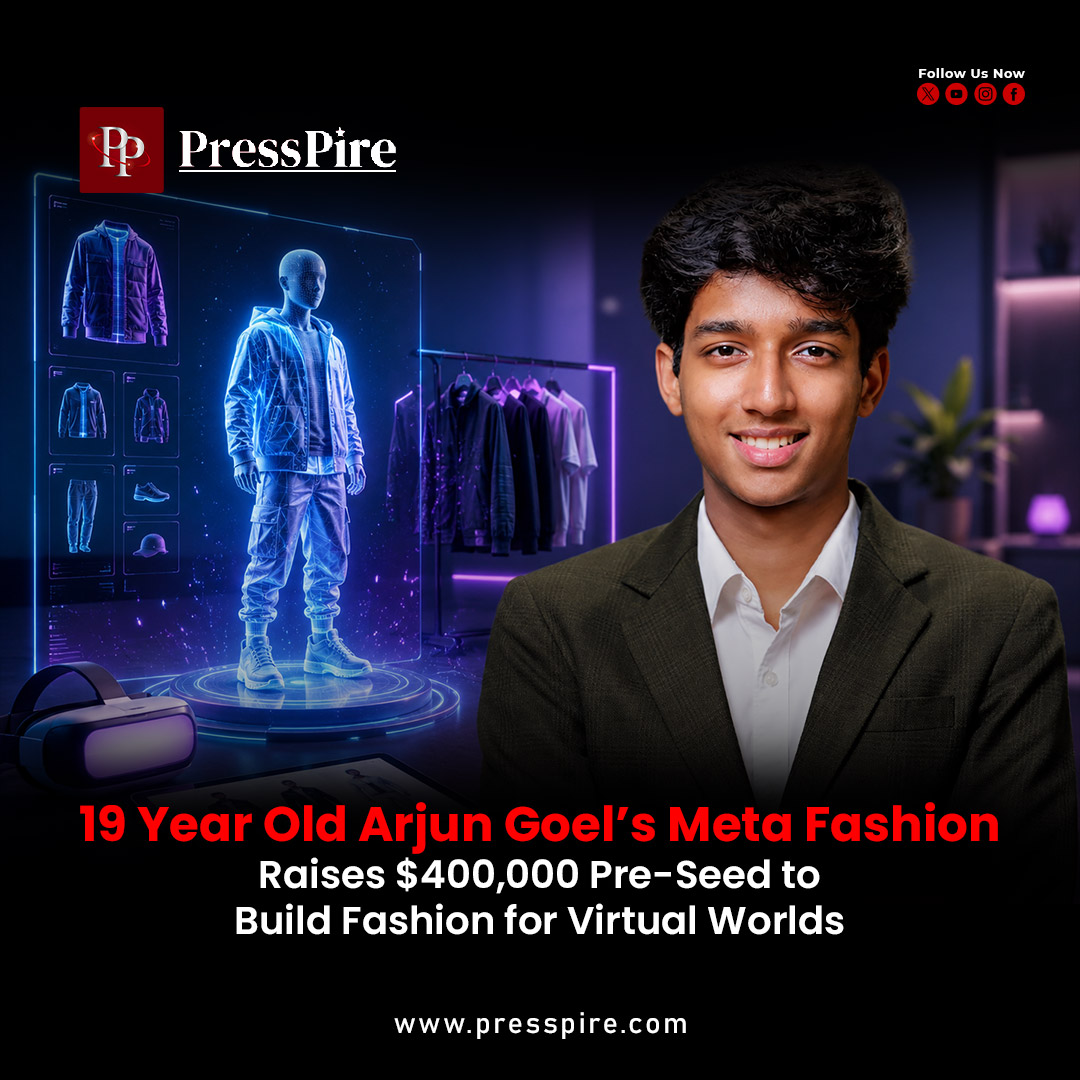
19-Year-Old Arjun Goel’s Meta Fashion Raises $400,000 Pre-Seed to Build Fashion for Virtual Worlds
Arjun Goel’s Meta Fashion raises $400,000 in pre-seed funding led by Lumikai to build digital fashion and expand virtual worlds. Arjun Goel’s Meta Fashion has raised approximately $400,000 in pre-seed funding led by Lumikai. The 19-year-old entrepreneur’s startup creates digital fashion for platforms such as Roblox, Fortnite and ZEPETO, while building a bridge between virtual fashion, gaming and physical commerce.
Arjun Goel Meta Fashion Takes a Bold Step
At 19, most entrepreneurs are still exploring which industry they want to enter. Arjun Goel has already found his arena: the rapidly evolving intersection of gaming, fashion and digital identity. His company, Meta Fashion, has raised approximately $400,000 in pre-seed funding, marking a significant early milestone for an Indian startup betting on the future of fashion in virtual worlds. The round was led by Lumikai, an investment firm focused on interactive media, gaming and digital platforms, with participation from Big Bets, Akshat Rathee of Nodwin Gaming and Masters’ Union founder Pratham Mittal.
The development is more than another startup funding announcement. It reflects a broader shift in how younger consumers express identity. Fashion is no longer restricted to physical wardrobes. For millions of players, avatars have become extensions of their personalities, and virtual outfits, accessories and experiences are increasingly part of that identity. Meta Fashion is positioning itself at the centre of this change by creating fashion products designed specifically for digital environments while exploring how virtual trends can influence physical commerce.
The Young Founder Behind Meta Fashion
The story of Arjun Goel Meta Fashion began with Roblox, where Goel started creating digital accessories at the age of 15. What initially looked like an interest in gaming gradually developed into an understanding of digital consumer behaviour. Meta Fashion says Goel became one of the first Indian creators in Roblox’s user-generated content ecosystem and went on to sell more than a quarter of a million digital accessories. The company’s website describes him as a digital fashion enthusiast who has been deeply involved in the Roblox UGC community since the pandemic period.
That early exposure gave Goel something many traditional fashion entrepreneurs may struggle to acquire: direct experience with consumers inside virtual marketplaces. Instead of predicting what digital users might want, he was already creating, launching and observing which products attracted attention. His journey also reached a wider audience through his appearance on Shark Tank India Season 5. Masters’ Union describes Meta Fashion as an extension of Goel’s attempt to transform his experience with virtual identity into a business connecting online creativity with real-world fashion.
Meta Fashion Raises $400K in Pre-Seed Funding
The Meta Fashion $400K funding round gives the company fresh capital to accelerate its digital fashion strategy. Lumikai led the approximately $400,000 pre-seed round, joined by investors including Big Bets, the family office associated with HUUUGE Games founder Anton Gauffin, Nodwin Gaming founder Akshat Rathee and Masters’ Union founder Pratham Mittal.
For an early-stage company, the significance of the round lies not only in the amount raised but also in the profile of the investors. The participation of investors with backgrounds in gaming, interactive entertainment and entrepreneurship provides strategic relevance to Meta Fashion’s ambitions. The funding is expected to support expansion of the company’s virtual fashion business, development of its original game GlamGirls and entry into additional user-generated-content platforms.
The investment also arrives at a time when digital platforms are increasingly becoming places where entertainment, commerce and self-expression overlap.
Building Fashion for Virtual Worlds like Meta Fashion
Traditional fashion is built around physical constraints: fabric, manufacturing, inventory, logistics and retail space. Virtual fashion operates under a different set of rules. A digital outfit does not require physical material, can be distributed instantly and can be designed for environments where consumers spend hours playing, socialising and creating.
Meta Fashion is developing digital apparel and accessories for platforms including Roblox, Fortnite and ZEPETO, with the broader ambition of becoming a major consumer fashion company for these emerging digital ecosystems. Reports on the company indicate that it has sold more than 2.5 million virtual fashion units and generated approximately $300,000 in gross merchandise value, with a reported gross margin of around 92%.
These figures illustrate why virtual fashion is attracting entrepreneurial and investor attention. Once a digital product has been created, reproducing and distributing it can be considerably more efficient than manufacturing physical goods. That creates room for experimentation, rapid product launches and entirely new approaches to fashion merchandising.
From Roblox Creator to Digital Fashion Founder: Meta Fashion
What makes the Arjun Goel startup story particularly interesting is the way it began with creation rather than conventional fashion retail. Goel entered Roblox as a teenager and learned about digital accessories from the creator side of the platform. Meta Fashion’s own profile says he has participated in Roblox’s UGC community, released multiple digital accessories and appeared on an official Roblox UGC panel.
That background has shaped the company’s philosophy. Rather than treating virtual fashion as a marketing extension of physical clothing, Meta Fashion sees digital spaces as independent consumer environments with their own tastes, trends and purchasing behaviours. The company’s model is therefore closer to a combination of fashion studio, gaming business and consumer technology platform.
The startup was founded in 2022 by Arjun Goel and Sanjay Goel. Sanjay brings experience in consumer technology and manufacturing, along with an educational background from NIFT Delhi and previous entrepreneurial experience. Together, the founders combine Arjun’s understanding of digital fashion with experience in building businesses beyond the virtual world.
Meta Fashion Connects Digital and Physical Retail
One of Meta Fashion’s most ambitious ideas is its digital-to-physical fashion model. The company describes its approach as a “phygital” fashion strategy, using signals from virtual environments to help identify trends before translating successful concepts into physical products. Dealroom describes Meta Fashion as a platform operating at the intersection of gaming, fashion and commerce, with virtual trends informing tangible retail products.
This could offer an important advantage over traditional fashion businesses. Instead of manufacturing large quantities based primarily on forecasts, a digital product can first be tested in a virtual marketplace. If consumers respond strongly, the underlying design can potentially inspire physical merchandise. In theory, this creates a feedback loop between digital demand and physical production while reducing some of the inventory risk associated with conventional fashion.
Meta Fashion has also explored physical products through its VKYD Labs initiative, which connects physical merchandise with digital experiences. The company describes its products as made-to-order and inspired by digital trends, demonstrating how the boundary between a gamer’s virtual wardrobe and physical wardrobe can increasingly become blurred.
GlamGirls Expands the Meta Fashion Vision
Meta Fashion’s ambitions extend beyond selling digital clothing. The company is also developing its own gaming ecosystem through GlamGirls, an original fashion-focused game on Roblox. According to Dealroom’s company information, GlamGirls launched in beta in late 2025 and has attracted more than 100,000 paying users. The company plans to use its new capital to continue growing the game while strengthening its presence across other UGC platforms.
The significance of GlamGirls is that it allows Meta Fashion to control more of the consumer experience. Instead of simply creating products for an existing platform, the company can build an environment where fashion, gameplay and community interaction are connected. That creates opportunities for digital merchandise, branded experiences and new forms of virtual commerce.
For Goel, this represents a natural progression from being a creator on someone else’s platform to building intellectual property of his own.
Why Virtual Fashion Is Becoming Big Business like Meta Fashion
The rise of fashion for virtual worlds is closely connected to a generational change in consumer behaviour. Younger audiences increasingly move between physical and digital identities without treating the two as separate experiences. An avatar’s appearance can communicate personality, status, creativity and belonging just as clothing does in the physical world.
Gaming platforms have accelerated this trend by turning digital environments into social spaces. Roblox, Fortnite and other UGC ecosystems allow users not only to play but also to create, communicate and customise their experiences. This has opened a new category of consumer spending around digital goods.
Meta Fashion’s reported sales demonstrate that virtual fashion is already capable of generating meaningful commercial activity. Its strategy also reflects a larger creator-economy movement in which individual designers can reach global audiences without building traditional manufacturing and retail infrastructure first.
The opportunity, however, comes with challenges. Digital platforms have their own rules, economies and algorithms, while consumer tastes can change quickly. Meta Fashion will need to maintain creative relevance while managing platform dependence and building intellectual property that can travel across ecosystems.
What Comes Next for Arjun Goel Meta Fashion
The next chapter of Arjun Goel Meta Fashion will be about turning early creator success into a scalable global company. The $400,000 pre-seed round provides the resources to expand its virtual fashion catalogue, develop GlamGirls and explore additional user-generated-content platforms.
The larger ambition is clear: Meta Fashion wants to make digital fashion a serious consumer category rather than a niche feature of gaming. Its approach combines the speed of virtual product creation with the commercial potential of physical fashion, creating a model where digital trends can influence tangible products and physical brands can find new audiences through virtual experiences.
Arjun Goel’s journey is compelling precisely because it began before the market fully understood the opportunity. At 15, he was experimenting with Roblox accessories. At 19, he is leading a funded startup attempting to redefine how fashion works in digital worlds. The challenge now is no longer proving that people will buy virtual fashion. It is proving that a young Indian company can turn that behaviour into a lasting global fashion and entertainment business.
For Meta Fashion, the future may not simply be about dressing avatars. It could be about creating a new fashion economy where the wardrobe exists everywhere on a screen, inside a game and eventually back in the real world.
For more insights navigate: PressPire | Stories That Shape the Future
Read previous article here: https://presspire.com/solinas-hero-mela/
Follow PressPire on Facebook | Instagram | LinkedIn | YouTube
PressPire | Stories That Shape the Future