
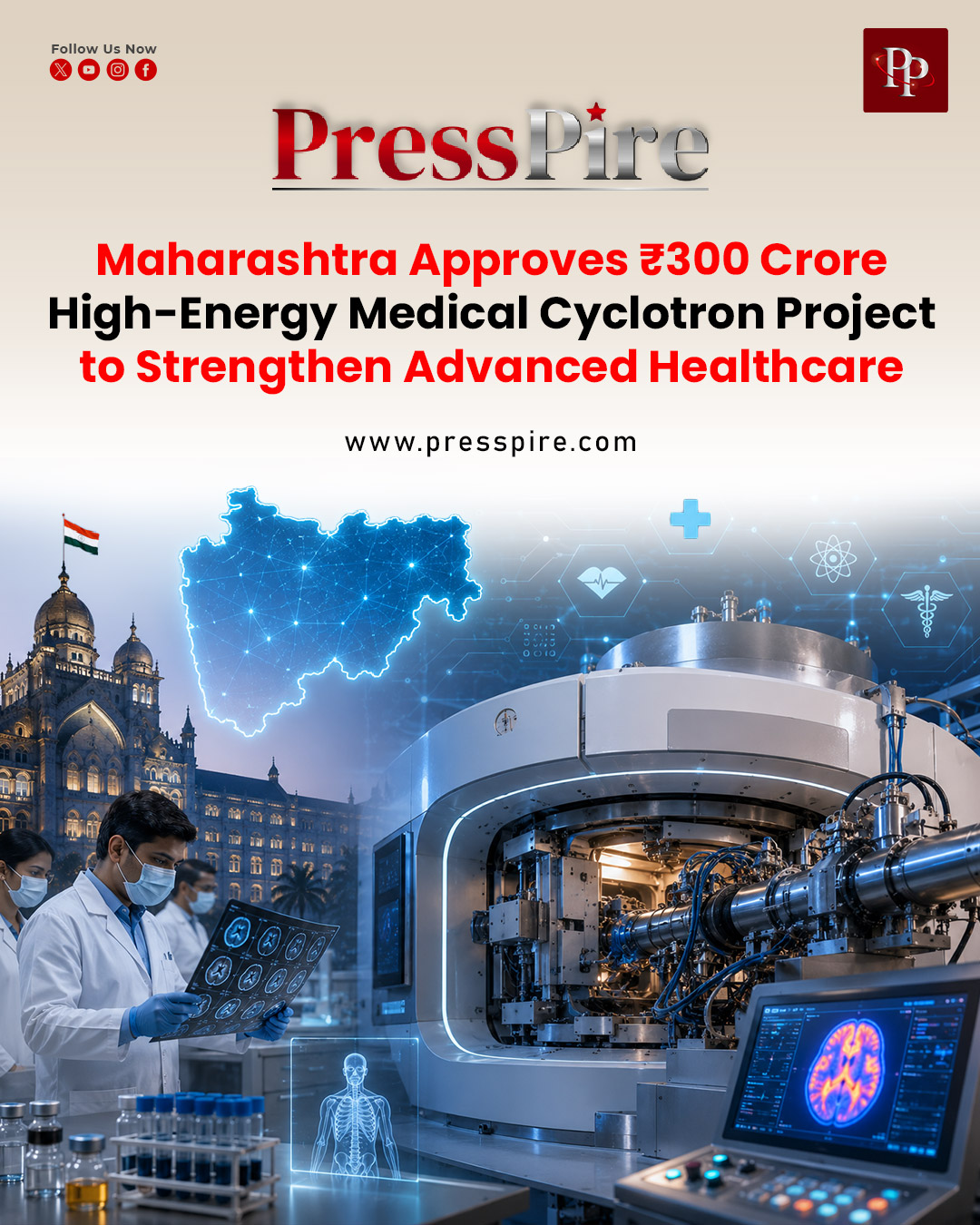
Maharashtra Approves ₹300 Crore High-Energy Medical Cyclotron Project to Strengthen Advanced Healthcare
Maharashtra sanctions a ₹300 crore high-energy medical cyclotron project to boost cancer diagnosis, nuclear medicine, and advanced healthcare. The Maharashtra government has approved a ₹300 crore High-Energy Medical Cyclotron Project to strengthen nuclear medicine, cancer diagnosis, and advanced healthcare infrastructure. The initiative is expected to improve the availability of life-saving radioisotopes, reduce dependence on imports, support medical research, and position Maharashtra as a leading healthcare innovation hub in India.
Maharashtra Medical Cyclotron Project Marks a New Healthcare Milestone
Healthcare infrastructure has become one of the strongest indicators of a state’s long-term development, and Maharashtra has once again taken a significant step toward strengthening its medical ecosystem. The Maharashtra government has approved a ₹300 crore High-Energy Medical Cyclotron Project, an ambitious initiative expected to transform nuclear medicine, cancer diagnosis, medical research, and the production of advanced radioisotopes within the state. The approval reflects the government’s increasing focus on developing world-class healthcare facilities that not only serve patients but also strengthen India’s scientific capabilities. As cancer cases continue to rise across India and the demand for precision diagnostics grows rapidly, healthcare experts have repeatedly emphasized the need for locally produced medical isotopes. Until now, hospitals have often depended on limited production facilities or imported radioisotopes, leading to delays, higher treatment costs, and logistical challenges because many isotopes have extremely short half-lives. The Maharashtra Medical Cyclotron Project aims to address these limitations by establishing advanced production capabilities that ensure a reliable supply of critical isotopes for Positron Emission Tomography (PET) scans and other sophisticated nuclear medicine procedures. Beyond improving patient access, the project also strengthens Maharashtra’s vision of becoming a leader in medical innovation, biomedical research, and high-end healthcare infrastructure, making it one of the state’s most strategic healthcare investments in recent years.
Why the Maharashtra Medical Cyclotron Project Matters
The Maharashtra Medical Cyclotron Project is not merely another infrastructure investment; it represents a strategic advancement in India’s healthcare ecosystem. A high-energy medical cyclotron is a sophisticated particle accelerator capable of producing a wide variety of radioisotopes that play a crucial role in diagnosing and treating serious illnesses such as cancer, neurological disorders, and cardiovascular diseases. Modern PET imaging relies heavily on these isotopes because they allow doctors to identify diseases at much earlier stages than conventional imaging techniques. Early diagnosis often translates into better treatment outcomes, reduced healthcare costs, and improved survival rates. However, radioisotopes decay rapidly and must reach hospitals within hours of production, making local manufacturing extremely important. By investing ₹300 crore in a dedicated high-energy facility, Maharashtra aims to establish a dependable domestic supply chain capable of serving hospitals throughout the state and potentially neighbouring regions. The project is also expected to reduce dependence on imported isotopes, minimise disruptions caused by transportation delays, and ensure greater consistency in patient care. For thousands of patients who undergo PET scans every day, faster access to diagnostic materials could significantly shorten waiting times while improving the overall efficiency of healthcare delivery.
Maharashtra Medical Cyclotron Project Will Improve Cancer Care
Cancer remains one of India’s fastest-growing healthcare challenges, with increasing cases requiring early detection, personalised treatment planning, and continuous monitoring. The Maharashtra Medical Cyclotron Project could become a game-changer in this fight by strengthening the state’s nuclear medicine capabilities. PET scans have become an essential tool in oncology because they help doctors detect tumours, determine cancer stages, monitor treatment responses, and identify recurrences with remarkable accuracy. These scans rely on radioactive tracers produced through cyclotrons, making uninterrupted isotope availability critical for hospitals. The new high-energy cyclotron is expected to produce a wider range of isotopes beyond conventional Fluorine-18, enabling more specialised diagnostic procedures and supporting emerging therapies in nuclear oncology. This enhanced capability may significantly benefit government hospitals, medical colleges, cancer research institutes, and private healthcare providers. Patients from smaller cities and semi-urban areas who currently travel long distances for advanced diagnostics may also experience improved accessibility as isotope distribution networks expand. More importantly, local production can lower operational costs for healthcare institutions over time, making sophisticated diagnostic procedures more affordable and accessible to a broader section of society while improving treatment timelines and patient outcomes.
Medical Cyclotron Project to Boost Research and Innovation
While patient care remains the project’s primary objective, the Maharashtra Medical Cyclotron Project also carries immense potential for scientific research and technological advancement. High-energy cyclotrons serve as valuable assets for universities, research laboratories, pharmaceutical companies, and biotechnology organisations working on next-generation diagnostic agents and targeted therapies. Researchers can develop innovative radiopharmaceuticals designed to detect diseases with greater precision or deliver highly targeted treatments directly to affected tissues. Such capabilities are becoming increasingly important as precision medicine continues to reshape global healthcare. Maharashtra already houses several leading educational institutions, medical colleges, pharmaceutical companies, and biotechnology clusters, making it well-positioned to leverage this advanced infrastructure. The project could encourage stronger collaborations between government agencies, healthcare institutions, academic researchers, and private industry, accelerating medical discoveries while enhancing India’s capabilities in nuclear medicine research. In addition, the facility may contribute to training specialised professionals, including nuclear medicine physicians, radiochemists, medical physicists, engineers, and technologists, creating a highly skilled workforce capable of supporting India’s expanding healthcare sector and improving the country’s competitiveness in advanced medical technologies.
Economic and Healthcare Benefits of the Maharashtra Medical Cyclotron Project
The impact of the Maharashtra Medical Cyclotron Project extends far beyond hospitals and laboratories, carrying substantial economic implications for the state. Large-scale healthcare infrastructure investments often generate employment opportunities across construction, engineering, healthcare operations, equipment maintenance, scientific research, logistics, and pharmaceutical manufacturing. Once operational, the cyclotron facility will require a multidisciplinary workforce, creating highly skilled jobs while supporting ancillary industries involved in medical equipment, quality assurance, transportation, and isotope distribution. Reduced dependence on imported isotopes could also lower foreign exchange expenditure while improving supply chain resilience during global disruptions. Maharashtra’s pharmaceutical and biotechnology industries may benefit from increased access to advanced radioisotopes required for clinical trials and drug development. Furthermore, stronger healthcare infrastructure enhances investor confidence and encourages medical technology companies to establish research partnerships within the state. As healthcare increasingly contributes to economic growth, projects like this strengthen Maharashtra’s position as a destination for medical innovation, healthcare investment, and scientific excellence. Improved patient outcomes, reduced diagnostic delays, and enhanced research capabilities together create long-term value that extends well beyond the initial ₹300 crore investment.
Challenges Before the Maharashtra Medical Cyclotron Project
Despite its enormous promise, the Maharashtra Medical Cyclotron Project will require careful execution to achieve its intended impact. High-energy cyclotron facilities involve complex engineering, stringent radiation safety protocols, regulatory approvals, specialised workforce development, and continuous operational maintenance. Delays in construction, equipment installation, or licensing could postpone the project’s benefits. Equally important is the creation of an efficient distribution network capable of transporting radioisotopes quickly to hospitals across Maharashtra before radioactive decay reduces their effectiveness. Healthcare professionals must also receive adequate training in handling advanced radiopharmaceuticals, operating specialised imaging equipment, and maintaining international safety standards. Sustained funding for maintenance, technology upgrades, and research collaborations will remain essential to keeping the facility globally competitive. Policymakers will also need to ensure that government hospitals and rural healthcare institutions gain equitable access to the isotopes produced rather than limiting benefits to metropolitan centres. Addressing these operational challenges proactively will determine whether the project becomes merely an infrastructure achievement or a truly transformative healthcare initiative capable of delivering lasting public health benefits across the state.
Maharashtra Medical Cyclotron Project Signals India’s Healthcare Future
The Maharashtra Medical Cyclotron Project represents more than a state-level healthcare initiative it reflects India’s broader ambition to build self-reliant, technology-driven healthcare systems capable of meeting future medical demands. Around the world, countries are investing heavily in nuclear medicine because of its growing role in early diagnosis, precision treatment, and personalised healthcare. Maharashtra’s decision aligns with this global trend while strengthening India’s domestic scientific infrastructure. The project demonstrates how healthcare investments today increasingly combine patient care, advanced technology, medical education, scientific research, and economic development into a single integrated strategy. If successfully implemented, the facility could serve as a model for other Indian states seeking to modernise healthcare infrastructure while reducing dependence on external supply chains. More importantly, it reinforces the principle that timely diagnosis often saves lives, making investments in diagnostic technologies as important as investments in hospitals themselves. As healthcare continues evolving through innovation, artificial intelligence, molecular imaging, and precision medicine, advanced facilities like this high-energy cyclotron will become foundational components of India’s next-generation healthcare ecosystem.
₹300 crore Maharashtra Medical Cyclotron Project marks an important milestone in the state’s healthcare journey
The approval of the ₹300 crore Maharashtra Medical Cyclotron Project marks an important milestone in the state’s healthcare journey. By expanding access to life-saving radioisotopes, strengthening nuclear medicine, supporting cancer diagnosis, encouraging scientific research, and creating a resilient healthcare infrastructure, the initiative has the potential to transform medical services for millions of people. While successful implementation will require strong governance, skilled professionals, and sustained investment, the long-term benefits could be substantial. From improving patient outcomes to positioning Maharashtra as a national leader in advanced healthcare and medical innovation, the project reflects a forward-looking vision that combines science, technology, and public welfare. In an era where early diagnosis and precision medicine are becoming increasingly critical, this investment may prove to be one of Maharashtra’s most impactful healthcare decisions, laying the foundation for a healthier and more technologically advanced future.
For more insights navigate: PressPire | Stories That Shape the Future
Read previous article here: https://presspire.com/hypertension-blood-pressure/
Follow PressPire on Facebook | Instagram | LinkedIn | YouTube
PressPire | Stories That Shape the Future