
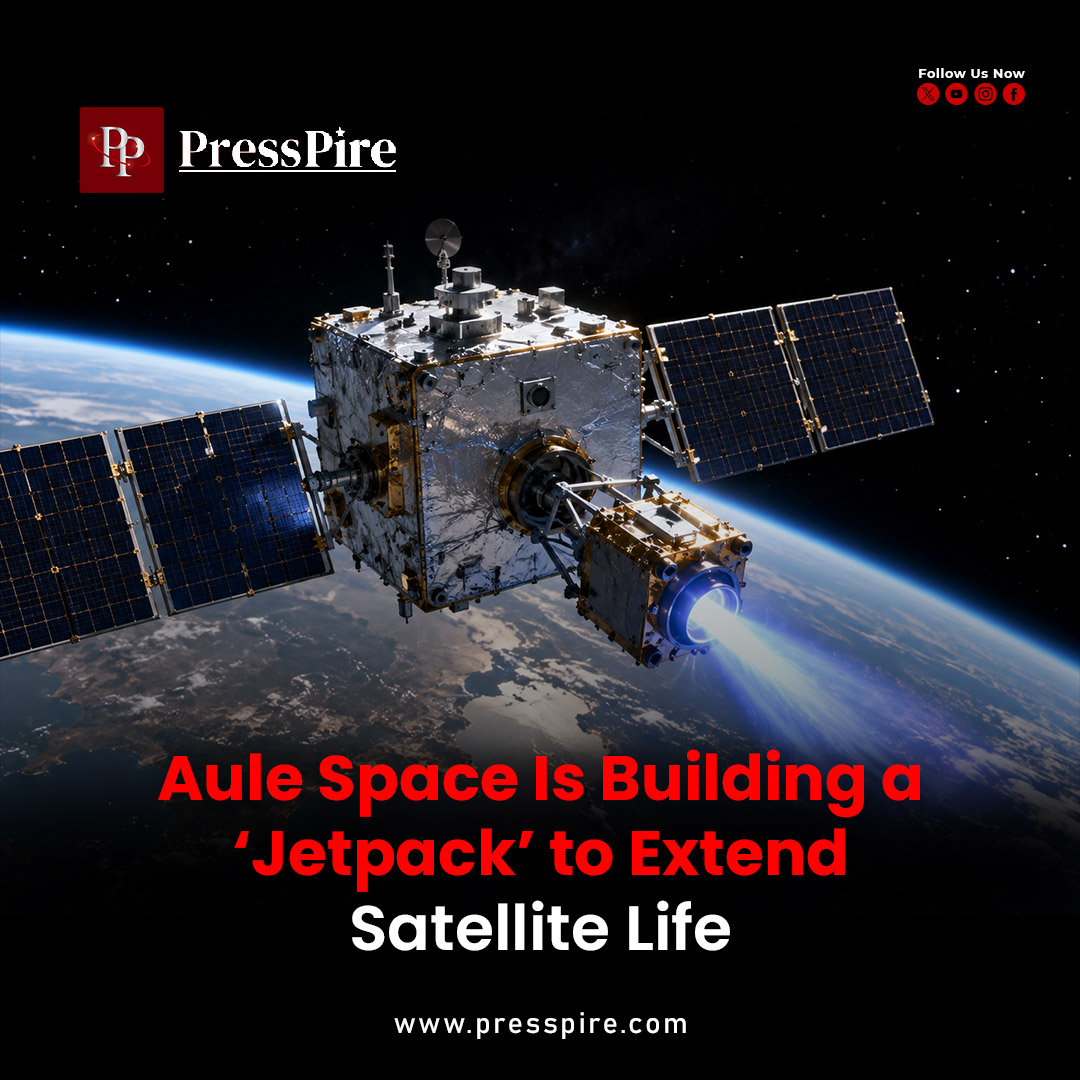
Aule Space Is Building a ‘Jetpack’ to Extend Satellite Life
Aule Space is building autonomous satellite jetpacks to extend satellite life, reduce space debris and transform India’s in-orbit servicing industry. Aule Space is developing autonomous satellite “jetpacks” that can dock with existing geostationary satellites and extend their operational life by up to six years. The Bengaluru-based deep-tech startup raised $2 million in pre-seed funding led by pi Ventures to advance its docking technology and demonstration satellites.
Aule Space Satellite Life Extension Begins With a Simple Idea
Satellites are among the most valuable machines humanity has ever placed in space, yet many of them eventually face a surprisingly ordinary problem: they run out of fuel. Their electronics, sensors, communication systems and other critical components may still be functioning, but without enough propulsion fuel, a satellite can no longer maintain its required position. This is the problem Bengaluru-based deep-tech startup Aule Space wants to solve with an unusual idea a robotic “jetpack” that can travel to an existing satellite, dock with it and provide additional propulsion.
Founded in 2024, Aule Space is developing autonomous spacecraft capable of rendezvous, proximity operations and docking, commonly known as RPOD. Instead of treating satellites as disposable assets, the company is working toward a model where valuable spacecraft can be serviced, inspected and potentially retired safely in orbit. Its immediate focus is satellite life extension, particularly for high-value geostationary communication satellites. Aule says its jetpack could extend the operational life of a compatible satellite by up to six years, creating a second lease of life for spacecraft that might otherwise be abandoned.
Why Satellites Become Useless Before They Really Die
The central challenge behind satellite life extension is not necessarily that a satellite stops functioning. In geostationary orbit, communication satellites must continuously make small orbital corrections to remain positioned over a particular region of Earth. These corrections consume fuel over time. Once the fuel becomes insufficient, the satellite may no longer be able to perform its primary mission even when much of its hardware remains operational. Aule Space estimates that more than $100 billion worth of commercial communication satellite assets in geostationary orbit could eventually stop generating revenue because of fuel depletion.
That creates an expensive cycle. Operators may need to launch replacement satellites, wait for them to reach their operational positions and transfer services before retiring the older spacecraft. Launches, manufacturing and orbital deployment can involve enormous costs. Satellite servicing introduces a different possibility: rather than replacing a functioning asset simply because its propulsion capability is reaching its limit, a smaller servicing spacecraft could take over part of the job. For Aule Space, this is where satellite life extension becomes both an engineering challenge and a commercial opportunity.
Aule Space Jetpack Technology Could Change Satellite Servicing
The phrase “jetpack” makes the technology sound almost futuristic, but the underlying business proposition is straightforward. Aule Space is developing an autonomous spacecraft that can approach an existing satellite, physically attach itself and use its own propulsion system to help maintain the host satellite’s orbit. The servicing spacecraft essentially becomes an additional propulsion system for the customer’s satellite, without requiring the customer to launch a completely new spacecraft.
The company’s approach is particularly interesting because it is designed around satellite-agnostic docking. Many older satellites were never designed to receive visiting spacecraft. They do not necessarily have dedicated servicing ports, handles or interfaces that make docking easy. Aule is therefore developing technology for what the industry calls non-cooperative docking, where the servicing vehicle must safely identify, approach and attach to a satellite that was not originally built for servicing. This capability could make satellite servicing useful for an existing generation of spacecraft rather than only future satellites designed with maintenance in mind.
How Aule Space Plans to Dock With Existing Satellites
Getting close to another spacecraft in orbit is only the beginning. The most difficult part is making the approach safely and accurately enough to establish a physical connection without damaging either vehicle. Aule Space is developing AI-driven Guidance, Navigation and Control systems to support this process. Its RPOD technology is designed to allow the servicing spacecraft to rendezvous with a target, operate in close proximity and eventually dock with it.
The company is also developing a docking mechanism intended to work across different satellite designs. According to reporting on the company’s technology, Aule plans to use existing features of compatible geostationary satellites rather than requiring extensive modifications or fuel-transfer infrastructure. This could make the service more practical for operators with legacy spacecraft already in orbit. The technology is still being developed and must be demonstrated in space before its commercial potential can be fully established, making its planned demonstration missions an important milestone for the startup.
Aule Space and the Rise of In-Orbit Servicing
Aule Space is entering a global industry that is moving from the idea of “launch and replace” toward a more service-oriented space economy. In-orbit servicing can include several activities, from extending satellite life and inspecting spacecraft to moving or removing objects that have become orbital debris. The underlying concept is similar to infrastructure maintenance on Earth: if an asset is expensive and difficult to replace, servicing it can create significant economic value.
For Aule, satellite life extension is the starting point because geostationary communication satellites represent high-value assets with established commercial functions. Once the company proves its rendezvous and docking capabilities, the same technological foundation could potentially support other missions. Aule has identified satellite inspection, space-domain awareness and active debris removal among the broader applications for its autonomous spacecraft. This gives the startup a potential pathway from one specific service into a wider orbital infrastructure business.
The $2 Million Funding Behind Aule Space
Aule Space’s ambition received an important boost in January 2026 when the company raised $2 million in pre-seed funding led by pi Ventures. The round also included angel investors such as Eash Sundaram, a former board member of Intelsat and founder of Utpata Ventures, and Arvind Lakshmikumar, chief executive of defence technology company Tonbo Imaging. Aule Space has also been part of the Entrepreneurs First accelerator and is backed by the Transpose Platform.
The capital is intended to support practical engineering rather than simply expand the company’s footprint. Aule plans to grow its engineering team, establish ground infrastructure for docking tests and advance its first demonstration satellites. The company has said these demonstration spacecraft are planned for launch in 2027, with the objective of validating RPOD capabilities in orbit. For a technology where millimetre-level precision and autonomous decision-making can determine mission success, proving the system outside a laboratory will be a defining moment.
Aule Space Founders Bring Deep Space-Tech Experience
Behind Aule Space is a founding team that combines experience across satellite engineering, autonomous systems and machine learning. The company was founded by Jay Panchal, Nithyaa Giri and Hrishit Tambi. Panchal previously worked as an early engineer at Pixxel, while Giri was a founding engineer at Trify EV. Tambi has worked alongside scientists from the European Space Agency through LibreCube.
That combination matters because orbital servicing is not a single-discipline problem. The company must bring together spacecraft engineering, propulsion, computer vision, navigation, robotics, artificial intelligence and mission operations. It must also make the economics work. A servicing spacecraft has to be significantly cheaper and more efficient than simply replacing the customer’s satellite, otherwise the business case for extending satellite life becomes difficult. Aule has positioned its Indian engineering base and supply chain as potential advantages in controlling development and operating costs.
Satellite Life Extension Could Reduce Space Debris
The economic argument for satellite servicing is only one side of the story. Orbital sustainability is becoming increasingly important as more satellites are launched and the number of objects in space continues to grow. When satellites reach the end of their useful lives, operators must manage them carefully to prevent them from becoming hazards for other spacecraft. Extending the productive life of existing assets can potentially reduce the need for premature replacement launches, while servicing technologies could eventually help remove or reposition objects that pose risks.
Aule Space sees this sustainability challenge as part of a larger transformation in how humanity uses orbit. Its technology is not limited to keeping satellites operational. The company also identifies active debris removal and satellite inspection as future applications. If autonomous spacecraft can reliably approach and interact with objects that were not designed for servicing, they could become an important part of the infrastructure needed for a more sustainable space environment.
Aule Space Targets a Growing Commercial Opportunity
The commercial opportunity for Aule Space extends beyond simply selling additional years of satellite operation. A successful satellite life-extension service could allow operators to postpone replacement missions, preserve revenue-generating spacecraft and gain greater flexibility in managing their orbital fleets. For satellite operators, that flexibility could become increasingly valuable as launch schedules, manufacturing timelines and orbital congestion become more complex.
Aule’s broader ambition is therefore significant. The company describes its long-term vision as building a robotic workforce for the in-space economy. Its autonomous spacecraft could eventually undertake multiple types of missions rather than performing only one specialized service. The first commercial proof point, however, remains docking and life extension. The ability to safely interact with a functioning satellite in orbit will determine whether Aule can move from an ambitious deep-tech concept toward a repeatable commercial service.
What Aule Space Could Mean for India’s Space Economy
India’s private space sector has entered a new phase, with startups increasingly moving beyond satellite manufacturing and launch-related technologies into more specialized areas of the space economy. Aule Space represents one of the more technically demanding opportunities: developing autonomous spacecraft that can physically interact with other satellites after launch. Its progress demonstrates how Indian startups are beginning to address infrastructure problems that have traditionally been dominated by large international aerospace companies.
The company has also received support through India’s growing commercial space ecosystem, including an IN-SPACe grant, while exploring potential government and defence applications. Its technology could eventually contribute to space-domain awareness and inspection missions in addition to commercial satellite servicing. That combination of commercial and strategic applications could make orbital robotics an important part of India’s emerging space-tech capabilities.
The Road Ahead for Aule Space Satellite Life Extension
Aule Space is still at an early stage, and the hardest test is ahead. Autonomous docking with a legacy satellite in orbit is fundamentally different from demonstrating software or hardware on the ground. The company will need to prove navigation accuracy, docking reliability, propulsion performance and mission safety under real orbital conditions. Its planned demonstration satellites will therefore be more than a technology showcase; they will be a critical test of whether its satellite life-extension vision can become commercially viable.
Yet the idea behind Aule Space is compelling because it challenges a long-standing assumption in the space industry: that satellites must eventually be replaced when their fuel runs low. By building a “jetpack” that can meet an ageing spacecraft in orbit and give it additional propulsion, the Bengaluru startup is attempting to turn satellites from disposable machines into serviceable infrastructure. If that vision succeeds, Aule Space could help shape a future in which spacecraft are not simply launched, used and abandoned, but maintained, upgraded and reused as part of a more sustainable in-space economy.
For more insights navigate: PressPire | Stories That Shape the Future
Read previous article here: https://presspire.com/yulu/
Follow PressPire on Facebook | Instagram | LinkedIn | YouTube
PressPire | Stories That Shape the Future