
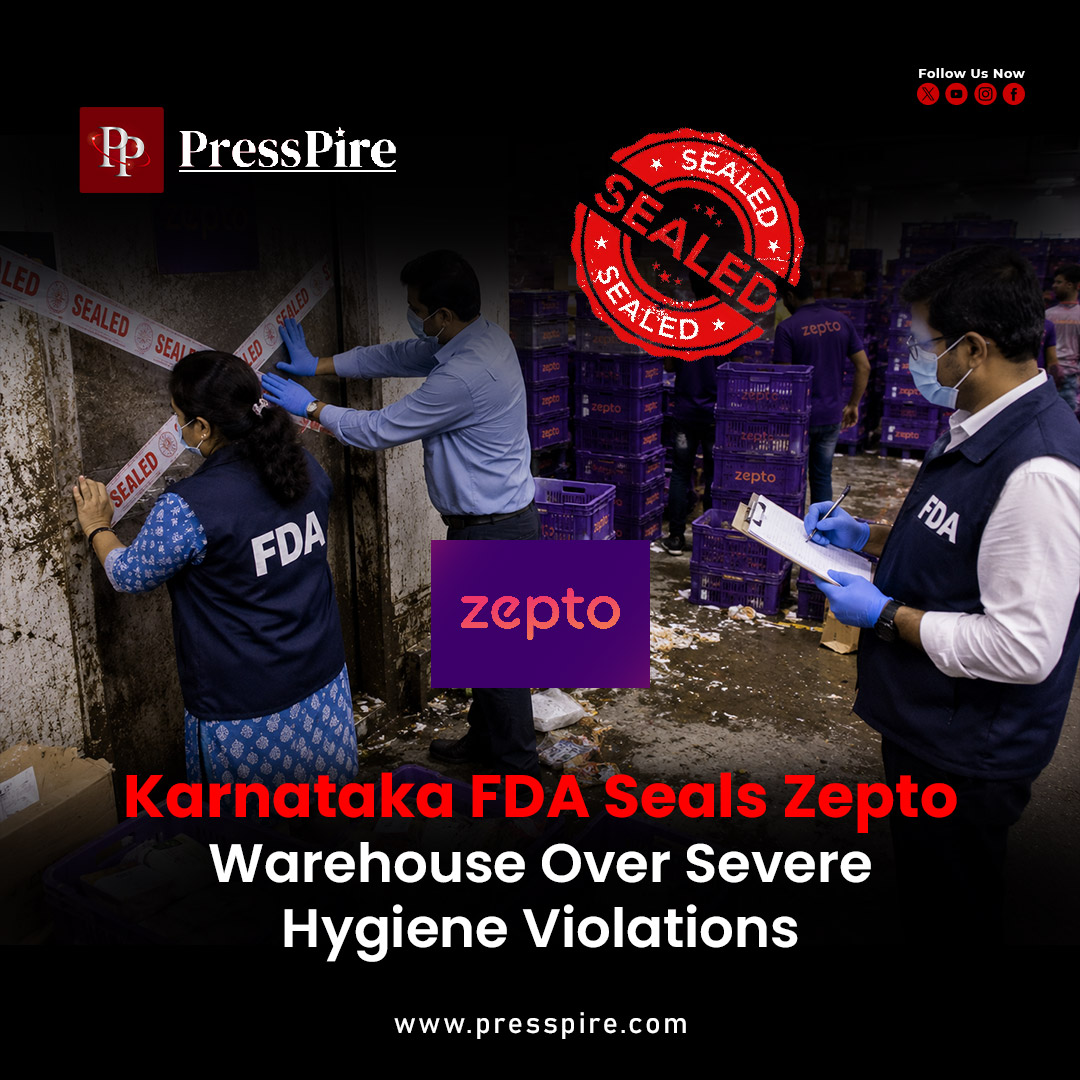
Karnataka FDA Seals Zepto Warehouse Over Severe Hygiene Violations
Karnataka FDA seals a Zepto warehouse in Hoskote after finding unhygienic food handling, storage, labelling and misbranding violations.
Karnataka FDA Seals Zepto Warehouse in Bengaluru
The Zepto warehouse in Hoskote taluk of Bengaluru Rural district has been sealed by the Karnataka Food Safety and Drug Administration (FDA) following an inspection that identified multiple food safety violations. The action was taken on August 11, 2026, during a special inspection drive focused on the quality, storage, labelling and handling of food products. According to reports, the facility, operated by logistics company Nippon Express for Zepto, was found to have unhygienic conditions associated with food handling and storage. Officials also identified issues involving non-compliant labelling and misbranding. The warehouse was subsequently sealed, while authorities issued a notice and recommended further legal proceedings before the concerned adjudicating authority.
For consumers, the development is significant because quick commerce has become an everyday part of urban shopping. Customers increasingly depend on platforms such as Zepto for groceries, packaged foods, beverages and household essentials, often expecting delivery within minutes. Yet the convenience visible on a smartphone depends on a much larger logistics network operating behind the scenes. A warehouse is one of the most important links in that network, making hygiene, storage and regulatory compliance essential to maintaining consumer confidence.
Zepto Warehouse Faces Serious Hygiene Violations
The Zepto warehouse action highlights a part of quick-commerce operations that consumers rarely see. While the customer experiences a fast and seamless delivery, products must first pass through storage, inventory management, picking, packing and dispatch processes. Food safety standards apply throughout these stages, particularly where food products are stored and handled before reaching consumers. The Karnataka FDA inspection reportedly found unacceptable hygiene conditions at the Hoskote facility, prompting regulators to take immediate enforcement action.
The issue becomes more important when the scale of modern quick-commerce operations is considered. A large fulfilment facility can handle substantial volumes of products every day, meaning any weakness in sanitation or storage controls can potentially affect many customer orders. Clean premises, appropriate storage conditions, proper product segregation and disciplined handling practices are therefore not simply operational preferences. They are critical safeguards. The sealing of the Zepto warehouse demonstrates that regulators are prepared to intervene when these basic expectations are not met, regardless of how quickly a business delivers products to customers.
Karnataka FDA Finds Labelling and Misbranding Issues
The Karnataka FDA inspection did not focus only on physical hygiene. Officials also identified concerns involving non-compliant labelling and misbranding at the Zepto warehouse. These findings are particularly important because product labels provide consumers with information that helps them make informed purchasing decisions. Food packaging can communicate essential details about the product, including its identity, contents, quantity and other mandatory declarations required under applicable regulations. When such information is incomplete, inaccurate or improperly presented, consumer trust can be undermined.
For a quick-commerce company, labelling compliance can become more complex because inventories move rapidly across multiple locations and product categories. Warehouse teams must ensure that products entering the fulfilment system meet regulatory requirements and that non-compliant stock is not distributed. Misbranding concerns also show why compliance cannot be separated from inventory management. The Karnataka FDA action sends a broader message to food businesses: speed, technology and convenience do not reduce the responsibility to meet food safety and product information standards. Every product delivered through a digital platform still has to comply with the rules governing food sold to consumers.
Zepto Warehouse Action Raises Food Safety Concerns
The Zepto warehouse sealing has renewed attention on the food safety responsibilities of quick-commerce companies and their logistics partners. The facility was operated by Nippon Express, which had established a major Hoskote warehouse to support the storage and distribution of groceries, FMCG products and household goods. Nippon Express had described the facility as an important logistics location supporting Zepto’s operations in the Bengaluru region.
The involvement of a logistics partner also raises an important question about accountability. Customers generally see one brand when they place an order, even though the actual fulfilment journey can involve several businesses. From warehousing and inventory handling to technology and last-mile delivery, the customer ultimately expects the platform to provide products safely and responsibly. That makes strong partner oversight crucial. Quick-commerce companies need robust audit mechanisms to ensure that third-party warehouses follow hygiene protocols, maintain compliant storage conditions and immediately isolate products that fail regulatory requirements. The Bengaluru case illustrates how weaknesses in one part of the chain can quickly become a broader reputational issue for the platform associated with the order.
Why Zepto Warehouse Hygiene Matters to Consumers
The condition of a Zepto warehouse matters because food safety begins long before a delivery reaches the consumer’s doorstep. A customer ordering groceries through an app usually cannot see where those products were stored, how they were handled or what checks were conducted before dispatch. Trust therefore depends heavily on the company maintaining effective internal controls and ensuring that its warehouses meet regulatory standards. When a government inspection identifies hygiene problems, it exposes a gap between the convenience promised to consumers and the operational discipline required to deliver that convenience safely.
For consumers, warehouse hygiene is connected to confidence in the entire shopping experience. Proper storage helps protect products from contamination and deterioration, while accurate labelling ensures that customers receive reliable product information. The Karnataka FDA’s action reinforces the idea that food safety is not merely a matter for restaurants, factories or traditional supermarkets. It is equally relevant to digital retailers that store and distribute food through modern fulfilment networks. As quick commerce becomes more deeply integrated into daily life, consumers are likely to expect stronger transparency and higher standards from the companies handling their groceries.
Quick Commerce Faces Growing Food Safety Scrutiny
The Zepto food safety issue in Bengaluru comes at a time when quick-commerce businesses across India are receiving greater regulatory attention. The sector has expanded rapidly, with companies competing on delivery times and convenience while operating extensive networks of warehouses, dark stores and fulfilment centres. Regulators are increasingly looking at these facilities as an important part of the food supply chain rather than treating them simply as retail back-end operations.
The growing scrutiny is not limited to Karnataka. Recent enforcement actions in Maharashtra have also targeted facilities associated with major quick-commerce platforms, with authorities reporting hygiene issues serious enough to trigger licence suspensions. Reuters reported that Maharashtra’s food safety authorities inspected dozens of establishments and took action against facilities linked to companies including Blinkit, Zepto and Swiggy Instamart. This broader regulatory environment indicates that food safety standards are becoming an increasingly important factor in the next phase of India’s quick-commerce growth. The industry’s future will depend not only on faster deliveries and larger networks but also on stronger compliance systems.
What the Zepto Warehouse Action Means for the Industry
The Zepto warehouse case could serve as an important warning for the wider quick-commerce industry. As fulfilment networks expand, companies will need to invest in more systematic hygiene audits, staff training, stock inspections, documentation and regulatory compliance. Third-party logistics partnerships may offer efficiency and scale, but they also require clearly defined accountability and continuous monitoring. A warehouse cannot be treated as merely a space to store inventory; it is part of the customer-facing quality system of the company whose products move through it.
The case also highlights the changing expectations around quick commerce in India. In its early growth phase, the sector attracted consumers largely through speed and convenience. Today, those advantages increasingly come with expectations of quality, authenticity, safety and reliability. Regulatory intervention can accelerate that shift by making companies demonstrate that their operational foundations are as strong as their technology platforms. The challenge for quick-commerce businesses is therefore clear: they must build systems in which speed and food safety work together rather than treating compliance as an obstacle to rapid delivery.
Zepto Food Safety Must Keep Pace With Growth
The Zepto warehouse sealing in Hoskote is more than an isolated regulatory action. It reflects the growing importance of food safety in a retail model that has changed how millions of consumers purchase everyday products. When grocery delivery happens in minutes, customers naturally focus on convenience. Regulators, however, are required to look deeper into the systems that make those deliveries possible. The Karnataka FDA inspection shows why warehouses, logistics providers and digital commerce companies must maintain high standards throughout the supply chain.
For Zepto and the wider quick-commerce sector, the road ahead will require greater operational discipline. Hygiene controls, compliant labelling, responsible storage and regular inspections must become integral to warehouse management. The strongest quick-commerce companies will ultimately be those that understand that customer trust cannot be delivered in ten minutes unless safety has been protected throughout the journey. The Zepto warehouse case has once again placed that principle at the centre of India’s rapidly evolving digital retail industry.
For more insights navigate: PressPire | Stories That Shape the Future
Read previous article here: https://presspire.com/indian-navy/
Follow PressPire on Facebook | Instagram | LinkedIn | YouTube
PressPire | Stories That Shape the Future