
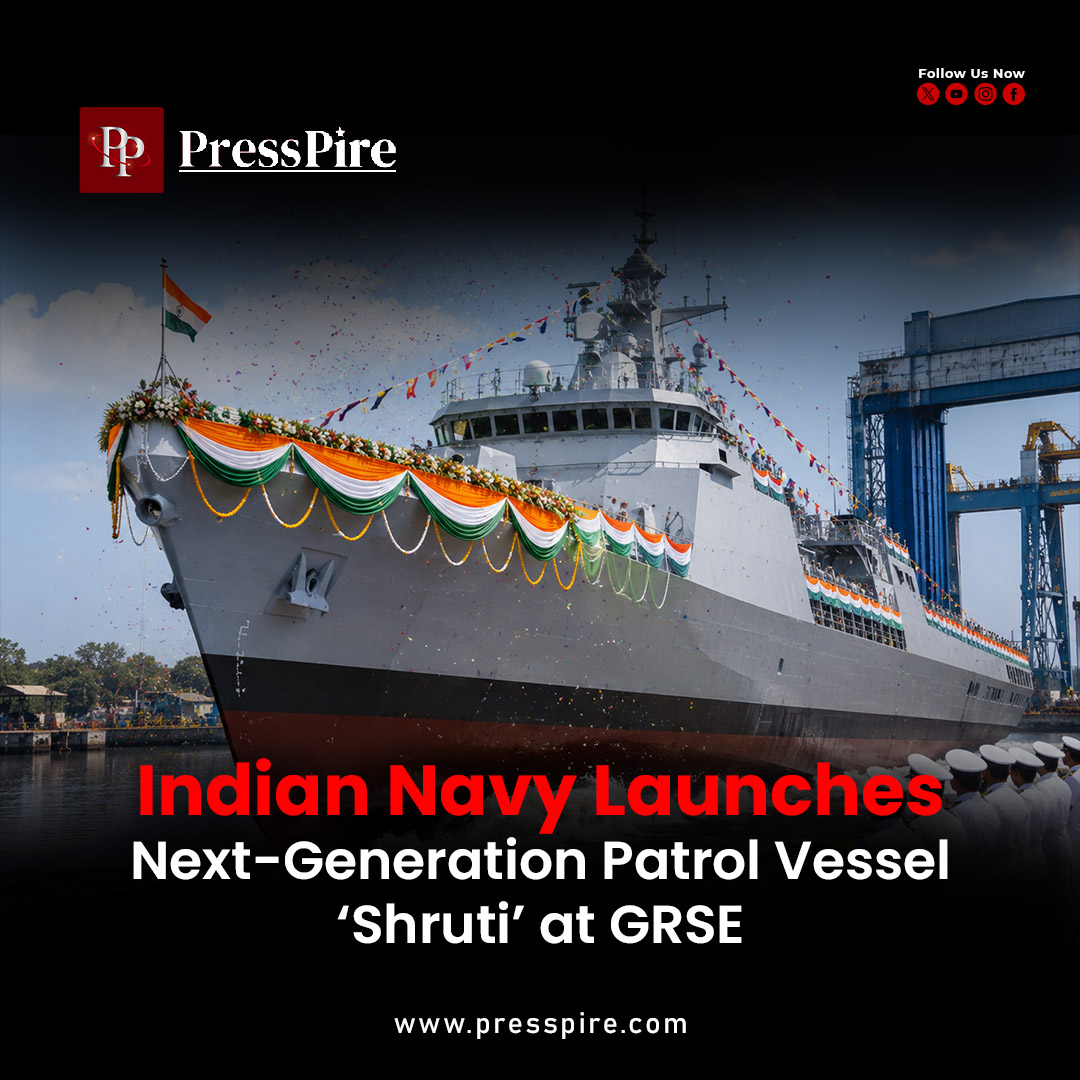
Indian Navy Launches Next-Generation Patrol Vessel ‘Shruti’ at GRSE
The Indian Navy’s next-generation patrol vessel Shruti is a modern offshore patrol vessel launched at GRSE in Kolkata. It is designed to strengthen maritime surveillance, coastal defence, offshore asset protection, search and rescue, humanitarian assistance and anti-piracy operations.
Indian Navy Next-Generation Patrol Vessel Shruti
The Indian Navy next-generation patrol vessel Shruti has been launched at Garden Reach Shipbuilders & Engineers (GRSE) in Kolkata, marking another important milestone in India’s growing maritime defence capabilities. The launch reflects the Navy’s continuing effort to strengthen its fleet with modern, versatile and indigenously built platforms capable of performing a wide range of missions at sea. The vessel is part of India’s larger Next Generation Offshore Patrol Vessel (NGOPV) programme, designed to strengthen surveillance, coastal defence, search and rescue and maritime security.
The arrival of Shruti comes at a time when maritime security has become increasingly important for India. The Indian Ocean is central to global trade, energy movement and regional connectivity, making continuous monitoring of surrounding waters strategically important. For the Indian Navy, modern patrol vessels can provide a persistent presence across areas of interest without requiring larger frontline warships for every surveillance or security task.
The launch therefore represents more than the addition of another vessel. It is part of a broader transformation in how India is building and deploying naval capabilities.
Indian Navy Next-Generation Patrol Vessel Strengthens Security
The Indian Navy next-generation patrol vessel has been conceived as a multi-purpose maritime security platform. Unlike specialised combat ships designed primarily for high-intensity warfare, offshore patrol vessels are expected to handle a broad range of missions that occur during routine maritime operations as well as periods of heightened tension. The NGOPVs being built for the Navy are intended for coastal defence and surveillance, search and rescue, protection of offshore assets, humanitarian assistance and disaster relief (HADR), and anti-piracy missions.
This versatility gives Shruti strategic value. Maritime threats do not always arrive in the form of conventional military attacks. Piracy, illegal activity at sea, maritime infiltration, threats to offshore installations and emergencies involving commercial vessels can require an immediate naval response.
A patrol vessel that can remain deployed for extended periods gives the Navy another layer of operational reach. It can monitor maritime activity, respond to incidents and support larger naval formations when required, helping India maintain greater awareness across its maritime areas of interest.
Indian Navy Next-Generation Patrol Vessel and GRSE
The Indian Navy next-generation patrol vessel programme also highlights the growing capabilities of India’s domestic shipbuilding industry. GRSE, one of India’s leading defence shipyards, is building four of the 11 NGOPVs ordered for the Indian Navy. The remaining seven vessels are being constructed by Goa Shipyard Limited (GSL), with the programme being executed concurrently at the two shipyards.
GRSE has extensive experience in building warships and patrol vessels for Indian and international customers. Its portfolio includes frigates, corvettes, fleet tankers, landing ships, survey vessels, offshore patrol vessels and fast attack craft. The shipyard has also developed in-house design and engineering capabilities, strengthening its position in India’s indigenous naval manufacturing ecosystem.
For India, this domestic capacity is strategically important. Building sophisticated naval vessels within the country creates a stronger industrial base, develops specialised engineering skills and reduces dependence on foreign shipyards for critical maritime platforms.
Indian Navy Next-Generation Patrol Vessel Missions
The Indian Navy next-generation patrol vessel is designed around flexibility. Official information on the NGOPV programme identifies coastal defence and surveillance, search and rescue, protection of offshore assets, HADR and anti-piracy as key operational roles. The vessels are expected to augment India’s existing Offshore Patrol Vessel and Next Generation Offshore Patrol Vessel fleet, giving the Navy greater capacity for sustained maritime operations.
For ordinary citizens, these missions may sound distant, but they have a direct connection with everyday economic security. India depends heavily on maritime routes for international trade, while offshore infrastructure plays an important role in the country’s energy and economic networks.
A modern patrol vessel can help safeguard these interests by providing a visible and responsive naval presence. It can also contribute to search and rescue operations when ships or individuals face emergencies at sea, demonstrating how naval platforms can serve both security and humanitarian purposes.
Indian Navy Next-Generation Patrol Vessel and Anti-Piracy
The Indian Navy next-generation patrol vessel will also strengthen India’s ability to respond to piracy and other maritime security threats. Anti-piracy operations require ships that can patrol large areas, respond quickly to suspicious activity and coordinate with other naval and maritime agencies.
India has significant interests in maintaining secure sea lanes across the Indian Ocean and beyond. Commercial ships carrying energy supplies, raw materials and manufactured goods depend on safe maritime routes. Disruption caused by piracy or other hostile activity can have consequences that extend far beyond the immediate incident.
Shruti and other NGOPVs can therefore contribute to a layered maritime security system. Their role is not necessarily to replace larger warships, but to complement them by handling persistent surveillance, patrol and response missions. This allows the Navy to deploy its fleet according to the nature and intensity of the situation.
Indian Navy Next-Generation Patrol Vessel Supports HADR
Another important role of the Indian Navy next-generation patrol vessel is humanitarian assistance and disaster relief. India’s maritime geography places it in a region where cyclones, floods, earthquakes and other natural disasters can affect coastal communities and neighbouring countries.
Naval vessels can become critical assets during such emergencies because they can transport personnel and essential supplies, support evacuation efforts, assist affected communities and operate when normal infrastructure has been damaged. The official NGOPV programme specifically includes HADR and search and rescue among the missions for which these vessels are being developed.
This makes the role of Shruti broader than traditional defence. A modern naval vessel can represent security during a crisis, but it can also represent assistance. In the Indian Ocean Region, where regional cooperation and disaster response are increasingly important, such capabilities can strengthen India’s position as a dependable maritime partner.
Indian Navy Next-Generation Patrol Vessel Boosts Self-Reliance
The Indian Navy next-generation patrol vessel programme is closely linked to India’s drive towards self-reliance in defence manufacturing. The contracts for the indigenous design and construction of 11 NGOPVs were concluded in March 2023, with seven vessels assigned to GSL and four to GRSE.
The programme is aligned with the government’s Aatmanirbhar Bharat and Make in India objectives. More importantly, indigenous shipbuilding creates a chain of economic activity involving designers, engineers, manufacturers, technology providers and skilled workers.
Every modern warship built in an Indian yard represents accumulated industrial knowledge. As shipyards undertake increasingly complex projects, they develop capabilities that can support future generations of naval platforms. The result is not simply a larger fleet, but a deeper domestic defence ecosystem.
Indian Navy Next-Generation Patrol Vessel and Maritime Power
The launch of the Indian Navy next-generation patrol vessel Shruti also needs to be viewed within the wider expansion of India’s maritime capabilities. The 11-ship NGOPV programme is intended to augment the Navy’s existing OPV and NOPV fleet and provide additional platforms for multi-domain maritime operations.
The Indian Ocean remains central to India’s strategic environment. Major shipping routes pass close to the country, while the region connects India with important economic and strategic partners. Maintaining maritime awareness is therefore not simply a military requirement; it is closely linked to economic stability and national security.
Patrol vessels can play a particularly useful role in this environment because they are designed for sustained operations and multiple missions. Their presence can strengthen surveillance while freeing larger and more heavily armed warships for missions requiring higher combat capabilities.
Indian Navy Next-Generation Patrol Vessel: The Road Ahead
The launch of the Indian Navy next-generation patrol vessel Shruti is another visible sign of India’s changing approach to maritime defence. The country is not merely seeking more ships; it is developing platforms designed for flexibility, endurance, surveillance, security and humanitarian response.
The wider NGOPV programme will add 11 indigenously designed and built vessels to the Navy’s capabilities. With construction taking place at both GRSE and GSL, the programme also demonstrates the importance of collaboration between Indian shipyards in expanding domestic production capacity.
For GRSE, Shruti represents another milestone in a long shipbuilding journey. For the Indian Navy, it adds another operational tool. For India’s defence industry, it reinforces the message that sophisticated naval platforms can increasingly be designed and built within the country.
The significance of the Indian Navy next-generation patrol vessel ultimately extends beyond the ship itself. At sea, presence can prevent threats, speed can save lives and surveillance can protect economic interests before problems escalate. As India strengthens its maritime capabilities, vessels such as Shruti will increasingly form an important part of that wider security architecture.
For more insights navigate: PressPire | Stories That Shape the Future
Read previous article here: https://presspire.com/supreme-court-cancer/
Follow PressPire on Facebook | Instagram | LinkedIn | YouTube
PressPire | Stories That Shape the Future