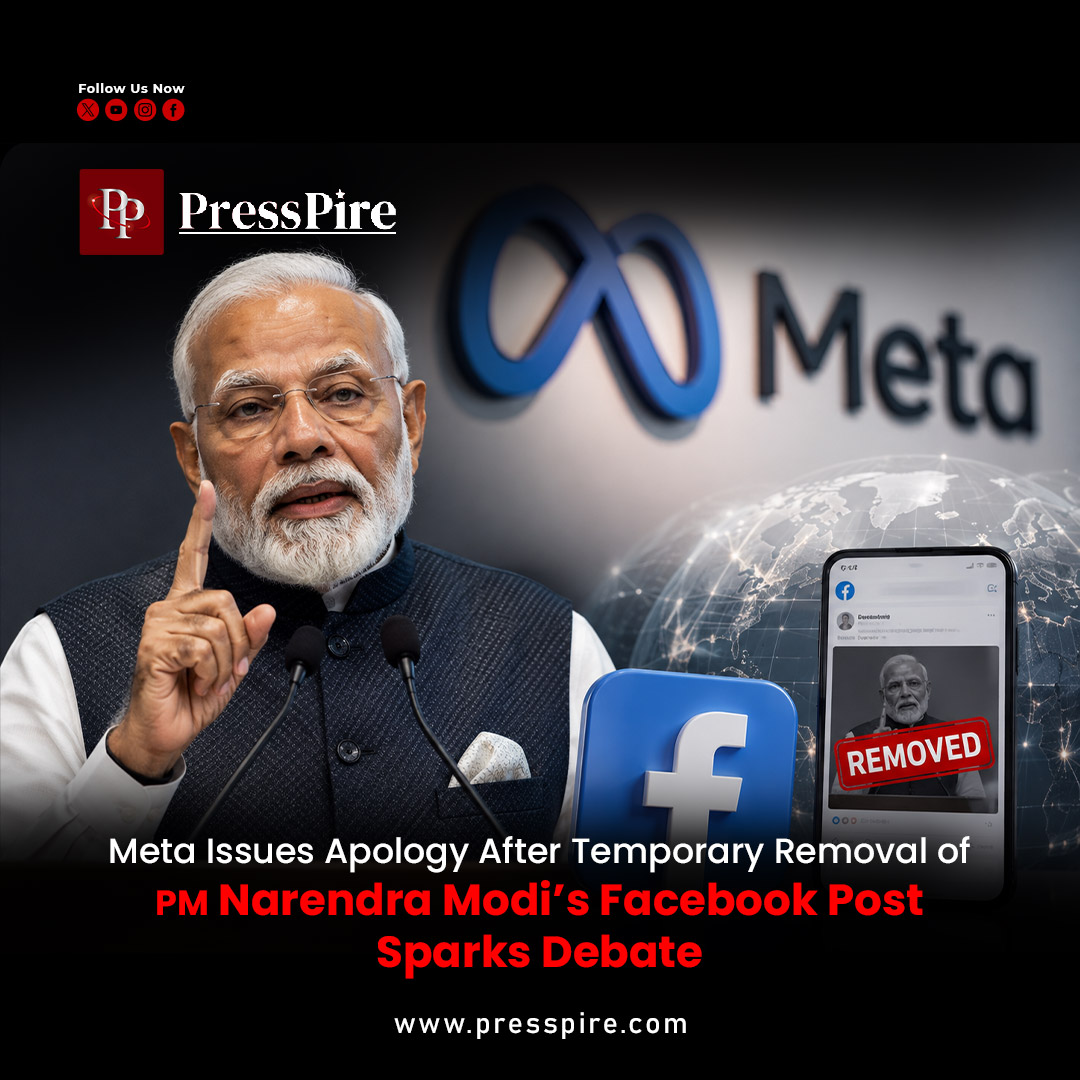
Meta Issues Apology After Temporary Removal of PM Narendra Modi’s Facebook Post Sparks Debate
Meta apologised after briefly restricting PM Narendra Modi’s Facebook post, raising fresh questions about content moderation, platform accountability and free speech.
Meta Apology for PM Modi Facebook Post
The Meta apology for PM Modi Facebook post has brought renewed attention to the growing debate over social media moderation, platform accountability and the power technology companies exercise over public communication. A video posted by Prime Minister Narendra Modi was briefly removed from Facebook before being restored, with Meta later stating that the content had been removed in error. The incident quickly attracted attention because the video was not an ordinary social media post. It featured the Prime Minister addressing young Indians during a period of heightened public discussion around examination paper leaks and student concerns. Meta’s explanation was that the removal resulted from an operational or technical error, but the episode raised a larger question: how should global technology platforms handle content posted by political leaders, particularly when automated systems are involved?
Why PM Modi’s Facebook Post Was Removed
The controversy began after PM Narendra Modi shared a video addressing India’s youth and speaking about measures to tackle paper leaks. The video was reportedly uploaded on July 23 and was subsequently unavailable for a brief period on Facebook. Reports indicated that the removal was connected to Meta’s automated content moderation systems rather than a deliberate decision to silence the Prime Minister. The timing nevertheless made the incident politically sensitive. Social media platforms have increasingly become important channels through which governments, political leaders and citizens communicate directly with one another. When a high-profile post disappears, even temporarily, questions naturally arise about who made the decision, what triggered the moderation system and whether human oversight was involved. In this case, Meta eventually restored the video and acknowledged that it had been removed erroneously.
PM Modi’s removed Facebook Post: Meta Calls it an Error
Meta’s immediate response was that the content had been removed in error and had since been restored. Sources also described the incident as a technical or operational glitch involving automated content filters. While such systems are designed to identify harmful, illegal or policy-violating material at enormous scale, they can sometimes produce incorrect outcomes. The difficulty becomes much greater when the content involves a public figure or a politically significant event. Meta’s explanation did not end the controversy. The Indian government sought further clarification and reportedly did not consider the initial explanation sufficient. This response underlines the growing expectation that technology platforms should not simply correct mistakes but also explain how those mistakes occur. For users, transparency is increasingly becoming as important as the removal or restoration itself.
PM Modi Government Seeks Answers From Meta Facebook removal post
The Indian government took the incident seriously and sought explanations from senior Meta officials. The Ministry of Electronics and Information Technology summoned Meta’s global affairs president Joel Kaplan and Instagram chief Adam Mosseri after the restriction of Modi’s content. The move reflected the larger importance India places on the functioning of major digital platforms within the country. India is one of Meta’s largest markets, and Facebook, Instagram and WhatsApp play a significant role in communication, business, news distribution and public engagement. The government’s intervention also showed that content moderation is no longer viewed simply as an internal matter for technology companies. When moderation decisions affect political communication or potentially violate regulatory expectations, governments increasingly want platforms to demonstrate accountability and explain their processes.
Meta apology for PM Modi Facebook post highlights one of the most difficult problems
The Meta apology for PM Modi Facebook post highlights one of the most difficult problems facing social media companies: moderation at scale. Platforms process millions of posts, images and videos every day, making automated systems essential for identifying harmful material. Yet automation is not perfect. Algorithms may misunderstand context, interpret words incorrectly or flag legitimate content because it resembles material associated with violations. Political communication presents an additional challenge because a single decision can quickly become a national controversy. A platform must therefore balance several competing responsibilities preventing harmful content, following its policies, respecting lawful speech and avoiding unnecessary restrictions. The Modi video incident demonstrates why transparency, human review and effective appeals systems are becoming increasingly important in digital governance.
Meta Faces Wider Accountability Questions
The controversy surrounding the PM Modi Facebook post emerged alongside broader concerns about Meta’s operations in India. Reuters reported that Meta CEO Mark Zuckerberg separately apologised to Indian officials over issues including child sexual abuse material, deepfake content and other operational lapses on Facebook and Instagram. That apology should not be confused with the specific apology over the temporary restriction of Modi’s post, which Reuters attributed to Meta Chief Global Affairs Officer Joel Kaplan. Together, however, the developments have placed Meta under increased scrutiny in one of its most important markets. The questions now extend beyond a single technical error to the larger issue of whether global platforms have adequate systems to detect harmful content while preventing legitimate material from being wrongly restricted.
India’s Growing Digital Platform Push vide Meta and PM Modi’s Facebook post
India’s response reflects a broader transformation in the relationship between governments and technology companies. Social media platforms once operated largely as private digital spaces, but they have become central to elections, public policy discussions, business communication and political messaging. As their influence has expanded, so has regulatory scrutiny. India has increasingly demanded faster responses to unlawful and harmful content, while technology companies have been required to demonstrate greater compliance with local rules. The debate is not limited to Meta. Google, YouTube, X, Snapchat and other major platforms also face growing expectations around content governance. For India, the central challenge is finding a balance between protecting users and ensuring that digital regulation does not unnecessarily restrict legitimate expression.
What the Meta Apology Means
The Meta apology for PM Modi Facebook post is significant because it acknowledges that even sophisticated moderation systems can make consequential mistakes. An apology can resolve an immediate dispute, but it does not automatically answer every question surrounding the incident. Users and regulators want to understand what caused the error, how long the restriction lasted, how the system identified the content and what safeguards will prevent a similar incident. These questions matter because trust in social media platforms depends not only on what content they remove but also on whether their decisions appear consistent and explainable. If an ordinary user’s legitimate post is wrongly removed, the consequences may be limited to an individual account. When the same system affects the communication of a national leader, the implications can quickly become much wider.
The Bigger Debate in PM Modi Government Meta apology
At the heart of the controversy lies a much larger debate about who controls digital speech. Platforms such as Facebook have enormous influence over what billions of people can see, share and discuss. Their algorithms and moderation policies can shape the visibility of political messages, business campaigns and public conversations. That power brings responsibility. At the same time, governments must ensure that demands for accountability do not become a pathway to excessive control over online expression. The answer lies in clearer rules, transparent moderation standards, meaningful human review and strong mechanisms for correcting mistakes. The Modi Facebook incident therefore matters beyond one political figure. It raises questions about how digital platforms should operate when private technology systems intersect with public institutions and democratic communication.
The Road Ahead for Meta in India
For Meta, the immediate task is rebuilding confidence through greater transparency and stronger operational safeguards. The company has already restored the disputed content and acknowledged the error, but future incidents will be judged against how effectively Meta improves its systems. India, meanwhile, is likely to continue demanding greater accountability from technology companies operating within its digital ecosystem. The Meta apology for PM Modi Facebook post may eventually become a footnote in the wider history of social media regulation, but the questions it raised are unlikely to disappear. As artificial intelligence and automated moderation become more deeply integrated into online platforms, mistakes will remain possible. What will matter most is how quickly companies detect those mistakes, how openly they explain them and how effectively they prevent them from happening again.
A Lesson in Digital Accountability vide PM Modi Meta Facebook post removal
The temporary removal of PM Narendra Modi’s Facebook post may have resulted from an error rather than an intentional act, but the reaction demonstrates how sensitive digital communication has become. Meta’s apology acknowledged the mistake, while the government’s response showed that major platforms are expected to answer for the systems they operate. The episode also offers a wider lesson: technology may automate moderation, but accountability cannot be automated away. As billions of people increasingly depend on digital platforms for information and communication, companies such as Meta will have to build systems that are not only fast and intelligent but also transparent, fair and capable of correcting their own mistakes. In that sense, the Meta apology for PM Modi Facebook post is not merely about one removed video. It is about the future relationship between technology, government and public trust.
For more insights navigate: PressPire | Stories That Shape the Future
Read previous article here: https://presspire.com/homerun-funding/
Follow PressPire on Facebook | Instagram | LinkedIn | YouTube
PressPire | Stories That Shape the Future