
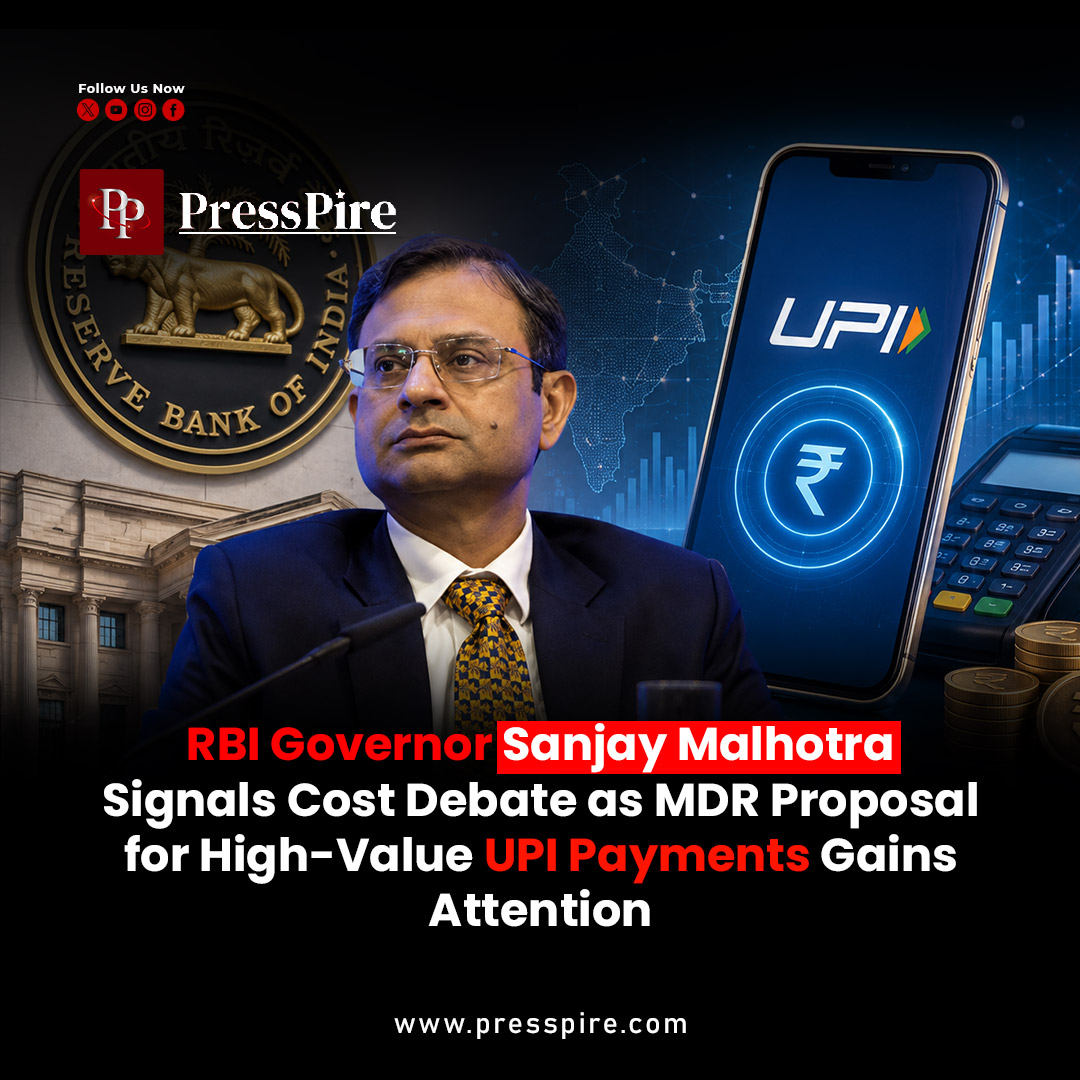
RBI Governor Sanjay Malhotra Signals Cost Debate as MDR Proposal for High-Value UPI Payments Gains Attention
RBI Governor Sanjay Malhotra says someone must bear the cost of UPI as the MDR proposal for high-value transactions sparks debate over India’s digital payments future. RBI Governor Sanjay Malhotra has reignited the debate over the future of India’s digital payments ecosystem by indicating that someone will eventually have to bear the operational costs of UPI. As discussions around introducing MDR on high-value UPI transactions gain momentum, policymakers, banks, merchants, and consumers are evaluating the long-term sustainability of India’s most successful digital payment platform.
RBI Governor Sanjay Malhotra remarked that operating the UPI ecosystem involves significant costs
India’s Unified Payments Interface (UPI) has transformed the country’s financial landscape in ways few technologies have achieved within such a short span. From roadside tea vendors and vegetable sellers to multinational retailers and e-commerce giants, digital payments have become an inseparable part of everyday commerce. The convenience of scanning a QR code instead of handling cash has made India one of the world’s leading digital payment economies. However, behind this remarkable success lies a growing concern over the sustainability of maintaining a payment infrastructure that currently offers free transactions to users and merchants alike.
The conversation took a fresh turn after RBI Governor Sanjay Malhotra remarked that operating the UPI ecosystem involves significant costs and that “someone has to bear the cost.” His statement has once again placed the spotlight on the long-discussed proposal of introducing Merchant Discount Rate (MDR) for high-value UPI transactions. While no formal policy has been announced, the Governor’s comments have revived an important national discussion on balancing innovation, affordability, and financial sustainability.
The debate extends beyond transaction fees. It raises broader questions about how India should finance one of its most successful digital public infrastructures while ensuring continued growth, financial inclusion, and innovation.
RBI Governor Sanjay Malhotra Revives MDR Debate
The renewed discussion surrounding RBI Governor Sanjay Malhotra comes at a time when UPI has reached unprecedented scale. India now processes billions of UPI transactions every month, making it one of the busiest real-time payment systems globally. Since January 2020, the government removed Merchant Discount Rate (MDR) on RuPay debit cards and UPI transactions to encourage digital adoption across the country. The move proved highly successful, accelerating digital payments even in rural regions and among small businesses. However, banks, payment service providers, fintech firms, and acquiring institutions have repeatedly highlighted that maintaining servers, cybersecurity frameworks, payment gateways, settlement systems, fraud detection mechanisms, and customer support requires continuous investment. While the government has periodically offered incentives to compensate stakeholders, industry experts argue that these reimbursements do not fully cover operational expenses. It is within this context that the Governor’s statement has gained significance. Rather than advocating an immediate fee on consumers, his remarks acknowledged the economic reality that every payment system carries infrastructure costs, prompting policymakers to reconsider whether a sustainable funding model should eventually replace the current subsidy-driven framework.
RBI Governor Sanjay Malhotra Explains UPI Costs
One of the key reasons RBI Governor Sanjay Malhotra highlighted the issue is the enormous infrastructure supporting every UPI payment. A transaction that takes only a few seconds involves authentication, routing, fraud monitoring, banking network communication, settlement processing, regulatory compliance, and cybersecurity protection. Every participating bank, fintech company, payment service provider, and technology partner incurs expenses to ensure these transactions remain reliable and secure. As transaction volumes continue to grow exponentially each year, so do infrastructure costs. Industry stakeholders have long maintained that while consumers enjoy free digital payments, financial institutions absorb a significant portion of operational expenses without corresponding revenue streams. This has become particularly challenging for smaller banks and payment service providers that rely on large transaction volumes but receive limited compensation. The discussion around MDR for high-value UPI transactions therefore focuses less on generating profits and more on creating a financially sustainable ecosystem capable of supporting continued innovation, stronger cybersecurity investments, and expanding digital payment services across India’s rapidly growing economy.
RBI Governor Sanjay Malhotra and the Banking Challenge
Banks have played a central role in India’s digital payment revolution, but many now face increasing pressure to maintain UPI infrastructure while balancing profitability. RBI Governor Sanjay Malhotra’s observations resonate with concerns repeatedly raised by banking institutions that process millions of transactions every day without receiving Merchant Discount Rate income. Unlike traditional card payments, where MDR helps cover operational expenses, UPI transactions currently generate little direct revenue despite requiring similar technological investments. Financial institutions continue to invest in artificial intelligence-driven fraud prevention, cloud infrastructure, customer support, cybersecurity upgrades, disaster recovery systems, and regulatory compliance to ensure uninterrupted services. As transaction volumes increase, these investments become even more substantial. Some industry experts believe introducing MDR only for high-value commercial transactions rather than everyday retail payments could strike a balance between preserving financial inclusion and ensuring the long-term viability of payment networks. Others argue that government incentives should continue, considering UPI functions as national digital infrastructure that delivers broader economic benefits extending far beyond banking alone.
RBI Governor Sanjay Malhotra on Merchant Concerns
The possibility of introducing MDR has naturally attracted attention from merchants, particularly small businesses that embraced digital payments because of their affordability. RBI Governor Sanjay Malhotra’s remarks have therefore triggered mixed reactions across the business community. Large retailers processing substantial transaction volumes may be better equipped to absorb modest MDR charges, whereas micro and small enterprises often operate on narrow profit margins. Policymakers would therefore need to carefully evaluate any future framework to ensure that digital payment adoption is not discouraged among small merchants who have significantly benefited from free UPI services. Industry observers suggest that if MDR were ever introduced, it might apply only above specific transaction thresholds or commercial payment categories while protecting everyday consumer payments. Such targeted implementation could preserve India’s financial inclusion goals while ensuring payment infrastructure providers receive sustainable compensation. The challenge lies in designing a balanced model that supports merchants, consumers, financial institutions, and fintech innovators without compromising the remarkable success that UPI has achieved over the past several years.
RBI Governor Sanjay Malhotra and India’s Digital Future
India’s digital payments journey is now entering a more mature phase where scalability and sustainability must progress together. RBI Governor Sanjay Malhotra has effectively shifted the national conversation from simply promoting adoption to ensuring that the ecosystem remains financially resilient over the coming decades. UPI has become more than just a payment mechanism; it serves as critical national infrastructure supporting financial inclusion, e-commerce growth, government benefit transfers, digital entrepreneurship, and formalisation of the economy. As India expands cross-border UPI partnerships and integrates new technologies such as artificial intelligence, digital identity verification, and programmable payments, infrastructure demands will only increase further. Sustainable funding models are therefore likely to become an increasingly important policy discussion. Whether this ultimately results in selective MDR implementation, enhanced government incentives, or an entirely new compensation framework remains uncertain. Nevertheless, stakeholders broadly agree that maintaining trust, affordability, and technological excellence must remain central to every future policy decision concerning India’s digital payments ecosystem.
What RBI Governor Sanjay Malhotra’s Statement Means
The significance of RBI Governor Sanjay Malhotra’s statement extends beyond the immediate MDR debate because it highlights the next stage of India’s digital financial evolution. The extraordinary success of UPI demonstrates what visionary policymaking, public-private collaboration, and technological innovation can accomplish. Yet long-term success depends not only on adoption but also on creating an ecosystem where every participant from banks and fintech companies to merchants and consumers can continue benefiting sustainably. The Governor’s remarks should therefore be viewed as an invitation for informed dialogue rather than an indication of imminent policy changes. Any future decision regarding MDR on high-value UPI transactions will likely involve extensive consultations with regulators, financial institutions, payment providers, merchants, consumer groups, and technology experts. For millions of Indians who rely on UPI every day, affordability will remain paramount. At the same time, ensuring adequate investment in secure, resilient, and innovative payment infrastructure will be equally essential. The coming months are expected to witness deeper policy discussions that could shape the future of India’s digital payment ecosystem while preserving the global leadership that UPI has earned through continuous innovation and widespread public trust.
Industry Experts Call for a Balanced MDR Framework Instead of Universal Charges
While the debate around Merchant Discount Rate (MDR) has resurfaced, several banking and fintech experts believe the conversation should move beyond a simple “fee or no fee” approach. Instead, many advocate for a calibrated framework that differentiates between low-value consumer transactions and high-value commercial payments. The reasoning is straightforward: a ₹100 payment made to a neighbourhood grocery store should not necessarily be treated the same as a ₹2 lakh business transaction processed by a large retail chain. A threshold-based MDR structure could allow India to preserve the affordability that has driven UPI adoption while ensuring that payment infrastructure providers recover at least a portion of their operational costs. Such a model is already common in several mature payment ecosystems worldwide, where transaction fees vary depending on payment value, merchant category, or payment instrument. Industry participants argue that if India decides to revisit MDR, any implementation must be gradual, transparent, and supported by extensive stakeholder consultation to avoid disrupting consumer confidence in digital payments.
UPI Success Has Created New Infrastructure Demands
The extraordinary growth of UPI has also created unprecedented technological challenges. Every second, thousands of payment requests pass through banking systems, requiring real-time authentication, instant settlement, fraud monitoring, and uninterrupted network availability. As transaction volumes continue to reach new highs each month, payment infrastructure must constantly evolve to prevent outages, improve speed, and strengthen cybersecurity. Banks and payment service providers are investing heavily in cloud computing, artificial intelligence-driven fraud detection, data centres, disaster recovery mechanisms, and advanced encryption technologies to maintain service reliability. These investments are essential not only for today’s payment volumes but also for future innovations such as recurring UPI mandates, cross-border payments, credit on UPI, offline digital payments, and integration with emerging financial technologies. The discussion initiated by RBI Governor Sanjay Malhotra therefore reflects a broader reality: sustaining one of the world’s largest real-time payment ecosystems requires continuous financial investment, regardless of whether those costs are ultimately borne by the government, financial institutions, merchants, or a carefully designed combination of all three.
Government Faces the Challenge of Balancing Innovation and Affordability
The Government of India has consistently positioned UPI as a public digital infrastructure designed to promote financial inclusion, reduce dependence on cash, and accelerate economic formalisation. Eliminating MDR in 2020 played a significant role in encouraging millions of merchants and consumers to embrace digital payments. Any future policy decision regarding transaction charges will therefore require careful consideration of its broader economic impact. Policymakers must ensure that digital payment adoption among small businesses, rural entrepreneurs, and first-time users is not adversely affected while simultaneously creating a financially sustainable ecosystem for banks and payment service providers. This balancing act will likely define the next phase of India’s digital payments journey. Rather than viewing MDR solely as an additional cost, policymakers may instead frame the discussion around long-term investment in secure, reliable, and globally competitive payment infrastructure. As India continues expanding UPI internationally and positioning it as a model for digital public infrastructure, achieving this balance will be crucial to preserving both public trust and technological leadership.
RBI Governor Sanjay Malhotra has opened an important conversation
The remarks by RBI Governor Sanjay Malhotra have opened an important conversation that extends far beyond the question of whether Merchant Discount Rate should be reintroduced for high-value UPI transactions. At its core, the debate is about ensuring that India’s digital payments revolution remains sustainable without compromising the accessibility and convenience that have made UPI a global success story. Whether the eventual solution involves selective MDR, enhanced government support, or an entirely new funding mechanism, the objective will remain the same: building a resilient payment ecosystem capable of supporting the country’s rapidly expanding digital economy. As regulators, banks, fintech firms, merchants, and consumers contribute to this discussion, one principle is likely to guide future policy maintaining India’s leadership in digital payments while ensuring that innovation continues to thrive on a financially sustainable foundation.
For more insights navigate: PressPire | Stories That Shape the Future
Read previous article here: https://presspire.com/neosapien-neo-1/
Follow PressPire on Facebook | Instagram | LinkedIn | YouTube
PressPire | Stories That Shape the Future