
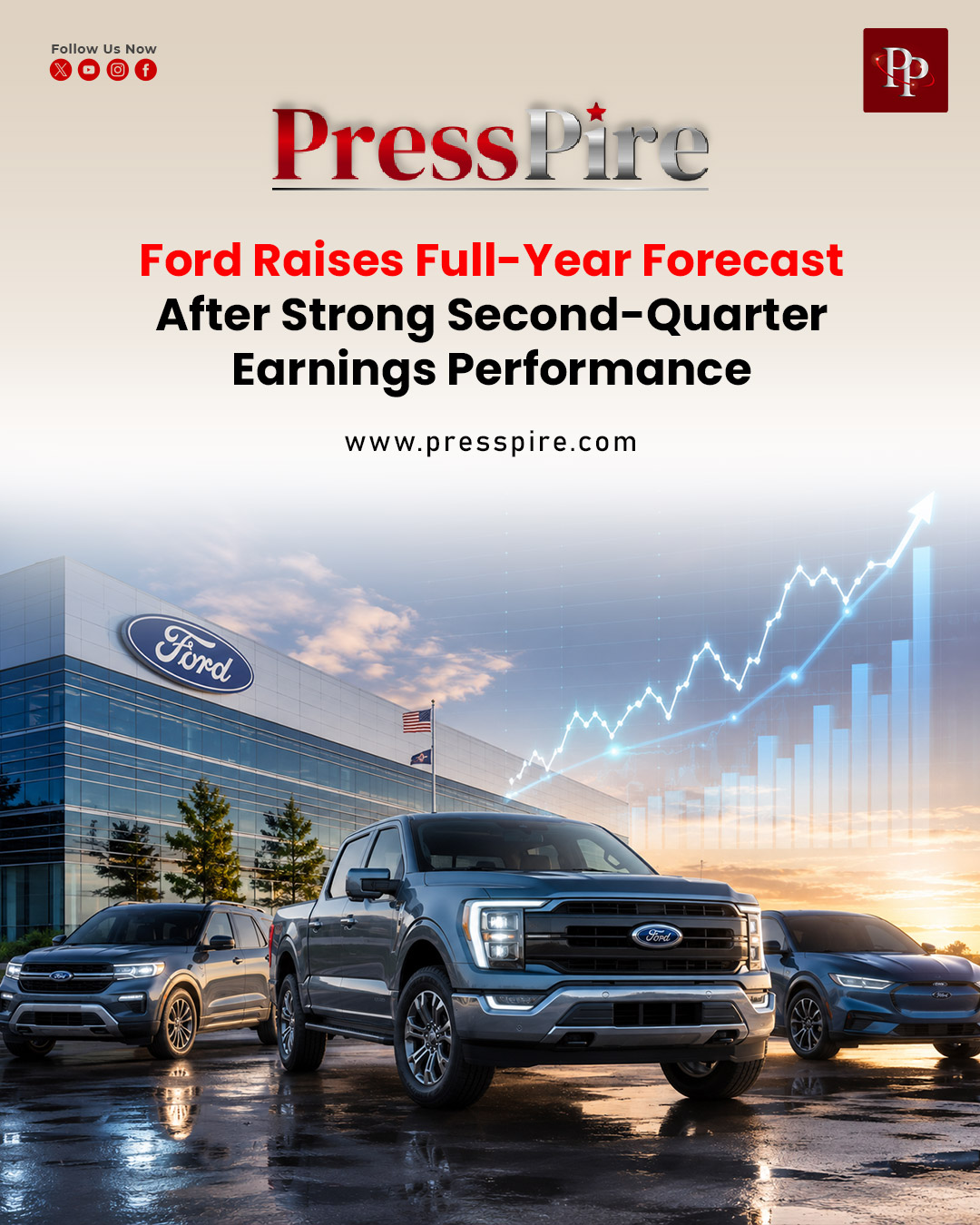
Ford Raises Full-Year Forecast After Strong Second-Quarter Earnings Performance
Ford raises its full-year forecast after a strong second-quarter earnings report, driven by robust commercial vehicle demand and cost discipline.
Ford Raises Full-Year Forecast After Strong Second-Quarter Earnings Performance
The global automotive industry has spent the past few years navigating economic uncertainty, changing consumer preferences, supply chain disruptions, and an accelerating shift toward electrification. Against this challenging backdrop, Ford Motor Company has delivered a reassuring message to investors and the broader market by raising its full-year financial forecast following an impressive second-quarter earnings performance. The revised outlook reflects stronger-than-expected profitability, resilient demand for its commercial vehicle business, disciplined cost management, and improving operational efficiency across several markets. While many legacy automakers continue balancing investments in electric mobility with traditional internal combustion vehicle sales, Ford’s latest results demonstrate that strategic execution and financial discipline can coexist during a period of industry transformation. The upgraded guidance has not only strengthened investor confidence but has also positioned the company as one of the strongest-performing global automobile manufacturers in recent quarters.
Ford Raises Full-Year Forecast After Strong Q2 Results
Ford’s second-quarter financial performance exceeded market expectations across several key metrics, enabling management to confidently raise its guidance for the remainder of the fiscal year. Revenue growth remained healthy despite persistent macroeconomic headwinds, while profitability benefited from stronger pricing, operational efficiencies, and disciplined spending. The company’s commercial vehicle division once again emerged as a standout contributor, delivering consistent margins and steady demand from businesses upgrading or expanding their fleets. Additionally, improved production stability helped Ford meet customer demand more effectively than in previous years when semiconductor shortages constrained deliveries. The company’s management also highlighted ongoing efforts to optimize manufacturing operations, reduce warranty-related expenses, and improve inventory management, all of which contributed to stronger cash generation. These improvements collectively reinforced Ford’s confidence that it can sustain earnings momentum even as global automotive markets remain competitive and consumer purchasing patterns continue evolving.
Ford Raises Full-Year Forecast Through Commercial Vehicle Strength
One of the biggest reasons behind Ford’s improved financial outlook has been the exceptional performance of its commercial vehicle business. Ford Pro, the company’s commercial division, continues to generate significant recurring revenue through fleet sales, software solutions, connected vehicle services, maintenance packages, and financing offerings. This integrated business model provides higher margins than traditional vehicle sales while creating long-term customer relationships. Demand from logistics companies, construction businesses, municipal organizations, and enterprise fleet operators has remained resilient despite broader economic uncertainty. Fleet customers increasingly prioritize operational efficiency, predictive maintenance, and digital fleet management, areas where Ford has invested heavily over the past several years. These recurring revenue streams reduce dependence on cyclical consumer vehicle demand and provide greater earnings stability. Analysts have increasingly recognized Ford Pro as one of the company’s most valuable growth engines, helping offset volatility in passenger vehicle markets while strengthening the overall financial position of the business.
Ford Raises Full-Year Forecast Despite Industry Challenges
Although Ford’s latest results have been encouraging, the company continues operating in an environment filled with significant challenges that affect nearly every global automaker. High interest rates continue influencing vehicle financing costs, inflation remains a concern in several markets, and raw material prices have experienced considerable volatility. In addition, increasing geopolitical tensions and changing trade policies have created uncertainty across international supply chains. Nevertheless, Ford has demonstrated resilience by maintaining pricing discipline, carefully managing production schedules, and prioritizing profitable vehicle segments instead of pursuing aggressive volume growth. The company has also continued improving manufacturing efficiency while strengthening supplier relationships to minimize operational disruptions. Rather than relying solely on cost reductions, Ford has focused on improving product quality and customer satisfaction, helping preserve brand loyalty in an increasingly competitive marketplace. This balanced strategy has allowed the automaker to navigate external pressures while continuing to generate healthy financial returns.
Ford Raises Full-Year Forecast with Electric Vehicle Strategy
Ford’s electric vehicle strategy remains a central pillar of its long-term transformation, even as the pace of global EV adoption has moderated compared to earlier expectations. Instead of pursuing rapid expansion at any cost, Ford has adopted a more disciplined investment approach focused on balancing profitability with innovation. The company continues developing next-generation electric platforms, battery technologies, and software capabilities while carefully aligning production with actual consumer demand. Management has repeatedly emphasized that sustainable profitability—not simply market share is the priority for its EV business. Meanwhile, hybrid vehicles have emerged as an important bridge between conventional internal combustion models and fully electric alternatives, attracting consumers seeking improved fuel efficiency without charging concerns. Ford’s diversified powertrain strategy allows it to respond more flexibly to regional market preferences while protecting profitability during a period when EV demand varies significantly across different countries. This pragmatic approach has reassured investors that Ford is managing the transition responsibly rather than chasing unsustainable growth targets.
Ford Raises Full-Year Forecast and Investor Confidence
The decision to increase full-year guidance has significantly strengthened investor confidence in Ford’s leadership and strategic direction. Financial markets generally interpret higher earnings forecasts as a signal that management possesses greater visibility into future business performance and expects operational momentum to continue. Investors have responded positively to Ford’s disciplined capital allocation, focus on high-margin business segments, and willingness to adjust investment priorities based on changing market conditions. The company has also maintained transparent communication regarding both opportunities and risks, helping build credibility among shareholders and analysts alike. While challenges remain—including competitive pricing pressure, evolving emissions regulations, and ongoing investments in software-defined vehicles Ford’s latest performance suggests that management has successfully balanced short-term profitability with long-term strategic investments. Strong free cash flow generation further enhances the company’s ability to invest in technology, manufacturing modernization, shareholder returns, and future product development without placing excessive pressure on its balance sheet.
What Ford Raises Full-Year Forecast Means for the Industry
Ford’s improved outlook carries broader implications for the global automotive industry, particularly for traditional manufacturers navigating one of the most significant transitions in modern automotive history. The results demonstrate that legacy automakers can remain financially strong while simultaneously investing in electrification, digital services, connected technologies, and software-driven business models. Ford’s emphasis on profitable growth rather than aggressive expansion reflects a wider industry trend toward sustainable financial performance over headline production volumes. Competitors are likely to closely study Ford’s approach to commercial vehicle services, cost discipline, manufacturing efficiency, and balanced powertrain strategy. Additionally, the company’s success highlights the growing importance of recurring revenue businesses that extend well beyond the initial vehicle sale. As software subscriptions, connected services, fleet management platforms, and predictive maintenance solutions become increasingly valuable, automakers are gradually transforming into mobility technology companies. Ford’s latest earnings therefore represent more than a single successful quarter—they illustrate how established automotive brands can evolve while maintaining financial resilience.
Ford’s decision is a significant milestone
Ford’s decision to raise its full-year forecast following a strong second-quarter earnings performance represents a significant milestone for both the company and the wider automotive industry. Supported by resilient commercial vehicle demand, disciplined financial management, operational improvements, and a pragmatic electrification strategy, the automaker has demonstrated that long-term transformation can coexist with short-term profitability. While economic uncertainty and competitive pressures are likely to persist, Ford’s latest results indicate that strategic focus, execution excellence, and customer-centric innovation remain powerful drivers of sustainable growth. As the automotive sector continues evolving through technological disruption and changing consumer expectations, Ford’s performance provides an encouraging example of how established manufacturers can adapt successfully without compromising financial strength. If the company maintains this momentum throughout the remainder of the year, its revised outlook may prove to be not only achievable but a foundation for even stronger long-term growth in the global mobility landscape.
For more insights navigate: PressPire | Stories That Shape the Future
Read previous article here: https://presspire.com/walmarts-mamdanis/
Follow PressPire on Facebook | Instagram | LinkedIn | YouTube
PressPire | Stories That Shape the Future