
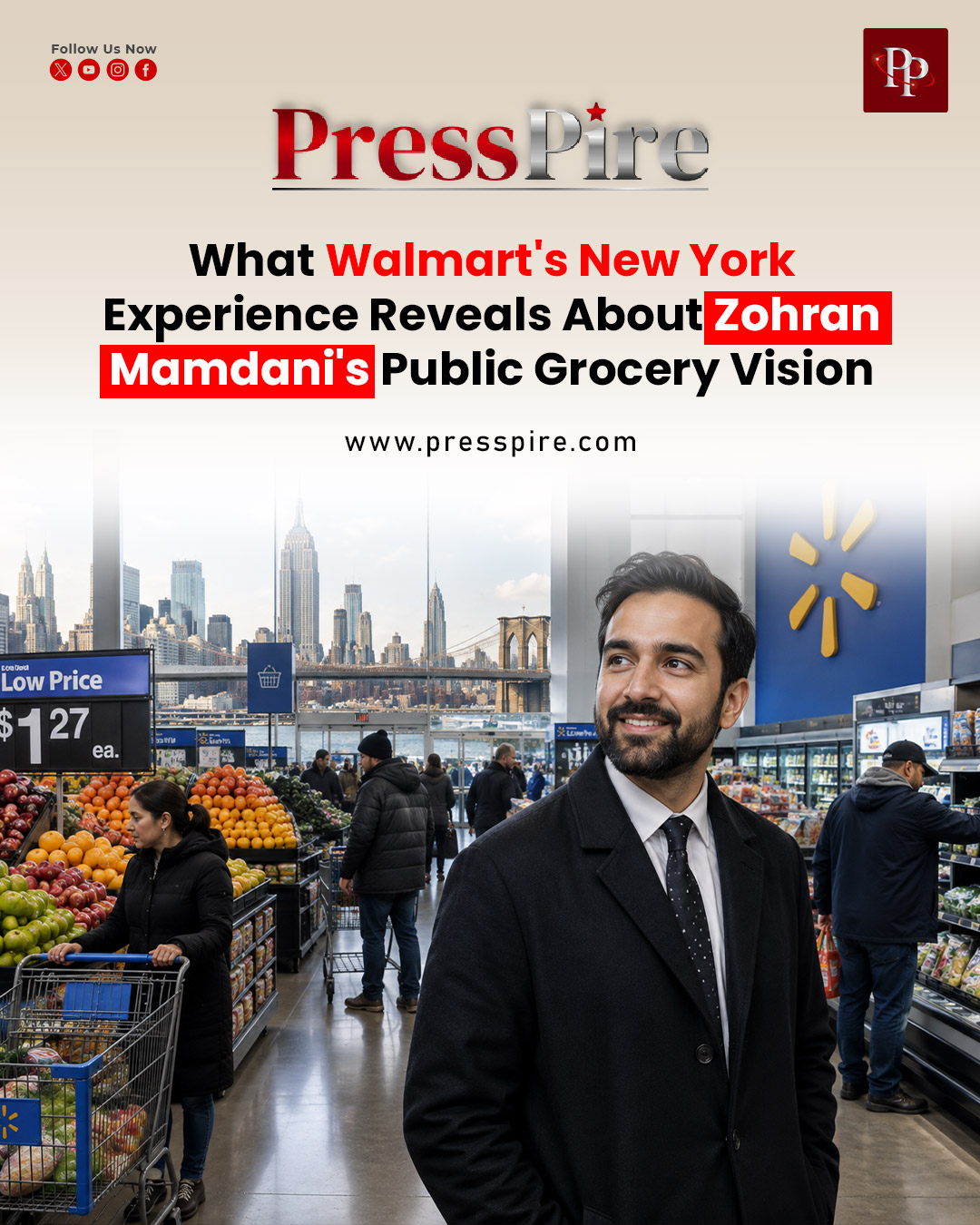
What Walmart’s New York Experience Reveals About Zohran Mamdani’s Public Grocery Vision
Explore how Walmart’s New York experience shapes the debate around Zohran Mamdani’s public grocery vision, affordability, competition, and urban food access. The Walmart New York Experience has become a central point in discussions surrounding Zohran Mamdani’s public grocery vision. While Walmart struggled to establish a strong urban retail presence in New York City, Mamdani believes publicly operated grocery stores could improve affordability and food access. The debate highlights broader questions about competition, pricing, consumer choice, and the future of urban food retail.
Walmart New York Experience and the ambitious proposal put forward by New York politician Zohran Mamdani
The future of grocery shopping has unexpectedly become one of the most discussed policy conversations in the United States. At the centre of that debate stands the Walmart New York Experience and the ambitious proposal put forward by New York politician Zohran Mamdani, who has advocated for publicly operated grocery stores to improve affordability and reduce the cost of essential food items. While supporters describe the proposal as an innovative response to rising living costs, critics argue that New York already offers valuable lessons through Walmart’s decades-long attempts to expand into one of the world’s most complex urban retail markets.
For years, Walmart has dominated suburban America through scale, efficient logistics, and aggressive pricing strategies. Yet New York City proved to be an entirely different challenge. Local opposition, labour concerns, zoning restrictions, and intense competition prevented the retail giant from establishing a meaningful footprint within the city’s five boroughs. Today, as Mamdani’s public grocery vision gains political attention, Walmart’s New York journey has resurfaced as an important case study on whether affordability alone can overcome structural and operational realities. The discussion goes beyond politics—it reflects how governments, businesses, and communities might shape the future of food accessibility in rapidly growing urban centres.
Walmart New York Experience Shows Urban Retail Challenges
The Walmart New York Experience illustrates that success in retail depends on far more than low prices. Despite being one of the world’s largest retailers, Walmart encountered persistent resistance from community organisations, labour unions, neighbourhood groups, and city officials who feared that the company’s business model would disrupt local businesses and alter employment standards. High commercial rents, limited land availability, complex zoning regulations, and the unique density of New York City further complicated expansion plans. Unlike suburban regions where Walmart’s large-format stores thrive, New York’s urban environment demanded smaller footprints, costly logistics, and supply chain adaptations that significantly affected profitability. These realities demonstrate that affordability alone cannot guarantee success in metropolitan markets. Instead, retailers must balance pricing with accessibility, infrastructure, community engagement, and long-term sustainability. These lessons are particularly relevant when evaluating Zohran Mamdani’s proposal, which similarly aims to transform grocery access through a completely different ownership model but would still need to operate within the same challenging urban ecosystem.
Walmart New York Experience Fuels Public Grocery Debate
The Walmart New York Experience has become one of the strongest reference points in discussions surrounding Zohran Mamdani’s publicgrocery vision because both approaches ultimately seek to improve consumer affordability through different mechanisms. Mamdani argues that publicly owned grocery stores could eliminate the profit motive and instead prioritise lower food prices, expanded access in underserved neighbourhoods, and greater transparency in pricing. Supporters believe government-operated stores could address food deserts, stabilise prices during periods of inflation, and increase competition in areas where private retailers have limited presence. However, critics question whether public institutions can consistently achieve the operational efficiency that allows private retailers such as Walmart to negotiate lower supplier costs, optimise distribution networks, and maintain product availability across thousands of locations. Walmart’s global scale is built upon decades of investment in logistics, procurement, inventory management, and technology. Replicating similar efficiencies within a publicly managed system would require significant taxpayer investment, experienced leadership, and robust accountability mechanisms. Consequently, the policy debate extends beyond ideology and instead focuses on whether public grocery stores can sustainably combine affordability, operational excellence, and financial responsibility without placing additional burdens on public finances.
Walmart New York Experience Raises Economic Questions
The Walmart New York Experience also raises broader economic questions about the relationship between competition, government intervention, and consumer welfare. Economists generally agree that healthy competition encourages lower prices, innovation, and improved customer service. Walmart has historically achieved its market leadership by leveraging scale to negotiate competitive supplier contracts and pass many of those savings to consumers. However, New York’s retail landscape demonstrates that market conditions differ considerably across regions. Dense urban neighbourhoods feature higher operating costs, limited warehouse capacity, expensive labour markets, and logistical complexities that naturally increase prices regardless of ownership structures. If publicly owned grocery stores enter this environment, they would still face many of these underlying cost pressures. Some analysts argue that government ownership could cushion certain expenses through public funding, while others caution that subsidies may simply shift financial responsibility from shoppers to taxpayers. The discussion therefore centres on long-term sustainability rather than short-term price reductions. Policymakers evaluating Mamdani’s proposal must carefully examine whether public grocery stores would generate measurable economic value through improved food security, increased competition, and broader social benefits, or whether private-sector reforms could deliver similar outcomes with fewer fiscal risks.
Walmart New York Experience Highlights Consumer Priorities
Beyond economics, the Walmart New York Experience highlights changing consumer expectations that increasingly shape modern grocery retail. Today’s shoppers evaluate stores not only on price but also on convenience, product quality, digital ordering, delivery options, sustainability initiatives, and locally sourced products. Walmart itself has evolved significantly over the past decade by investing in e-commerce, automated fulfilment centres, mobile applications, and omnichannel shopping experiences that blend physical and digital retail. Any future public grocery system would similarly need to meet these evolving expectations rather than relying solely on lower prices as its competitive advantage. Consumers increasingly expect seamless technology, reliable inventory, fresh produce, transparent sourcing, and efficient home delivery services. Furthermore, local communities often value neighbourhood identity and independent businesses alongside affordability. These factors explain why New York’s grocery landscape remains highly diverse despite the absence of Walmart’s traditional supercentres. As Mamdani’s proposal continues attracting national attention, the central question becomes whether publicly operated stores can deliver both affordability and the modern customer experience that urban consumers increasingly demand in an intensely competitive retail environment.
What Walmart New York Experience Means for the Future
The Walmart New York Experience ultimately offers policymakers valuable lessons as discussions surrounding Zohran Mamdani’s public grocery vision continue to evolve. Rather than presenting a simple choice between private enterprise and government ownership, the debate reflects the broader challenge of ensuring affordable, reliable, and equitable food access in modern cities. Future grocery models may increasingly combine public-private partnerships, community-supported markets, technology-enabled logistics, and targeted policy interventions to address food insecurity without undermining healthy market competition. Governments may also prioritise incentives for retailers to expand into underserved communities while strengthening local supply chains and encouraging innovation. Walmart’s New York journey demonstrates that urban retail success depends upon understanding community needs, adapting operational strategies, and maintaining financial sustainability over the long term. Whether Mamdani’s vision ultimately succeeds or not, it has already encouraged a meaningful conversation about how cities should balance affordability, accessibility, consumer choice, and economic resilience. That discussion is likely to shape grocery policy well beyond New York, influencing urban planning, retail investment, and public policy debates across major cities around the world.
Walmart New York Experience is more than a story about one retailer’s challenges in a complex urban market
The Walmart New York Experience is more than a story about one retailer’s challenges in a complex urban market it has become an important lens through which policymakers, economists, and consumers are evaluating the practicality of Zohran Mamdani’s public grocery vision. Walmart demonstrated that delivering consistently low prices requires enormous operational efficiency, sophisticated logistics, and careful adaptation to local market conditions. Mamdani’s proposal, meanwhile, seeks to redefine grocery retail by placing public welfare at the centre of food distribution rather than private profitability.
Neither model offers a universal solution. Instead, both reveal the complexities involved in balancing affordability, sustainability, consumer choice, and economic viability. As cities continue searching for innovative ways to combat rising living costs and improve food accessibility, the lessons from Walmart’s New York experience will remain highly relevant. Ultimately, the future of grocery retail may depend not on choosing between public and private systems, but on identifying collaborative approaches that combine efficiency with equity while serving the evolving needs of urban communities.
For more insights navigate: PressPire | Stories That Shape the Future
Read previous article here: https://presspire.com/mahindra-novavayu/
Follow PressPire on Facebook | Instagram | LinkedIn | YouTube
PressPire | Stories That Shape the Future