
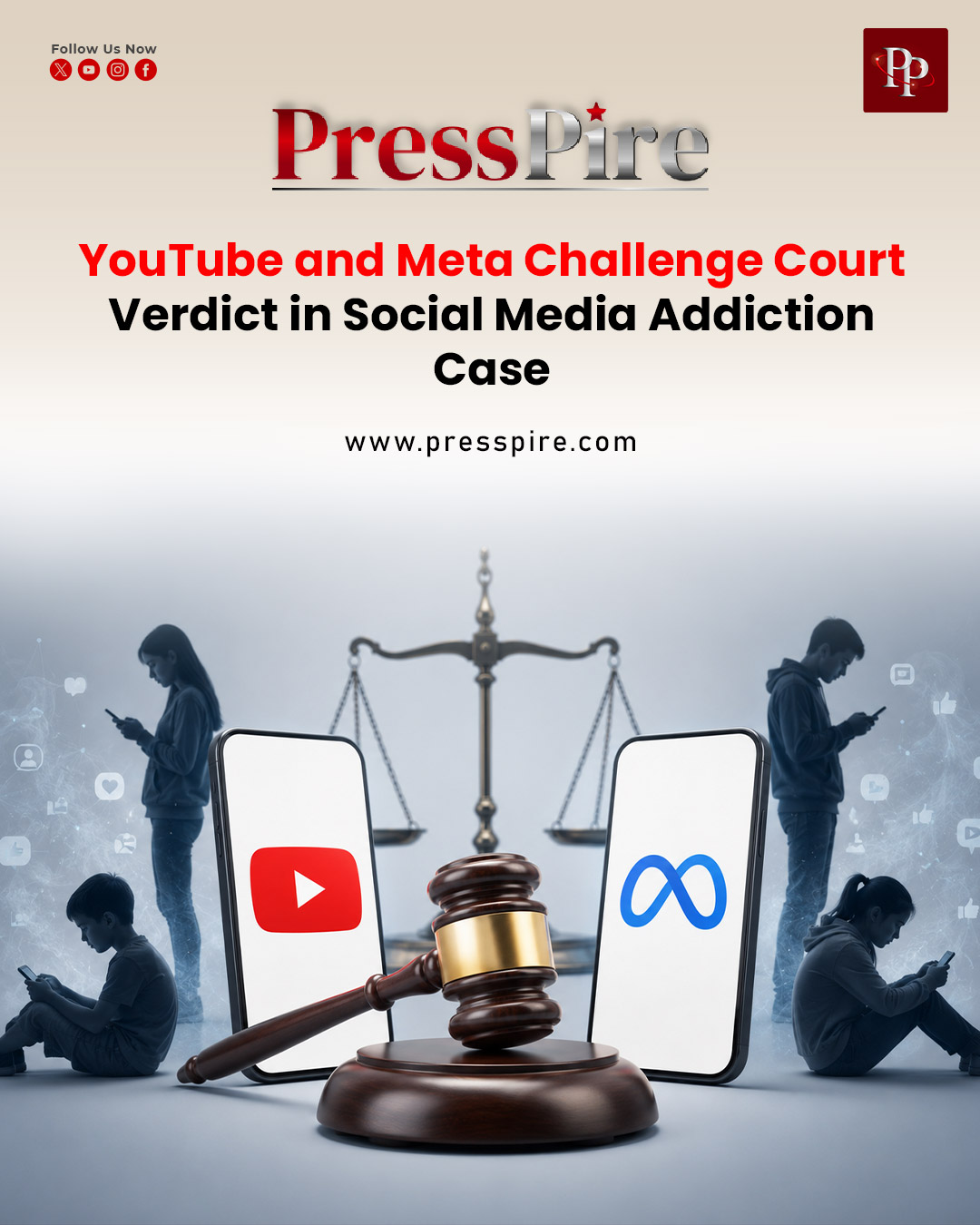
YouTube and Meta Challenge Court Verdict in Social Media Addiction Case
YouTube and Meta challenge a landmark court verdict in the social media addiction case, raising global debates on platform accountability, child safety, and digital regulation.
YouTube and Meta Challenge Court Verdict in Social Media Addiction Case
Social media has transformed the way people communicate, learn, and entertain themselves. However, alongside its many advantages, concerns over excessive screen time, addictive algorithms, and the mental health of young users have become impossible to ignore. These concerns have now reached one of the biggest legal battlegrounds in the technology industry, as YouTube and Meta challenge a court verdict in a landmark social media addiction case. The legal dispute is not merely about compensation or liability, it represents a defining moment in determining how much responsibility technology companies should bear for the impact of their platforms on millions of users, particularly children and teenagers. As governments across the world tighten digital regulations and families seek greater accountability, the outcome of this case could influence future laws governing social media companies and reshape how digital platforms are designed, operated, and regulated for years to come.
The Growing Social Media Addiction Case Against Big Tech
The legal battle surrounding the social media addiction case has emerged after years of mounting scientific research, public concern, and growing evidence suggesting that certain platform features encourage compulsive usage among young audiences. Plaintiffs have argued that recommendation systems, endless scrolling, autoplay videos, push notifications, and personalised content feeds are intentionally designed to maximise engagement rather than user wellbeing. Families involved in the litigation claim that these design choices contributed to anxiety, depression, sleep disorders, self-esteem issues, and addictive behavioural patterns among teenagers who spent extended hours on social media platforms. Technology companies, however, maintain that their products provide users with choice and valuable opportunities for communication, education, creativity, and business while offering parents various safety tools and privacy settings. The disagreement reflects a broader societal debate over where personal responsibility ends and corporate responsibility begins in an increasingly digital world.
Why YouTube and Meta Challenge the Court Verdict on Social Media Addiction
Following the court’s decision allowing significant portions of the lawsuit to proceed, YouTube and Meta challenged the verdict, arguing that the legal interpretation creates an unfair precedent for online platforms. The companies contend that the court overlooked existing legal protections available to internet services and failed to properly distinguish between harmful third-party content and the platforms themselves. According to their legal arguments, recommendation algorithms are an essential function of modern digital services that help users discover relevant content rather than intentionally cause addiction. Both companies also emphasise their ongoing investments in parental controls, youth safety initiatives, content moderation systems, digital wellbeing reminders, and artificial intelligence tools designed to reduce harmful experiences online. By challenging the verdict, the companies are seeking greater legal clarity on the extent of platform liability, believing that the decision could fundamentally alter how internet companies develop recommendation systems and manage user engagement across their global ecosystems.
How Algorithms Became the Centre of the Social Media Addiction Case
At the heart of the social media addiction case lies one of the most powerful innovations of the digital era, the recommendation algorithm. Unlike traditional media, platforms such as YouTube and Meta do not simply display content in chronological order; they use sophisticated artificial intelligence models that continuously analyse user behaviour to predict what individuals are most likely to watch, read, or interact with next. Every click, pause, like, share, and search contributes to an increasingly personalised experience designed to maximise engagement. Critics argue that this constant optimisation encourages prolonged usage, making it especially difficult for children and teenagers to disconnect. Supporters, however, contend that recommendation systems improve user experience by delivering relevant educational, entertainment, and community-driven content while enabling creators and businesses to reach audiences more effectively. The ongoing legal proceedings are expected to examine whether these algorithms merely organise available information or actively contribute to addictive behaviours. The distinction could become one of the most consequential legal questions for the global technology industry, influencing future product design, regulatory frameworks, and corporate responsibilities toward users of all ages.
The Global Push for Platform Accountability
The legal challenge by YouTube and Meta comes at a time when governments across the world are introducing stricter measures to regulate digital platforms and strengthen online safety, particularly for minors. Countries including the United States, the United Kingdom, members of the European Union, and Australia have either implemented or proposed laws aimed at improving transparency around algorithms, enhancing child protection, limiting harmful content, and increasing corporate accountability. Regulators are demanding greater disclosure about how recommendation systems function and whether engagement-driven business models unintentionally prioritise profits over user wellbeing. At the same time, technology companies argue that excessive regulation could restrict innovation, limit freedom of expression, and reduce the personalised experiences that users have come to expect. The YouTube and Meta Challenge Court Verdict in Social Media Addiction Case has therefore evolved into more than a domestic legal dispute, it has become a closely watched global benchmark that may influence policymakers, courts, technology firms, and digital rights advocates as they seek to strike a balance between innovation, commercial growth, and the protection of vulnerable users in an increasingly connected world.
What the Social Media Addiction Case Verdict Means for Technology Companies
The outcome of the YouTube and Meta Challenge Court Verdict in Social Media Addiction Case could have far-reaching consequences for the global technology industry. If courts ultimately determine that digital platforms can be held legally responsible for the addictive nature of their algorithms or product designs, companies may need to fundamentally rethink how they measure success and user engagement. Features such as autoplay, infinite scrolling, personalised recommendations, and continuous notifications could face increased regulatory scrutiny, prompting platforms to redesign interfaces with greater emphasis on digital wellbeing rather than prolonged screen time. Such changes could also influence advertising revenue models, as user engagement remains the foundation of many social media businesses. Industry experts believe that the verdict could encourage companies to invest more heavily in transparent algorithms, independent safety audits, age-appropriate design standards, and stronger parental controls. Even if YouTube and Meta succeed in overturning parts of the ruling, the litigation itself demonstrates that courts, regulators, investors, and the public are increasingly expecting technology companies to demonstrate that innovation can coexist with ethical responsibility. The case may therefore become a catalyst for a new generation of platform governance where trust, transparency, and user protection become just as important as technological advancement.
Parents, Mental Health, and the Future of Social Media
While legal experts debate constitutional protections and platform liability, the social media addiction case has brought renewed attention to the experiences of parents, educators, healthcare professionals, and young users navigating an increasingly digital world. Many families have expressed concerns about excessive screen time, online comparison culture, cyberbullying, disrupted sleep patterns, and declining attention spans, while mental health professionals continue to study the complex relationship between social media usage and psychological wellbeing. Researchers generally agree that social media is neither entirely harmful nor entirely beneficial; rather, its impact depends on factors such as age, duration of use, content consumed, parental supervision, and individual vulnerability. This broader understanding has shifted public discussion away from blaming technology alone and towards creating healthier digital habits through education, responsible platform design, and collaborative regulation. The YouTube and Meta Challenge Court Verdict in Social Media Addiction Case has therefore become symbolic of a larger societal conversation about how digital platforms should serve users without compromising their wellbeing, particularly at a time when younger generations spend a significant portion of their daily lives online. The case reminds businesses and policymakers alike that technological progress must ultimately be measured not only by innovation but also by its positive impact on society.
YouTube and Meta Challenge Court Verdict in Social Media Addiction Case: A Defining Moment for Digital Responsibility
The YouTube and Meta Challenge Court Verdict in Social Media Addiction Case represents one of the most significant legal battles confronting the technology sector in recent years. Beyond the courtroom, it reflects growing expectations that digital platforms should balance innovation, commercial success, and social responsibility in equal measure. Regardless of the final judicial outcome, the case has already intensified discussions surrounding algorithmic transparency, child safety, mental health, and the ethical design of online platforms. Governments are likely to continue strengthening digital regulations, while technology companies will increasingly be expected to demonstrate that user wellbeing is integrated into product development rather than treated as an afterthought. For parents, educators, regulators, investors, and billions of users worldwide, the verdict will serve as an important indicator of how the digital economy evolves in the years ahead. As social media continues to shape communication, education, business, and culture, this landmark case may ultimately define not only the future legal responsibilities of technology companies but also the broader relationship between innovation and accountability in the digital age.
For more insights navigate: PressPire | Stories That Shape the Future
Read previous article here: https://presspire.com/former-isro-chairman-somanath/
Follow PressPire on Facebook | Instagram | LinkedIn | YouTube
PressPire | Stories That Shape the Future