
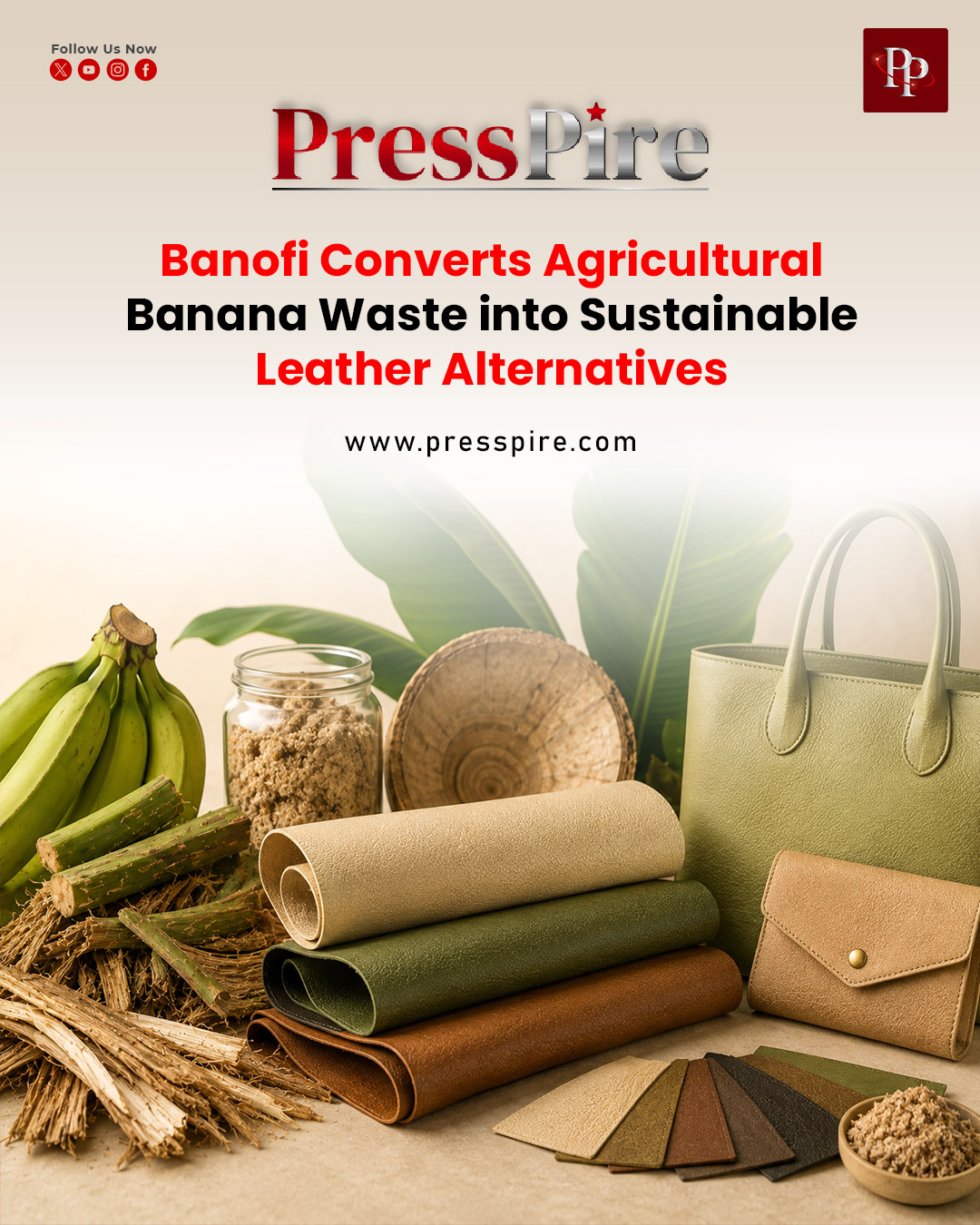
Banofi Converts Agricultural Banana Waste into Sustainable Leather Alternatives
Discover how Banofi is converting agricultural banana waste into sustainable leather alternatives, driving innovation, circular economy, and eco-friendly fashion. Banofi is transforming discarded banana agricultural waste into sustainable leather alternatives that reduce environmental impact while creating new income opportunities for farmers. The innovation demonstrates how agricultural by-products can reshape the future of fashion, interiors, and sustainable manufacturing.
Banofi Converts Agricultural Banana Waste into Sustainable Leather Alternatives
The global fashion industry is undergoing one of its biggest transformations as brands search for materials that reduce environmental impact without compromising on quality or durability. Traditional leather production has long been associated with intensive resource consumption, while synthetic alternatives often depend on petroleum-based plastics that create their own environmental concerns. In this changing landscape, innovative startups are proving that agricultural waste can become a valuable resource instead of ending up in landfills. One such company making remarkable progress is Banofi, which has developed an innovative process to convert discarded banana plant waste into sustainable leather alternatives. By transforming an agricultural by-product into a premium material, the company is addressing multiple challenges at once reducing farm waste, creating additional income for cultivators, lowering industrial waste, and providing manufacturers with environmentally responsible materials. As sustainability becomes a priority across industries ranging from fashion to automotive interiors, Banofi Banana Leather demonstrates how scientific innovation and circular economy principles can work together to redefine the future of sustainable manufacturing.
Banofi Banana Leather Gives Agricultural Waste a New Purpose
Every year, millions of tonnes of banana plant biomass are discarded after fruit harvesting because only the fruit is commercially valuable while the remaining pseudostem is typically treated as agricultural waste. Farmers often burn or dispose of this biomass, contributing to unnecessary waste and environmental pollution. Banofi recognised this overlooked opportunity by extracting fibres from banana stems and transforming them into high-performance sustainable leather alternatives using advanced material engineering techniques. Instead of relying on animal hides or petroleum-derived synthetic fabrics, the company creates a renewable material from an abundant natural resource that would otherwise remain unused. This innovative approach reflects the principles of a circular economy, where waste is converted into valuable products rather than becoming an environmental burden. The resulting Banofi Banana Leather combines sustainability with functionality, making it suitable for multiple commercial applications while helping reduce dependence on conventional leather production methods.
Banofi Banana Leather Supports the Circular Economy
The growing adoption of circular economy principles has encouraged businesses to rethink how products are designed, manufactured, and recycled. Banofi Banana Leather perfectly aligns with this vision by extending the lifecycle of agricultural resources and minimising waste generation across the supply chain. Instead of extracting fresh raw materials, the company utilises existing biomass, reducing pressure on natural ecosystems while improving overall resource efficiency. The innovation also lowers carbon emissions associated with waste disposal and creates an additional economic opportunity within rural communities. By connecting agriculture with advanced manufacturing, Banofi demonstrates how sustainability can become commercially viable rather than remaining merely an environmental objective. The company’s production model illustrates that environmental responsibility and economic growth can coexist when innovation focuses on utilising underused natural resources effectively.
Sustainable Leather Alternatives Are Becoming an Industry Priority
Consumers today are increasingly evaluating products based not only on quality but also on environmental impact. Fashion brands, luxury manufacturers, furniture companies, and automotive businesses are actively searching for sustainable leather alternatives that satisfy both performance expectations and sustainability commitments. Banofi Banana Leather arrives at a time when global demand for plant-based materials is expanding rapidly. Unlike conventional leather, which requires significant water usage and chemical processing, or synthetic leather, which contributes to plastic pollution, banana fibre-based materials offer a renewable and biodegradable solution. The versatility of the material allows it to be used in handbags, footwear, wallets, upholstery, accessories, corporate gifting, and premium lifestyle products. As environmental regulations tighten and consumers increasingly favour responsible brands, innovative materials like Banofi Banana Leather are expected to play an important role in reshaping manufacturing practices across multiple industries.
Farmers Gain New Economic Opportunities Through Banofi Banana Leather
One of the most significant advantages of Banofi’s innovation extends beyond sustainability and directly benefits farming communities. Banana cultivation generates substantial biomass after every harvest, but this residue traditionally carries little or no commercial value. By creating a market for banana fibres, Banofi enables farmers to monetise agricultural waste that previously represented an expense for disposal. This additional revenue stream can improve rural livelihoods while encouraging more sustainable farming practices. The model strengthens local supply chains, supports rural employment, and creates opportunities for decentralised fibre collection and processing. As agricultural innovation increasingly focuses on maximising resource utilisation, Banofi Banana Leather demonstrates how technology can empower farmers while simultaneously addressing industrial sustainability goals. This integration of agriculture, entrepreneurship, and environmental responsibility highlights the broader socioeconomic value of circular economy innovations.
Challenges Ahead for Banofi Banana Leather
Despite its promising potential, scaling sustainable material innovation comes with several challenges. Manufacturing at commercial scale requires consistent fibre quality, efficient processing technologies, reliable supply chains, and competitive production costs. Consumer education also remains an important factor, as many buyers are still unfamiliar with plant-based leather alternatives and their long-term performance characteristics. Additionally, large global manufacturers often require extensive testing, certifications, and compliance before adopting new materials into their production systems. Banofi will need continued investment in research, quality assurance, strategic partnerships, and production capabilities to compete effectively with established material suppliers. Nevertheless, increasing environmental awareness, government support for sustainable manufacturing, and growing corporate ESG commitments create favourable conditions for innovative companies developing next-generation materials.
Why Banofi Banana Leather Represents the Future of Sustainable Materials
Innovation often begins by looking at familiar resources differently, and Banofi has demonstrated exactly that by transforming discarded banana plant waste into a commercially valuable material. The company’s approach represents more than a technological breakthrough—it reflects a changing mindset where sustainability, business growth, and community development reinforce one another. By reducing agricultural waste, supporting farmers, lowering environmental impact, and offering industries a viable alternative to conventional leather, Banofi Banana Leather showcases the immense possibilities of circular economy innovation. As governments, businesses, and consumers collectively move towards more sustainable choices, such pioneering solutions are likely to influence the next generation of material science. While challenges remain in scaling production and expanding market adoption, Banofi has positioned itself at the intersection of agriculture, sustainability, and advanced manufacturing, proving that tomorrow’s premium materials may emerge not from new resources, but from reimagining the value hidden within today’s agricultural waste.
Banofi’s journey illustrates how innovation can convert a common agricultural by-product into a solution with global relevance
Banofi’s journey illustrates how innovation can convert a common agricultural by-product into a solution with global relevance. As industries increasingly embrace sustainable leather alternatives and circular economy practices, banana fibre-based materials have the potential to reduce waste, support farmers, and transform manufacturing. If successfully scaled, Banofi Banana Leather could become an important contributor to a more sustainable future where environmental responsibility and economic opportunity advance together.
For more insights navigate: PressPire | Stories That Shape the Future
Read previous article here: https://presspire.com/swichh-zero-sugar-soda/
Follow PressPire on Facebook | Instagram | LinkedIn | YouTube
PressPire | Stories That Shape the Future