
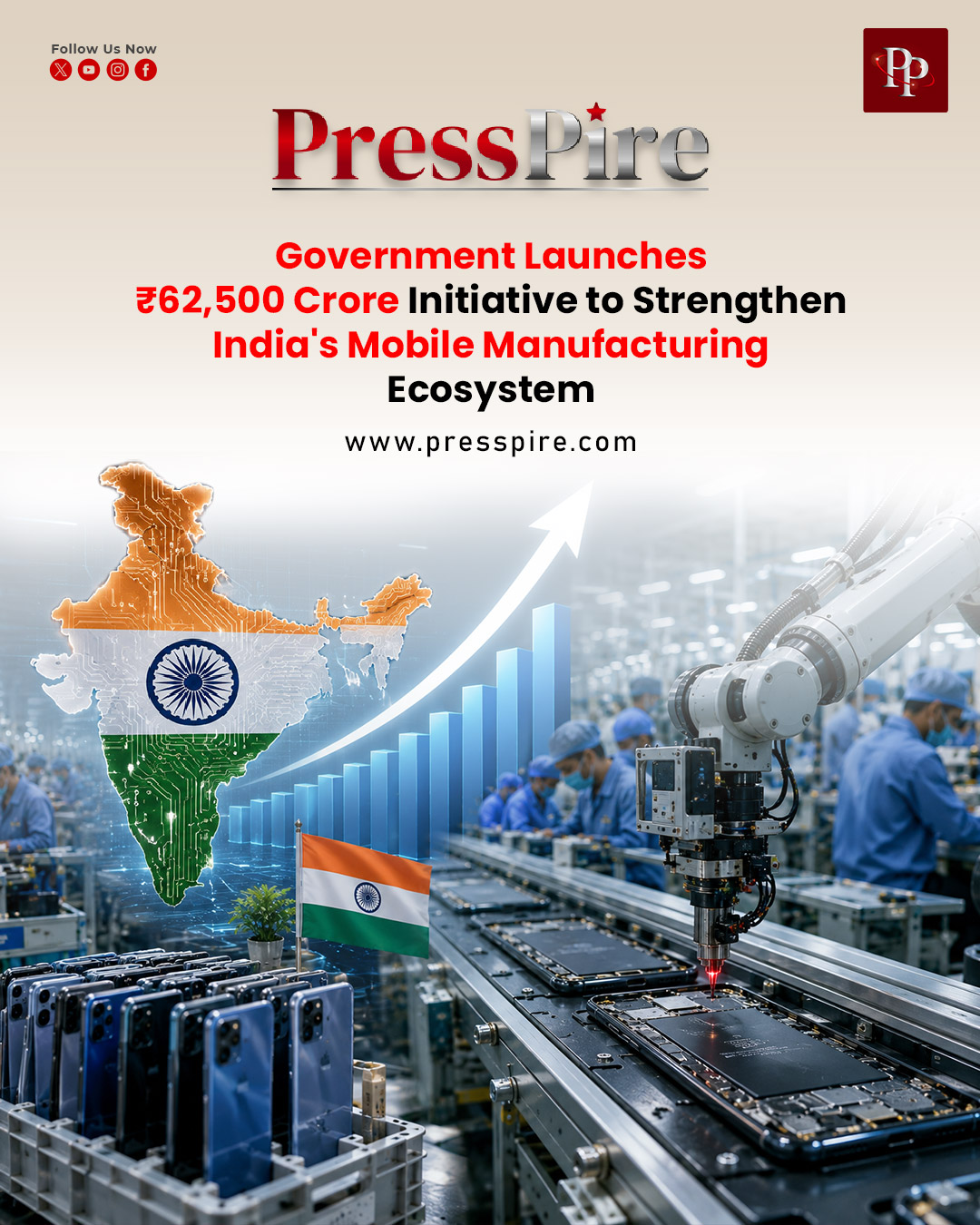
Mobile Manufacturing Ecosystem Gets ₹62,500 Crore Boost as Government Launches New Initiative
India launches a ₹62,500 crore mobile manufacturing initiative to strengthen electronics production, create jobs, boost exports, and reduce imports. India has unveiled a ₹62,500 crore Mobile Manufacturing Initiative aimed at strengthening domestic electronics production, boosting component manufacturing, attracting global investments, generating employment, and positioning India as a global smartphone manufacturing powerhouse under the Make in India vision.
India’s ambition to become a global manufacturing powerhouse has received another major push with the Union Government unveiling a ₹62,500 crore Mobile Manufacturing Initiative aimed at strengthening the country’s electronics ecosystem. While India has already emerged as one of the world’s largest smartphone assembly hubs, policymakers now want to move beyond assembling finished products and focus on manufacturing the high-value components that power modern smartphones. The initiative is expected to encourage investments across semiconductor packaging, printed circuit boards (PCBs), display modules, camera systems, batteries, precision mechanics, and other advanced electronic components that currently rely heavily on imports. Industry experts believe the scheme could become one of India’s biggest industrial policy interventions after the Production Linked Incentive (PLI) programme, creating a stronger domestic supply chain while reducing dependence on overseas manufacturers. At a time when global companies are actively diversifying their manufacturing bases beyond China, India sees this initiative as a strategic opportunity to position itself as a trusted destination for electronics manufacturing. Beyond boosting industrial output, the programme also aims to create millions of jobs, attract international capital, improve export competitiveness, and deepen technological capabilities. As global demand for smartphones, wearables, AI-powered devices, and connected electronics continues to rise, India’s latest policy could redefine the country’s role in the international technology supply chain for the coming decade.
Mobile Manufacturing Initiative Marks a New Industrial Chapter
The newly announced Mobile Manufacturing Initiative represents a strategic shift in India’s industrial policy by focusing not only on assembling smartphones but also on building a comprehensive manufacturing ecosystem capable of producing sophisticated electronic components domestically. Over the past five years, India has become one of the world’s fastest-growing smartphone manufacturing destinations, with global brands such as Apple, Samsung, Xiaomi, Oppo, Vivo, and Motorola significantly expanding production in the country. However, despite impressive assembly numbers, a substantial portion of critical components—including chipsets, displays, camera modules, sensors, connectors, and integrated circuits—continues to be imported. The government’s ₹62,500 crore commitment seeks to bridge this gap by encouraging companies to manufacture these components locally through targeted incentives, infrastructure support, and policy stability. Officials believe that increasing domestic value addition will make India’s electronics sector more resilient, reduce import dependence, improve foreign exchange savings, and enable manufacturers to capture greater value across the global electronics supply chain while strengthening the long-term objectives of the Make in India and Digital India missions.
Mobile Manufacturing Initiative Focuses on Local Components
One of the biggest objectives of the Mobile Manufacturing Initiative is increasing domestic production of components that account for the majority of smartphone manufacturing costs. While smartphone assembly contributes significantly to production volumes, high-value components continue to be sourced from countries such as China, South Korea, Taiwan, Japan, and Vietnam. The new initiative aims to incentivise manufacturing across printed circuit boards, batteries, display modules, camera systems, connectors, mechanics, enclosures, sensors, charging systems, and other precision electronic parts. Developing these manufacturing capabilities domestically would significantly improve local value addition, which currently remains considerably lower than mature manufacturing economies. Industry leaders believe that localisation will not only reduce production costs over time but also shorten supply chains, minimise logistics risks, and improve operational efficiency for manufacturers operating in India. As global electronics companies increasingly seek diversified manufacturing destinations amid geopolitical uncertainties, India’s strengthened component ecosystem could become a decisive competitive advantage that attracts even larger investments from multinational technology firms.
Mobile Manufacturing Initiative Creates Jobs and Investment
Apart from strengthening manufacturing capacity, the Mobile Manufacturing Initiative is expected to become a major employment generator across multiple sectors. Large-scale electronics manufacturing requires engineers, technicians, machine operators, logistics professionals, research specialists, quality control experts, packaging personnel, software engineers, and skilled factory workers, creating opportunities across different educational backgrounds and regions. Industry estimates suggest that every major electronics manufacturing facility generates thousands of direct jobs while supporting many more indirect opportunities through suppliers, transport providers, industrial parks, construction companies, and service businesses. The initiative is also expected to encourage global companies to establish new production facilities while motivating domestic firms to expand existing capacities. Increased capital investment could accelerate the development of industrial corridors, electronics clusters, warehousing infrastructure, testing laboratories, and research centres across several states. By integrating employment generation with manufacturing expansion, the government hopes to strengthen India’s economic growth while enhancing workforce skills required for advanced electronics production.
Mobile Manufacturing Initiative Supports Global Competitiveness
The success of India’s smartphone manufacturing industry has already transformed the country into a significant exporter of mobile devices, particularly with Apple’s increasing production footprint. However, policymakers recognise that global competitiveness increasingly depends on manufacturing complete ecosystems rather than merely assembling imported components. The Mobile Manufacturing Initiative therefore seeks to strengthen India’s position in international supply chains by encouraging innovation, technology transfers, research collaborations, and higher domestic value creation. A stronger component ecosystem could reduce production timelines, improve cost efficiency, and help manufacturers respond faster to evolving global demand. Furthermore, global electronics companies increasingly prioritise countries offering policy consistency, skilled talent, modern infrastructure, and reliable supplier networks. By addressing these factors simultaneously, India aims to establish itself not simply as an alternative manufacturing destination but as a preferred global electronics hub capable of supporting next-generation technologies, including artificial intelligence devices, connected hardware, wearable electronics, electric mobility systems, and smart consumer products.
Mobile Manufacturing Initiative Strengthens India’s Supply Chain
Global disruptions experienced during the COVID-19 pandemic, semiconductor shortages, and geopolitical tensions exposed the vulnerabilities of heavily concentrated supply chains. India’s Mobile Manufacturing Initiative seeks to address these challenges by creating a more diversified and resilient electronics manufacturing network within the country. Domestic production of critical components would reduce dependence on overseas suppliers, minimise shipping delays, and provide manufacturers with greater operational flexibility during international disruptions. The initiative also complements India’s broader semiconductor ambitions and aligns with national efforts to establish advanced electronics clusters capable of supporting long-term technological development. As supplier ecosystems mature, smaller and medium-sized enterprises are expected to benefit by becoming part of larger manufacturing networks supplying global brands. This expansion could stimulate innovation, improve manufacturing standards, encourage technology adoption, and create an integrated ecosystem where component manufacturers, assemblers, logistics providers, testing facilities, and research institutions work together to enhance India’s global manufacturing competitiveness.
Mobile Manufacturing Initiative Faces Key Challenges
Despite its ambitious vision, the Mobile Manufacturing Initiative must overcome several structural challenges before achieving its full potential. Electronics manufacturing demands reliable power supply, world-class logistics infrastructure, advanced manufacturing equipment, skilled technical talent, intellectual property protection, and globally competitive production costs. India continues to face competition from established manufacturing nations that possess mature supplier ecosystems developed over several decades. Industry stakeholders also emphasise the importance of consistent policy implementation, faster regulatory approvals, simplified compliance frameworks, and sustained government support to ensure investor confidence. Workforce development remains equally critical, as advanced electronics manufacturing increasingly depends on specialised technical expertise rather than low-cost labour alone. Addressing these issues effectively will determine whether India can successfully transition from being primarily an assembly destination to becoming a globally recognised centre for high-value electronics manufacturing and innovation.
Mobile Manufacturing Initiative Could Transform India’s Future
The ₹62,500 crore Mobile Manufacturing Initiative has the potential to become one of the defining industrial reforms shaping India’s economic future. By encouraging domestic component manufacturing, strengthening supply chains, creating employment, attracting global investments, and increasing exports, the initiative seeks to build a self-reliant electronics ecosystem capable of competing with the world’s leading manufacturing economies. Its success would contribute not only to industrial growth but also to technological advancement, innovation, skill development, and long-term economic resilience. As international companies continue diversifying production bases and global demand for advanced electronics accelerates, India is positioning itself to capture a much larger share of worldwide manufacturing opportunities. If implemented effectively with sustained industry collaboration and policy consistency, the Mobile Manufacturing Initiative could mark the beginning of India’s transition from a major smartphone assembler to a global leader in electronics manufacturing, reinforcing the nation’s aspirations of becoming a technology-driven economic powerhouse while strengthening its position in international supply chains for years to come.
For more insights navigate: PressPire | Stories That Shape the Future
Read previous article here: https://presspire.com/premiumisation/
Follow PressPire on Facebook | Instagram | LinkedIn | YouTube
PressPire | Stories That Shape the Future