
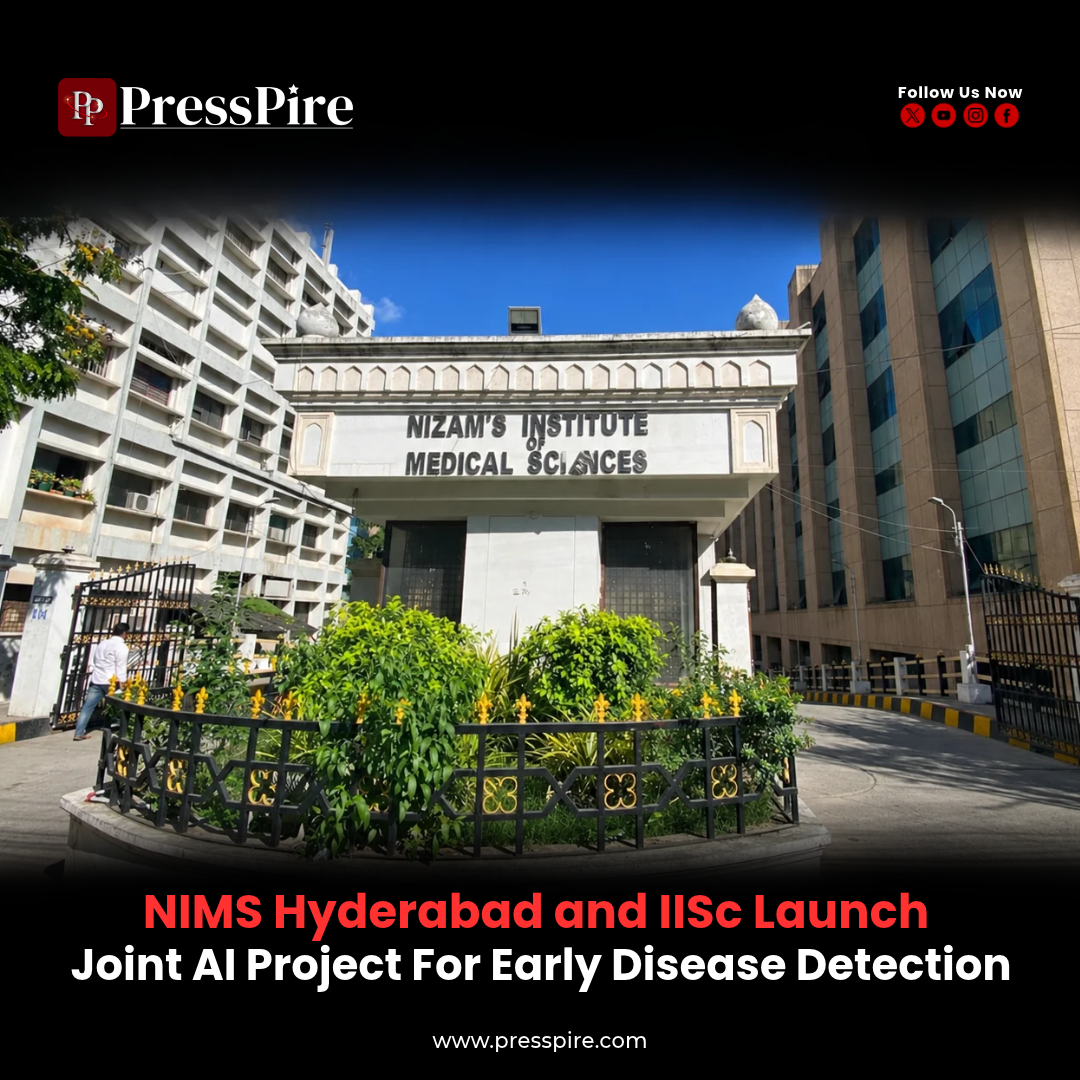
NIMS-IISc AI Project Aims to Improve Early Disease Detection for Indian Patients
The collaboration aims to combine clinical expertise and artificial intelligence research to develop tools for diagnosis, risk assessment and personalised treatment planning.
Hyderabad | Healthcare and Technology
Launch reported: 18 June 2026 | Updated: 26 November 2026
The NIMS-IISc AI project brings together Nizam’s Institute of Medical Sciences in Hyderabad and the Indian Institute of Science in Bengaluru to develop artificial intelligence tools for healthcare. Announced in June 2026, the initiative aims to support earlier diagnosis and help clinicians make informed decisions using models tailored to Indian patients.
IISc scientists visited NIMS on 18 June for discussions with doctors and faculty members. The meeting, chaired by NIMS Dean Dr P. Chandrasekhar, addressed the research roadmap and the potential role of AI in improving patient care.
Research priorities for the NIMS-IISc AI project
The announced programme covers five broad areas:
- Breast cancer.
- Oral cancer.
- Kidney diseases.
- Cardiovascular disorders.
- Obesity-related conditions.
Researchers intend to explore applications in diagnosis, risk assessment, analysis of disease progression and personalised treatment planning. The scope therefore extends across several stages of care, from identifying possible disease to supporting decisions about its management.
These objectives involve different research questions. A tool estimating future risk would need a different evaluation from one helping interpret evidence of an existing condition. Defining each intended use will be important as the NIMS-IISc AI project develops its individual models.
A six-month first phase focused on preliminary models
At launch, the NIMS-IISc AI project set an initial six-month target for work on clinical data analysis, algorithm design and preliminary model development. That timetable runs from the June announcement, placing the original target around December 2026.
The planned activities form the research foundation: examining available clinical information, designing computational methods and producing models for further assessment.
The launch reports describe intended work and expected benefits, without results establishing diagnostic accuracy or improved patient outcomes. They also do not specify a date for routine clinical deployment. The six-month target concerned the initial research phase.
Building on earlier discussions with TANUH
The NIMS-IISc AI project follows discussions reported in May 2026 between NIMS leadership, the TANUH Foundation and IISc’s AI Centre of Excellence in Healthcare.
Those discussions explored studies involving multiple centres, joint development of patient-care tools, research using clinical data and precision medicine. The institutions also expressed interest in a longer-term partnership to help translate research into clinical applications.
TANUH stands for Translational AI for Networked Universal Healthcare. Hosted at IISc under the Ministry of Education’s AI Centre of Excellence initiative, it develops healthcare AI tools for non-communicable diseases. Its current list of partners and collaborators includes NIMS Hyderabad.
Connecting hospital needs with scientific research
The NIMS-IISc AI project creates an opportunity for clinicians and technical researchers to work on the same healthcare problems from the beginning.
Doctors can help define the decisions that need support and assess whether a model’s output is clinically meaningful. Researchers can investigate how computational methods might answer those questions and where additional evidence is needed.
This approach is consistent with IISc’s description of TANUH as a multidisciplinary initiative bringing together clinicians, data scientists and AI researchers. The institute emphasises developing tools with medical partners and retaining human decision-making in care.
For a hospital collaboration, that means keeping the clinical purpose central throughout development and evaluation.
Designing tools for Indian patients
A stated priority of the NIMS-IISc AI project is to develop models relevant to Indian patients. Achieving that objective will depend on the clinical information used to develop and assess each tool.
The World Health Organization emphasises representative datasets, data quality and external validation in its guidance on healthcare AI. It also stresses the importance of clearly defining what a system is intended to do.
For this collaboration, those principles make evaluation across relevant patient groups and care settings particularly important. The practical test will be whether a model remains useful in the circumstances where clinicians are expected to use it.
Supporting clinical decisions and personalised care
The NIMS-IISc AI project aims to provide information that can assist medical judgement, including assessments of risk and possible disease progression.
These goals fit the broader TANUH approach, which includes risk prediction, monitoring and personalised healthcare tools. IISc describes such systems as supporting frontline workers and hospital care while incorporating human decisions into their use.
In practice, a useful decision-support tool needs to give clinicians information they can interpret alongside the patient’s history, examination and other findings. Its contribution should be assessed in relation to a specific clinical task.
The value of personalisation will therefore depend on the quality and relevance of the evidence behind each recommendation.
Measuring performance and protecting research participants
For the NIMS-IISc AI project, credible progress will require evidence about performance, limitations and usefulness in clinical settings.
WHO’s healthcare AI guidance highlights external validation and evaluation before release. These steps help establish whether a system performs appropriately beyond the data used in its development.
Research involving patient information also requires attention to privacy, transparency and accountability. In September 2026, WHO called for stronger oversight of AI-related health research, including the involvement of research ethics committees and clear responsibilities throughout a study’s lifecycle.
These broader principles provide a useful framework for evaluating future updates from the collaboration. Public reporting of methods and results would make its progress easier to assess.
From research goals to patient benefit
The NIMS-IISc AI project reflects an effort to connect India’s clinical institutions with its scientific and computational research capabilities.
The next meaningful developments will be details about the models produced, the clinical questions they address and the evidence gathered during evaluation. Such information would show how the programme is progressing towards its stated goals.
If the research produces reliable, usable tools, the collaboration could contribute to more informed diagnosis and treatment planning. Its lasting significance will depend on demonstrated benefits for clinicians and patients as the work moves towards practical healthcare use.
For more insights navigate: PressPire | Stories That Shape the Future
Read previous article here : zoho-classes-2-0-free-government-licences/
Follow PressPire on Facebook | Instagram | LinkedIn | YouTube
PressPire | Stories That Shape the Future