
Project Vayu: Delhi Students’ ₹140 Fan Filters Earn Founder the 2026 Diana Award
Krish Aggarwal and Samarth Meattle have developed an affordable filter for existing table and wall fans, with participating schools receiving the equipment free.
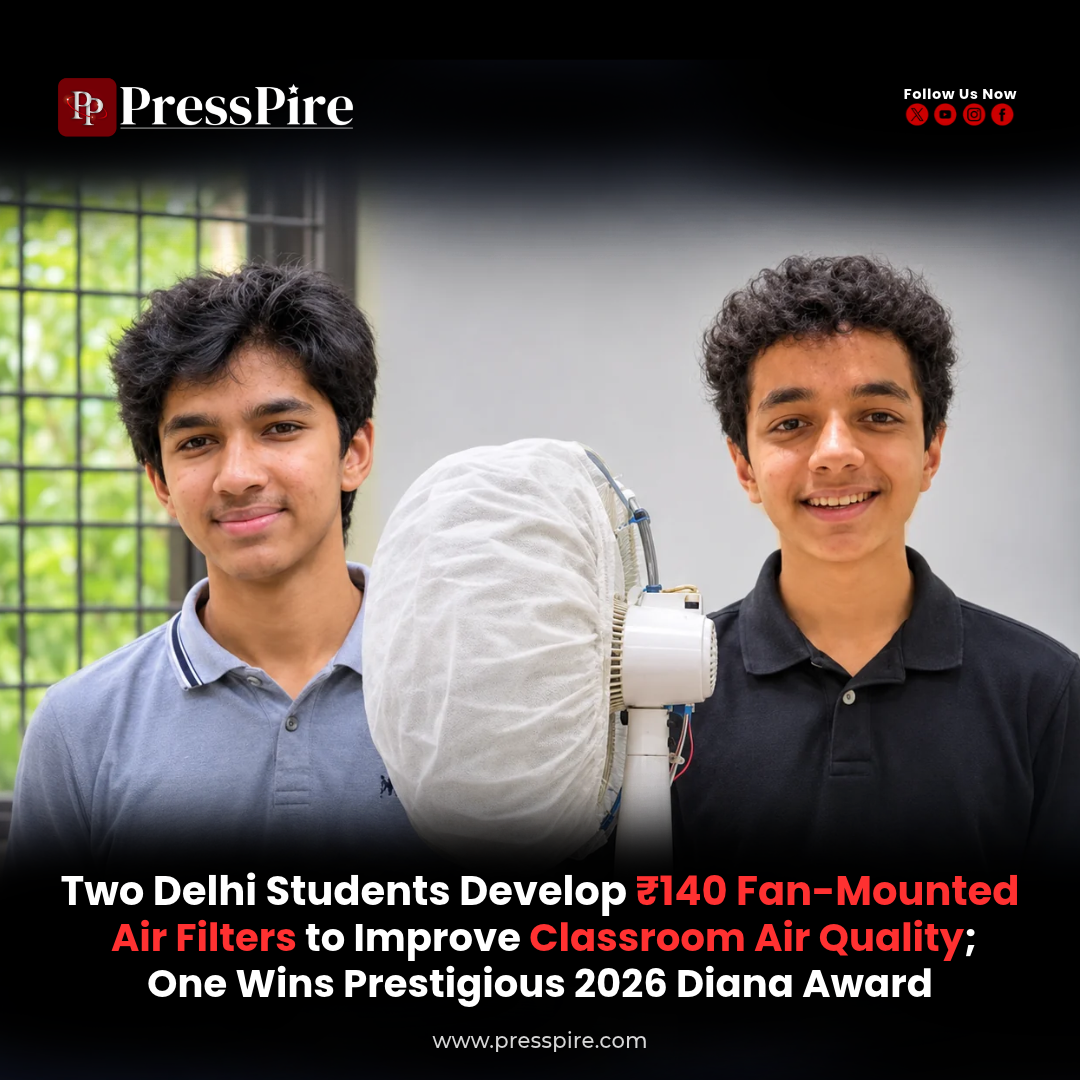
Two Delhi students, Krish Aggarwal and Samarth Meattle, have developed a low-cost approach to classroom air filtration through Project Vayu.
Their filter fits onto an existing table or wall fan and uses its airflow to capture airborne particles. The team puts the cost at approximately ₹140 per filter, while supplying filters free to participating schools.
Aggarwal has been named in the 2026 Diana Award Roll of Honour for his work. The award organisation’s profile says the initiative has benefited more than 10,000 students in schools with limited resources.
The Students Behind Project Vayu
Aggarwal is a Class 12 student at Sanskriti School, while Meattle is in Class 11 at Vasant Valley School, according to the initiative’s website.
Their work focuses on a practical affordability problem: schools that cannot invest in standalone air purifiers still need ways to address indoor particulate pollution.
The team’s website also credits Savya Meattle with early foundational work before he left to study at Stanford University.
The aim is to make filtration easier to introduce by adapting equipment schools may already have, supported by local manufacturing and free distribution.
How the Fan Filter Works
Project Vayu uses electret filter media, whose electrically charged fibres help attract and capture fine particles, including PM2.5.
The filter is designed for table and wall fans with protective grilles. An elastic edge holds it around the grille, and the fan’s airflow inflates the material into a balloon-like shape.
According to the team, the inflated design provides approximately five square feet of filtering surface. The existing fan supplies the airflow, so the filter does not need its own motor.
The concept combines particle-capturing material with a familiar appliance. Its effectiveness depends on how the complete fan-and-filter system performs in the room where it is used.
What the ₹140 Cost Includes
Project Vayu publishes the following breakdown for each filter:
| Component | Stated cost |
|---|---|
| Filter material | ₹85 |
| Elastic lining | ₹15 |
| Stitching and transportation | ₹40 |
| Total per filter | ₹140 |
The figure refers to the filter, including its stated production and transport costs. A complete classroom installation also depends on a suitable fan, electricity and replacement filters over time.
Schools receiving support are not charged this amount. The initiative says it provides filters free and can also supply fans where needed.
This distinction is central to the model: a low unit cost makes sponsored distribution easier, while free provision removes the immediate purchase cost for participating schools.
What the Reported Test Results Show
Project Vayu’s technology page describes a test in a closed room of approximately 168 square feet.
It reports that PM2.5 concentrations fell from 158 micrograms per cubic metre to 11 micrograms per cubic metre after 60 minutes—a reduction of approximately 93%.
These are results reported by the project under specific test conditions. They do not establish the same reduction in every occupied classroom.
Room size, airflow, outdoor pollution entering the building and the condition of the filter can affect performance. Measurements during normal school use would help show how consistently the system works across different classrooms.
The reported figures describe particle concentrations, rather than an AQI reading or a measured health outcome.
From a Classroom Pilot to Wider Reach
The initial Project Vayu pilot involved 602 filters across 295 classrooms, reaching approximately 8,000 students, according to the team’s published account and subsequent reporting.
The Diana Award’s official profile records a later reach of more than 10,000 students.
Those figures describe distribution and participation. Assessing the programme’s continuing effect also means understanding how regularly the filters are used and replaced.
A classroom programme needs dependable deliveries, working fans and cooperation from school staff. The project’s approach therefore includes ongoing support alongside the initial equipment.
Krish Aggarwal’s 2026 Diana Award Recognition
The official Roll of Honour recognises Aggarwal’s work through Project Vayu and his advocacy for evidence-based environmental action.
The Diana Award honours young people for social action and humanitarian work. In this case, the recognition highlights efforts to make classroom filtration more accessible to children in schools with fewer resources.
Aggarwal is the recipient named in the award listing. The initiative itself is a collaborative effort involving the student team, technical partners and participating schools.
The recognition brings attention to a practical question facing many community projects: how to make an intervention affordable enough to reach people who would otherwise struggle to access it.
Manufacturing, Materials and Replacement Filters
Project Vayu says it worked with filtration manufacturer Hollingsworth & Vose on research and development and received 700 metres of sponsored filter material.
The filters are manufactured at a Delhi workshop before being packaged and delivered.
The project’s published distribution model includes monthly replacement filters. This ongoing supply is an important part of the service because filters collect particles during use.
For organisers and sponsors, expansion therefore involves recurring material, production and transport requirements. The affordability of the first filter is one part of maintaining the programme over a school term.
For more insights navigate: PressPire | Stories That Shape the Future
Read previous article here : dehaat-success-story-founders-funding-farmers/
Follow PressPire on Facebook | Instagram | LinkedIn | YouTube
PressPire | Stories That Shape the Future