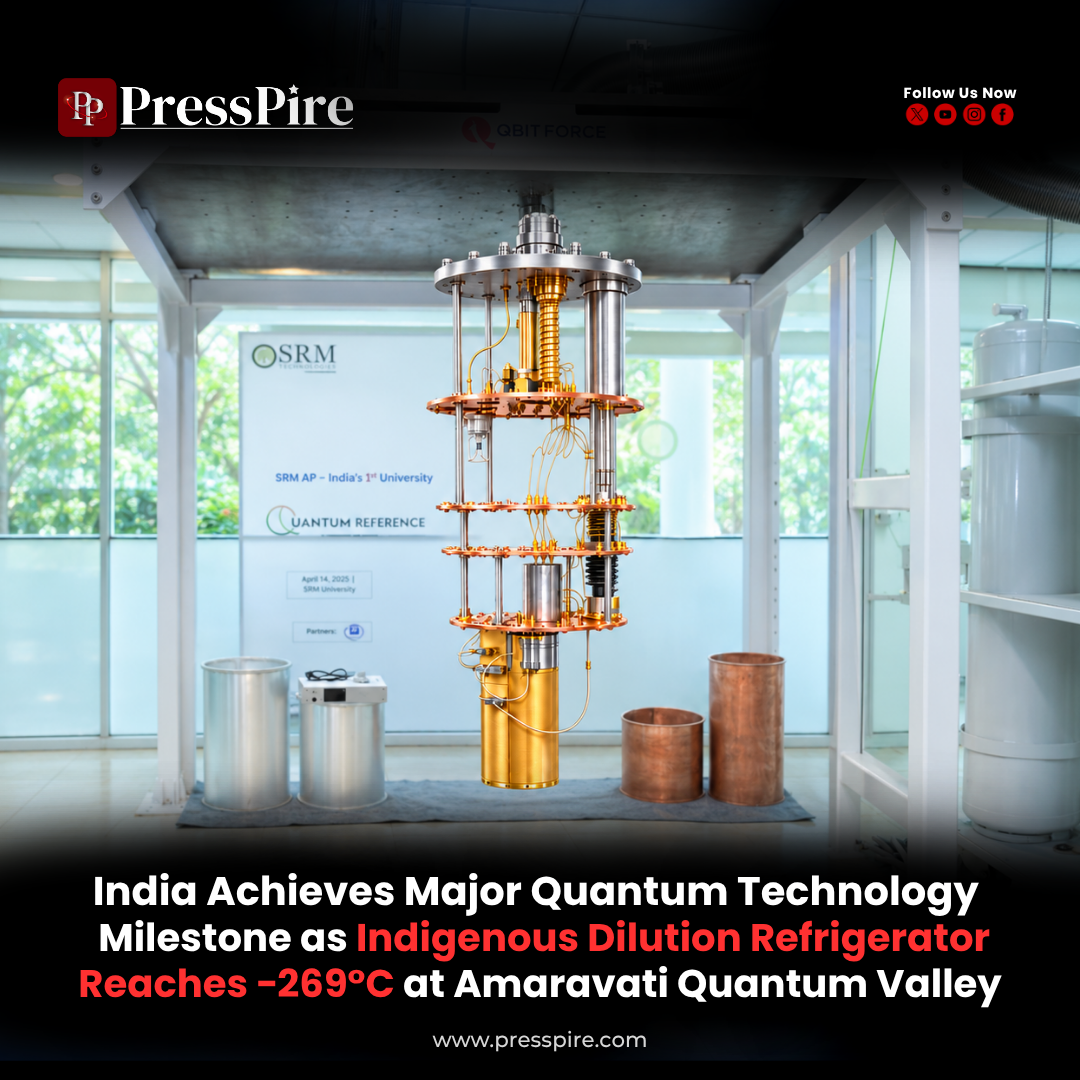
India’s Indigenous Dilution Refrigerator Hits −269°C at Amaravati Quantum Valley
Announced in June 2026, the 4-kelvin milestone demonstrated progress in locally developed cryogenic infrastructure for quantum hardware research.
An indigenous dilution refrigerator at Amaravati Quantum Valley reached 4 kelvin, approximately −269°C, marking a significant step in India’s efforts to develop the specialised equipment needed for quantum research.
The achievement, announced on June 19, 2026, was recorded at the Quantum Reference Facility in Medha Towers, Gannavaram, Andhra Pradesh. It highlighted progress in domestic cryogenic engineering and the creation of shared facilities where researchers can test quantum components.
The significance lies in building local engineering capability and access to testing. The initiative focused on developing and integrating equipment through a predominantly domestic supply chain.
What the Indigenous Dilution Refrigerator Achieved
Four kelvin is equivalent to −269.15°C, just four degrees above absolute zero. Reaching this temperature is an important stage in cooling equipment that will eventually operate at much lower temperatures.
For the indigenous dilution refrigerator, the June announcement documented progress through this initial cryogenic stage. It did not, by itself, demonstrate operation at the millikelvin temperatures commonly used for superconducting quantum processors.
The temperature scales help explain the difference:
| Temperature | Celsius equivalent | Meaning |
|---|---|---|
| 4 K | −269.15°C | The cooling milestone announced in June |
| 20 mK, or 0.020 K | −273.13°C | A millikelvin temperature used in advanced cryogenic testing |
| 0 K | −273.15°C | Absolute zero, the reference point of the Kelvin scale |
Although the Celsius values look close together, 4 K and 20 mK represent substantially different operating conditions. Reaching the latter requires additional cooling stages and careful control of incoming heat.
Why Superconducting Quantum Hardware Needs Extreme Cooling
Superconducting quantum processors use qubits whose behaviour can be disturbed by unwanted energy and environmental noise. Extremely low temperatures help reduce thermal excitation and provide conditions in which these devices can be controlled and measured.
The cooling system therefore works alongside shielding, electrical wiring, control electronics and measurement equipment. Each part must support the experiment without introducing excessive heat or interference.
Cooling performance is one part of a working quantum computer. Processor quality, control accuracy, readout and error management also determine what the machine can accomplish.
How an Indigenous Dilution Refrigerator Works
A dilution refrigerator combines several stages of cooling. Initial refrigeration brings the equipment into the few-kelvin range before lower-temperature processes take over.
The deepest cooling stage uses two isotopes of helium: helium-3 and helium-4. At sufficiently low temperatures, their mixture separates into phases with different concentrations of helium-3.
When helium-3 moves from the concentrated phase into the dilute phase, it absorbs heat. Continuous circulation allows the system to keep removing heat from the experimental environment.
Vacuum insulation, radiation shields and heat exchangers help limit unwanted heat entering the colder stages. This is why successful cryogenic engineering involves the complete system, including its mechanical construction and gas-handling equipment.
A Shared Testbed for Indian Researchers and Startups
The indigenous dilution refrigerator forms part of a wider effort to give Indian research teams access to equipment for testing and validating quantum hardware.
Amaravati Quantum Valley worked with Qbit Force and Qubitech on identifying domestic hardware-development opportunities. Quantum Reference Facilities were established at Medha Towers and SRM University-AP in April 2026.
These facilities are intended to support startups, universities, research laboratories and industry partners. Depending on the temperature and experimental configuration, relevant work includes:
- Testing superconducting devices and resonators.
- Characterising cryogenic electronics, wiring and interconnects.
- Evaluating quantum sensors and suitable photon detectors.
- Integrating control and readout electronics with experimental hardware.
Shared access can help teams examine how a component behaves inside a working system before committing to a larger design. It also creates opportunities for hands-on training in measurement, calibration and troubleshooting.
Building a Domestic Quantum Hardware Supply Chain
Developing an indigenous dilution refrigerator requires expertise across precision fabrication, vacuum engineering, cryogenics, electronics and software.
SRM University-AP describes the Amaravati reference platforms as designed, assembled and tested in India, with a predominantly domestic supply chain involving seven institutions across six cities.
That description is more specific than a claim of complete independence from imported equipment. Local development can include domestic design, manufacturing and integration while selected specialist inputs continue to come from international suppliers.
The industrial opportunity extends to individual components. An Indian company developing a sensor, connector, power supply or control module needs evidence that its product performs reliably under the conditions its customers require.
Access to a functioning testbed can support that evaluation and give developers feedback for subsequent designs.
How the Project Fits India’s National Quantum Mission
An indigenous dilution refrigerator supports the research infrastructure needed for parts of India’s wider quantum programme.
The Union Cabinet approved the National Quantum Mission on April 19, 2023, with an outlay of ₹6,003.65 crore for 2023–24 to 2030–31. Its scope includes quantum computing, communication, sensing, metrology, materials and devices.
The mission’s objectives include developing intermediate-scale quantum computers across different technologies. The announced funding covers the wider national programme and should not be treated as the budget of the Amaravati refrigeration project.
Facilities that help researchers test locally developed hardware can contribute to these goals by connecting scientific work with engineering, manufacturing and workforce development.
Later Operator Information Describes 20 mK Capability
Qubitech’s current website separately describes its QU-414 Quantum Reference Facility at Medha HiTech City, Gannavaram, as operating with a base temperature of 20 millikelvin.
The company advertises access for hardware characterisation, component validation and supervised work on a superconducting quantum system. These are operator-reported capabilities.
The June announcement documented 4 K, while the current facility description reports a lower operating temperature. Keeping those disclosures separate makes the development timeline clearer.
Operating an indigenous dilution refrigerator at millikelvin temperatures requires sustained thermal control and reliable measurements, especially when experimental devices and their connections introduce additional heat.
What Will Determine Its Long-Term Impact?
The long-term value of an indigenous dilution refrigerator will depend on how consistently it supports useful research.
For prospective users, relevant performance measures include temperature stability, cooling capacity under load, measurement noise, repeatability and the time needed to prepare a new experiment.
For the domestic industry, accessible testing, dependable maintenance and documented results could be especially valuable. They would help researchers improve devices and give manufacturers evidence about the performance of their components.
The practical opportunity is to turn local engineering capability into infrastructure that universities, laboratories and startups can use repeatedly as they develop more capable quantum hardware.
For more insights navigate: PressPire | Stories That Shape the Future
Read previous article here : mangaluru-lpg-cavern-devangonthi-terminal/
Follow PressPire on Facebook | Instagram | LinkedIn | YouTube
PressPire | Stories That Shape the Future