
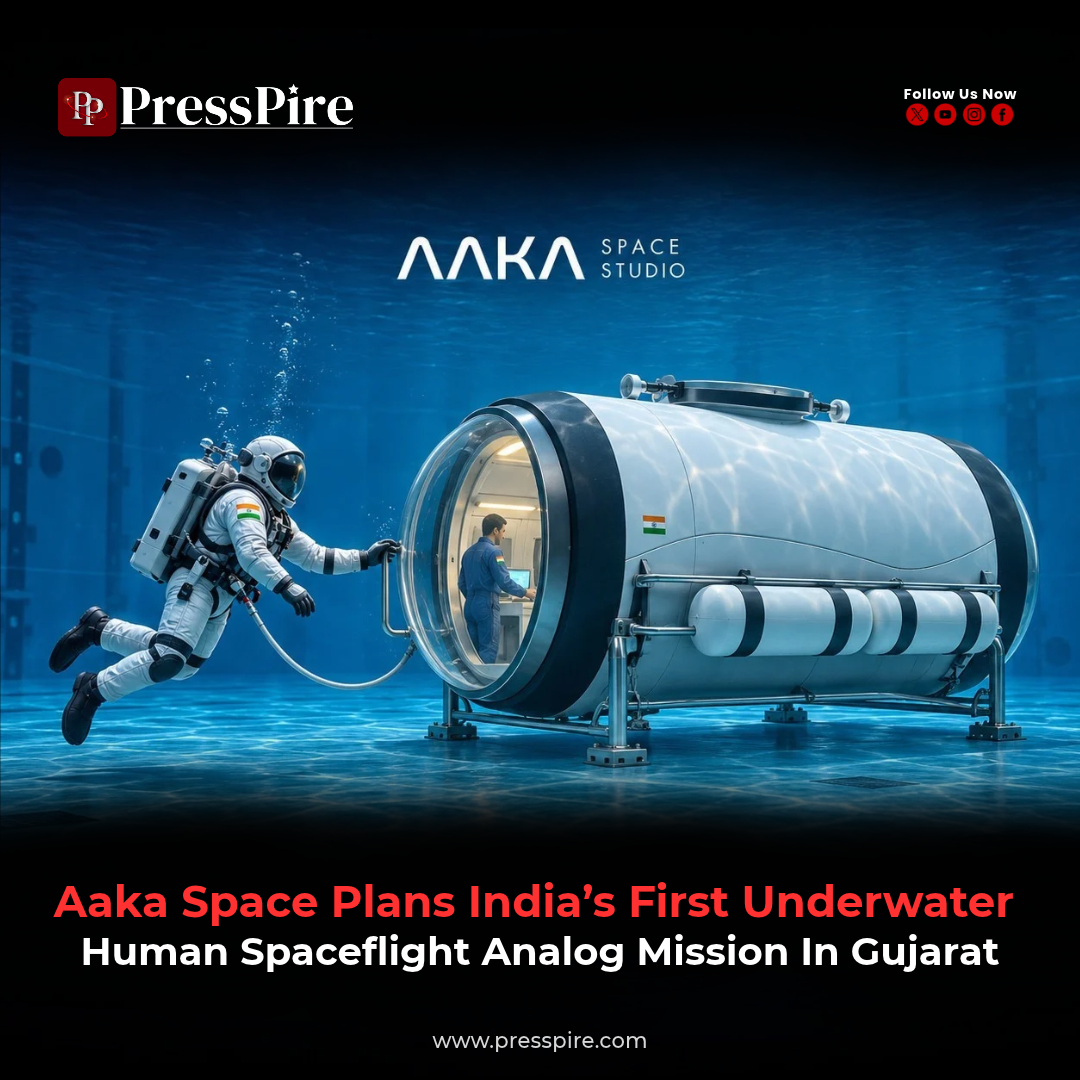
AAKA Space Plans Underwater Mission in Gujarat to Simulate Life in Space
The startup’s proposed habitat programme would use an Earth-based environment to study challenges associated with living and working in space.
AAKA Space is planning what The New Indian Express describes as India’s first underwater human spaceflight analog mission, beginning with a trial in Gujarat.
The company aims to develop a habitat for studying the operational demands and human challenges of spaceflight. An analog mission is an Earth-based exercise that reproduces selected conditions relevant to space exploration, allowing researchers to test equipment, procedures and human performance.
AAKA Space Underwater Mission: The Proposed Timeline
The report, published on 18 October 2026, outlines a two-stage programme.
| Stage | Proposed timing | Duration | Location |
|---|---|---|---|
| Initial trial | December 2026 | 24 hours | Controlled environment in Gujarat |
| Follow-up mission | March 2027 | 72 hours | Yet to be finalised |
The schedule describes planned trials. The report does not provide a final crew list or identify the precise site in Gujarat.
What Is an Underwater Spaceflight Analog?
An analog provides a practical setting for investigating questions that would be difficult to explore for the first time during a space mission.
Researchers can examine how people organise tasks, interact with equipment and adapt to an unfamiliar environment. The objective is to identify problems early and improve the design of systems and procedures.
ISRO describes ground-based analog missions as a way to study human health and performance risks. The agency’s work in this area includes physiological, psychological and operational research relevant to future human exploration.
An underwater habitat adds a particular challenge: the surrounding environment cannot support normal human living without protective infrastructure. That makes the relationship between people, equipment and mission support central to the exercise.
Why Use an Underwater Environment?
Underwater missions have an established place in space research.
NASA’s Extreme Environment Mission Operations programme, known as NEEMO, has used the Aquarius underwater research habitat near Florida to bring astronauts, engineers and scientists into an environment suitable for rehearsing aspects of space exploration.
Its activities have included living in a confined habitat and testing techniques relevant to spacewalks. NASA has also used carefully adjusted buoyancy and weights to simulate aspects of movement under different gravity conditions.
For AAKA Space, the proposed underwater programme would add another environment to its analog research work. The practical value would come from the observations and operational lessons produced during the trials.
Underwater Simulation Has Limits
An underwater experiment does not recreate orbital microgravity.
Buoyancy can balance a person’s or an object’s weight in water, helping researchers simulate selected movements. Gravity still acts on the body, however, and water resists motion.
NASA’s descriptions of neutral-buoyancy training explain this distinction. Moving through water creates drag, while astronauts moving in space face different challenges when trying to stop or remain in position. Water pressure also changes with depth.
These differences matter when interpreting results. An underwater test may help assess a procedure or equipment layout, but its findings need to be evaluated against the conditions of the intended space mission.
The Startup Behind the Programme
AAKA Space identifies Aastha Jhala as its founder. Its work spans space architecture, habitat design and analog mission operations.
The company’s published mission history includes expeditions in the salt desert of Kutch and a 21-day high-altitude mission in Ladakh. These programmes have explored habitat operations, isolation, field activities and adaptation to demanding conditions.
The environments offer different research opportunities. A desert expedition can examine field operations and resource constraints, while a high-altitude setting introduces another combination of environmental pressures.
The proposed underwater work would broaden that experience, bringing habitat engineering and human performance into a setting with its own operational requirements.
Habitat Design Is More Than Building a Chamber
AAKA Space’s architecture portfolio covers life support, power, communications and the way people interact with equipment. It also lists underwater habitat concepts.
Those areas point to a broader design problem: a habitat must support both human living and useful work.
For example, an equipment control may function correctly but still be difficult to reach. A work area may need to accommodate several activities without interfering with movement. Communication arrangements must allow the crew and support team to understand what is happening.
These are examples of the questions that habitat trials can investigate. They are not a confirmed list of experiments for the Gujarat mission.
Relevance to India’s Human Spaceflight Research
India’s analog research programmes provide context for the proposal.
ISRO’s Human Space Flight Centre led the Ladakh Human Analog Mission in November 2024. The agency subsequently described further analog work as a way to develop knowledge about crew workflows, environmental adaptation and technology performance.
The purpose of such research is to turn observations into practical improvements: better procedures, more suitable infrastructure and a clearer understanding of how people perform in demanding conditions.
AAKA Space’s underwater initiative could contribute to that wider field if it produces useful, well-documented results. Its relevance will depend on the research design and findings.
What to Watch Next
The next useful updates would explain the habitat configuration, crew selection, research objectives and arrangements for conducting the trials.
For a programme centred on human performance, mission duration is only one measure of progress. The quality of the observations and the changes made after testing will help determine its value.
For more insights navigate: PressPire | Stories That Shape the Future
Read previous article here : rapidcanvas-29-million-series-b-enterprise-ai/
Follow PressPire on Facebook | Instagram | LinkedIn | YouTube
PressPire | Stories That Shape the Future