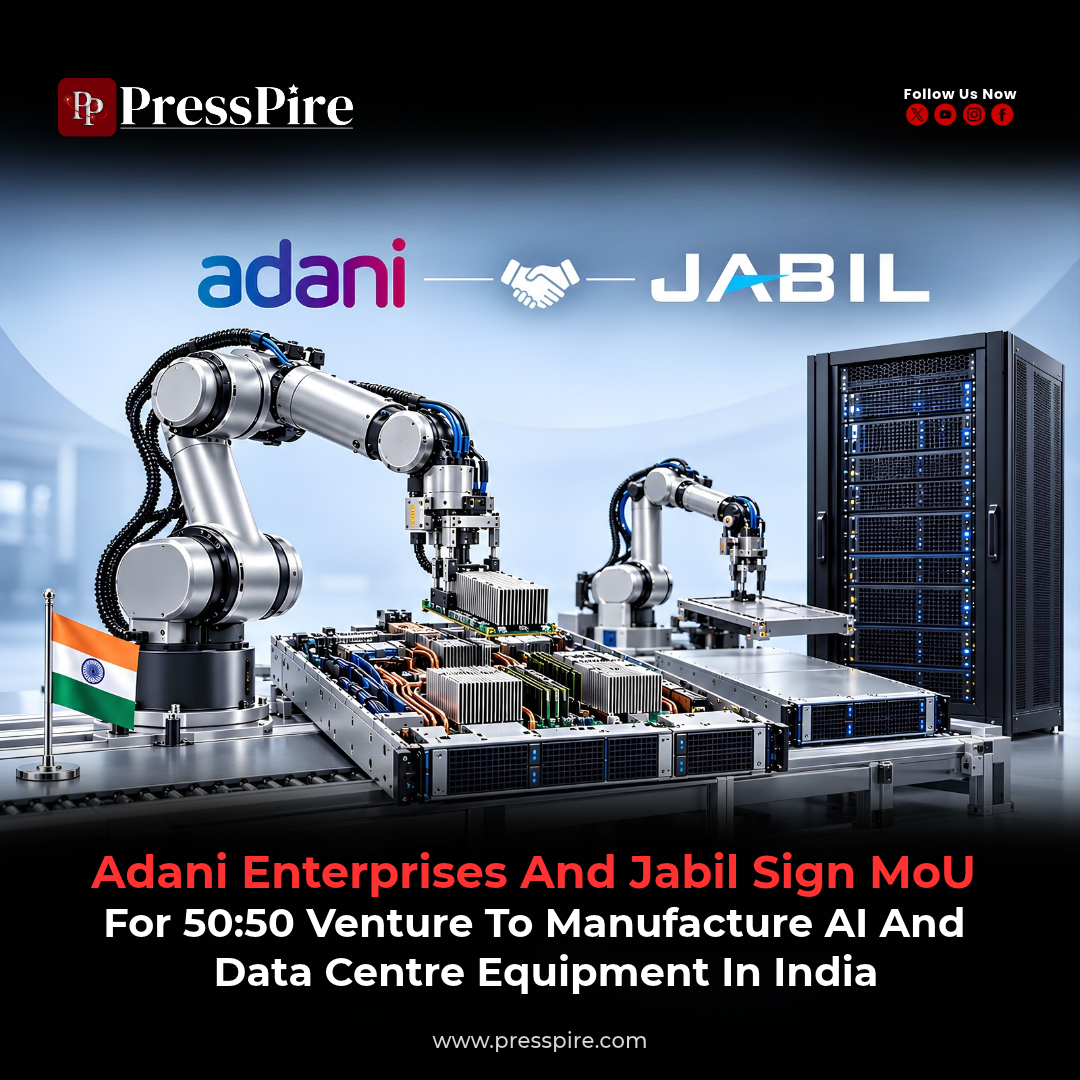
Adani Enterprises and Jabil Sign MoU for 50:50 AI Hardware Venture in India
The proposed partnership would combine Jabil’s manufacturing expertise with Adani’s infrastructure capabilities to supply equipment for Indian and global data centres.
The proposed Adani Jabil joint venture would manufacture and assemble artificial intelligence and data centre equipment in India, following a non-binding memorandum of understanding between Adani Enterprises and US-based Jabil.
Announced on 13 October 2026, the arrangement outlines equal ownership of a business intended to supply the physical systems behind advanced computing. Establishing the venture remains subject to definitive agreements, applicable approvals and customary conditions.
The proposal builds on the companies’ June 2026 announcement of plans for a strategic alliance. It connects two areas of the AI economy: developing the infrastructure that hosts computing systems and manufacturing the equipment installed inside them.
What the Adani Jabil Joint Venture Would Manufacture
The planned product range covers computing equipment and the systems needed to keep it operating.
| Equipment | Role in a data centre |
|---|---|
| AI racks and servers | House and run the computing systems used for AI and other digital services. |
| Storage equipment | Holds the data used and produced by computing workloads. |
| Networking equipment | Connects servers and allows information to move between systems. |
| Power equipment | Distributes electricity to equipment and supports its electrical requirements. |
| Cooling systems | Removes heat so computing equipment can operate reliably. |
The companies are targeting multi-gigawatt AI rack manufacturing capacity. This refers to racks supporting computing systems with a combined power capacity of several gigawatts. The proposed business would also offer installation and commissioning services.
Its intended customers include large cloud providers, specialist AI cloud businesses, data centre operators and enterprises, with both domestic sales and exports in view.
Why Complete Rack Systems Matter
An AI rack brings together several interdependent components. Servers need connections to other machines, a suitable power supply and cooling that can handle the heat they produce.
Jabil’s existing data centre business works at this integrated level. Its published capabilities include combining computing, storage, networking, power and cooling equipment, followed by testing at both server and rack level.
That provides a practical explanation for the proposed venture’s broad scope. Delivering a working system requires attention to how individual parts perform together, as well as the quality of each component.
The potential benefit for customers is a more coordinated route from manufacturing to deployment. Whether that translates into shorter delivery times or lower costs will depend on the final products, commercial terms and execution.
Power and Cooling Are Central to AI Infrastructure
As more computing equipment is concentrated into a limited space, managing heat becomes increasingly important. Cooling affects the ability of a facility to keep equipment running and use energy efficiently.
The engineering challenge extends beyond the server. Heat must move through a cooling system and ultimately be removed from the facility. Electrical equipment must also deliver power reliably across the installation.
Jabil’s thermal management operations already cover equipment such as chillers and integrated cooling systems for data centres. Its rack-level capabilities include liquid cooling components and coolant distribution equipment.
These existing capabilities help explain why power and cooling feature prominently in the proposed Indian manufacturing business. Building AI infrastructure requires coordinated electrical, mechanical and computing engineering.
What Adani and Jabil Bring to the Partnership
The companies’ June alliance announcement outlined complementary roles.
Jabil contributes engineering, supply-chain management and manufacturing experience, including work on equipment for large data centre customers. Adani brings its energy businesses, logistics network, infrastructure development experience and data centre presence.
The June plan also described manufacturing techniques used to assemble electronic boards and integrate them into finished systems. Its ambition extended from production to deployment, giving customers access to several connected hardware requirements through one manufacturing platform.
For the proposed business, the commercial task will be to turn those capabilities into products that meet customer specifications, arrive on schedule and can be supported after installation.
Jabil Already Has a Manufacturing Presence in India
Jabil’s involvement comes alongside an expansion of its existing Indian operations.
In June 2026, the company announced a new factory in Pune. It said its Indian manufacturing footprint had increased from approximately 500,000 square feet to 1.2 million square feet over the preceding year, while regional employment had grown from 5,000 to nearly 11,000 people.
Those figures describe Jabil’s wider operations at the time of that announcement. The October MoU does not identify the Pune factory as the location of the proposed joint venture.
The existing footprint provides relevant background on Jabil’s experience operating in India, while the new partnership’s manufacturing arrangements still require further detail.
How the Plan Fits Adani’s Data Centre Strategy
Adani’s interest in manufacturing sits alongside a much larger infrastructure programme.
On 17 February 2026, the group announced a $100 billion commitment to develop renewable-energy-powered, AI-ready data centres by 2035. That announcement set out a roadmap towards 5 GW of data centre capacity.
It also described plans to support domestic production of equipment such as transformers, power electronics and thermal management systems. The proposed Jabil partnership fits that stated direction by adding a manufacturing role to Adani’s energy and data centre activities.
The $100 billion figure belongs to Adani’s broader programme. It is not a disclosed investment amount for the proposed Adani Jabil joint venture.
Details Still to Be Announced
The October statement does not specify the venture’s investment amount, manufacturing location or production start date.
These details will help determine how the proposal moves into execution. Further milestones would include final agreements, required approvals, factory preparation, customer qualification and commercial deliveries.
For potential buyers, a manufacturing plan becomes useful when it produces equipment that meets technical requirements consistently. Product quality, reliable delivery and ongoing support will therefore matter alongside the scale of the announced ambition.
For more insights navigate: PressPire | Stories That Shape the Future
Read previous article here : culture-circle-ccnow-luxury-delivery-delhi-ncr/
Follow PressPire on Facebook | Instagram | LinkedIn | YouTube
PressPire | Stories That Shape the Future