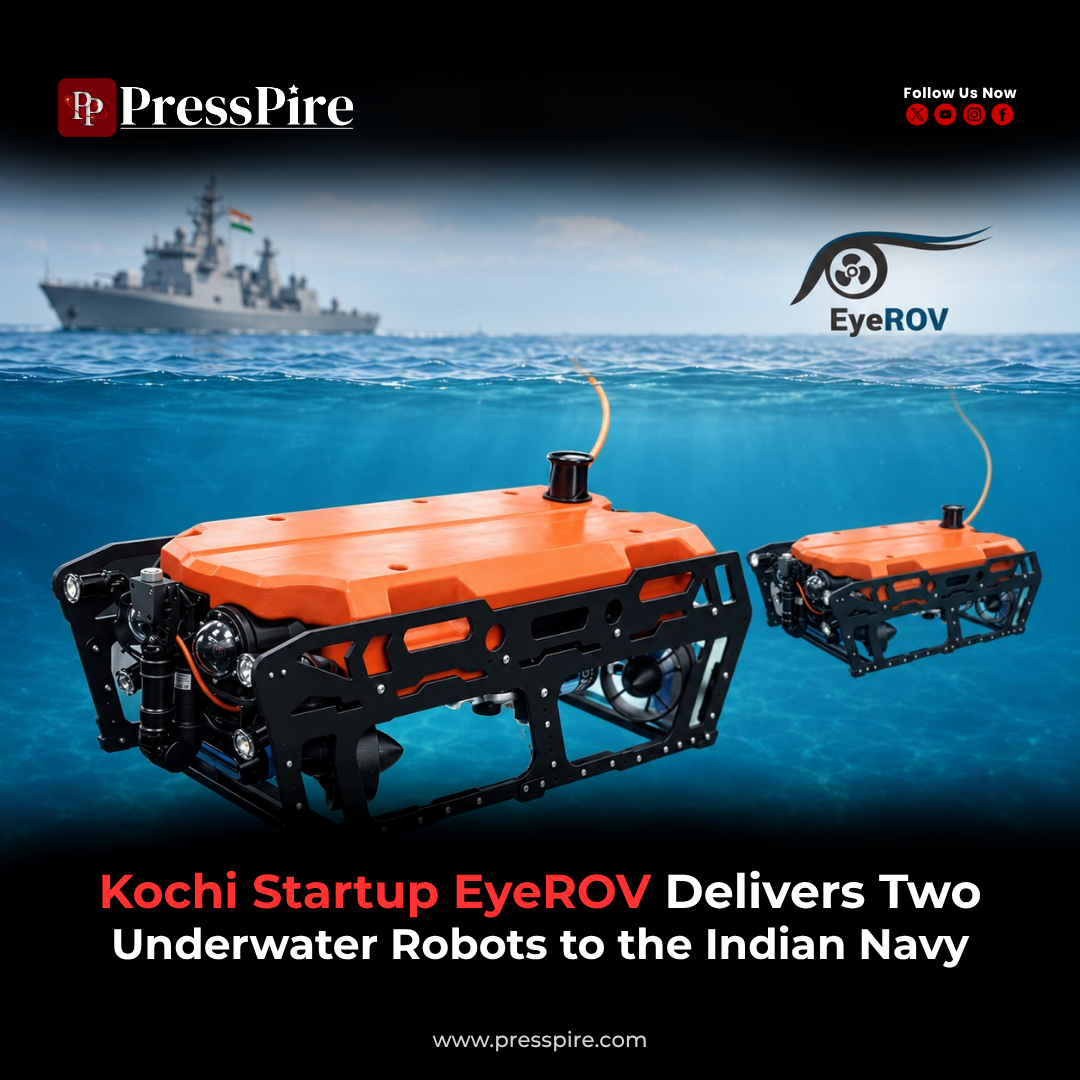
Kochi Startup EyeROV Delivers Two Underwater Robots to the Indian Navy
The two TROUT systems form part of a five-system order, marking a delivery milestone for the Kerala company’s underwater robotics business.
Information checked: 12 October 2026
Kochi-based marine robotics startup EyeROV has delivered two EyeROV TROUT underwater remotely operated vehicle systems to the Indian Navy. The company confirmed that the delivery is part of a programme covering five systems.
The development, reported on 7 October 2026, marks progress from designing and testing an Indian-built underwater platform to supplying equipment for naval use.
EyeROV describes TROUT as a military-grade system. Its delivery brings attention to the specialised engineering needed to build machines that can be controlled and used effectively below the water’s surface.
Two Systems Delivered Under a Larger Navy Order
The latest announcement covers two systems within the Navy’s five-system programme.
EyeROV’s underwater robotics business had secured a ₹47 crore contract from the Indian Navy, reported in September 2025. The company also identifies that contract in its public corporate profile.
The contract value provides commercial context for the relationship. It should not be treated as the price paid exclusively for the two recently delivered robots.
For a hardware startup, fulfilling an order requires manufacturing, testing, documentation and customer support alongside product development. The delivery is therefore a business milestone as well as an engineering one.
The announcement reviewed does not specify when the remaining three systems will be handed over.
How EyeROV TROUT Works Underwater
TROUT is a remotely operated vehicle, or ROV. An operator controls the underwater machine through a connected system, using information from its cameras and instruments.
EyeROV’s published product specifications describe a platform rated for depths of 300 metres, with a tether and a piloting interface that brings camera feeds and operating data together.
The manufacturer lists the following features for the TROUT platform:
| Feature | Published description |
|---|---|
| Depth rating | 300 metres |
| Cameras | Dual HD/4K cameras with 10x zoom |
| Movement | Six degrees of freedom |
| Lighting | 6,000-lumen lighting system |
| Tether | 400-metre neutrally buoyant tether |
Six degrees of freedom refers to control over movement and rotation along three axes. In practical terms, it helps explain how the vehicle can change position and orientation underwater.
These are the manufacturer’s public platform specifications. They do not disclose every detail of the configuration supplied to the Navy.
The term “remotely operated” is also important: the delivery announcement should not be read as confirmation that these robots independently conduct fully autonomous missions.
Supporting Inspection and Underwater Operations
EyeROV’s defence offering covers underwater surveillance, reconnaissance and search-and-rescue applications. Its broader services also include collecting inspection data and examining submerged structures.
The practical value of an ROV is that a team can observe and assess an underwater area while controlling the vehicle from elsewhere. That can support work in locations where direct access is difficult.
For inspection tasks, the useful output is the information collected: images, measurements and a record of the area examined. That information can help personnel decide whether further investigation or intervention is needed.
The role of robotics is therefore closely connected to the quality of the data and the operator’s ability to interpret it. Sending a vehicle underwater is only one part of completing a useful inspection.
Development Through the iDEX Programme
According to the delivery announcement reported by The New Indian Express, EyeROV TROUT was developed under the iDEX DISC 7 SPRINT Challenge, with the Indian Navy serving as the nodal agency.
iDEX stands for Innovations for Defence Excellence. It provides a framework for bringing businesses and innovators into defence technology development.
The wider SPRINT initiative was unveiled in July 2022 to encourage the use of indigenous technology in the Navy. At its launch, the government outlined an ambition to introduce at least 75 new domestically developed technologies or products.
EyeROV’s delivery illustrates one company’s progress through that development environment. It connects an identified defence requirement with engineering work and the subsequent supply of equipment.
Testing and Qualification for Naval Use
Delivery coverage states that TROUT underwent field trials covering movement, depth capability, navigation, endurance, operator control and performance in underwater currents.
The company also reported work under the Directorate of Quality Assurance (Naval) framework, environmental stress screening requirements and applicable military standards. It said the system completed type testing to check whether the design met specifications under defined conditions.
Those statements describe the qualification process reported for the platform. Detailed test results and the Navy’s full acceptance documentation were not included in the public materials reviewed.
For readers, the distinction matters because a depth rating alone cannot describe overall performance. A useful underwater system must combine movement, sensing, communication and control into equipment that personnel can operate reliably.
The Kochi Company Behind the Robots
EyeROV was founded in 2016 by Johns T. Mathai and Kannappa Palaniappan. Its official website identifies Mathai as CEO and Palaniappan as CTO.
The company’s work extends beyond naval equipment. Its website describes underwater inspection services for dams, tunnels, pipelines, bridges and offshore energy infrastructure.
Its wider product portfolio includes the TUNA ROV, TROUT and the iBOAT ALPHA surface vehicle. EyeROV also offers software for visualising and analysing inspection data.
This combination places the business across equipment, software and field services. Commercially, those activities can support different customer needs: some organisations need their own robotic systems, while others need a specific underwater asset inspected.
Why the Delivery Matters for Indian Deeptech
The significance of the Navy delivery lies in the transition from development work to supplying a demanding customer.
Domestic design and engineering can give customers closer access to the people responsible for a system. That may help with maintenance, training and future modifications, depending on the support arrangements in place.
For EyeROV, the next stage involves completing the announced programme and supporting the equipment already delivered. Consistent manufacturing and dependable service will matter alongside technical capability.
The handover of two TROUT systems provides a concrete milestone for the Kochi startup. Its longer-term commercial progress will depend on how effectively it fulfils the remaining order and supports customers throughout the equipment’s working life.
For more insights navigate: PressPire | Stories That Shape the Future
Read previous article here : slayrobe-ai-styling-app-women/
Follow PressPire on Facebook | Instagram | LinkedIn | YouTube
PressPire | Stories That Shape the Future