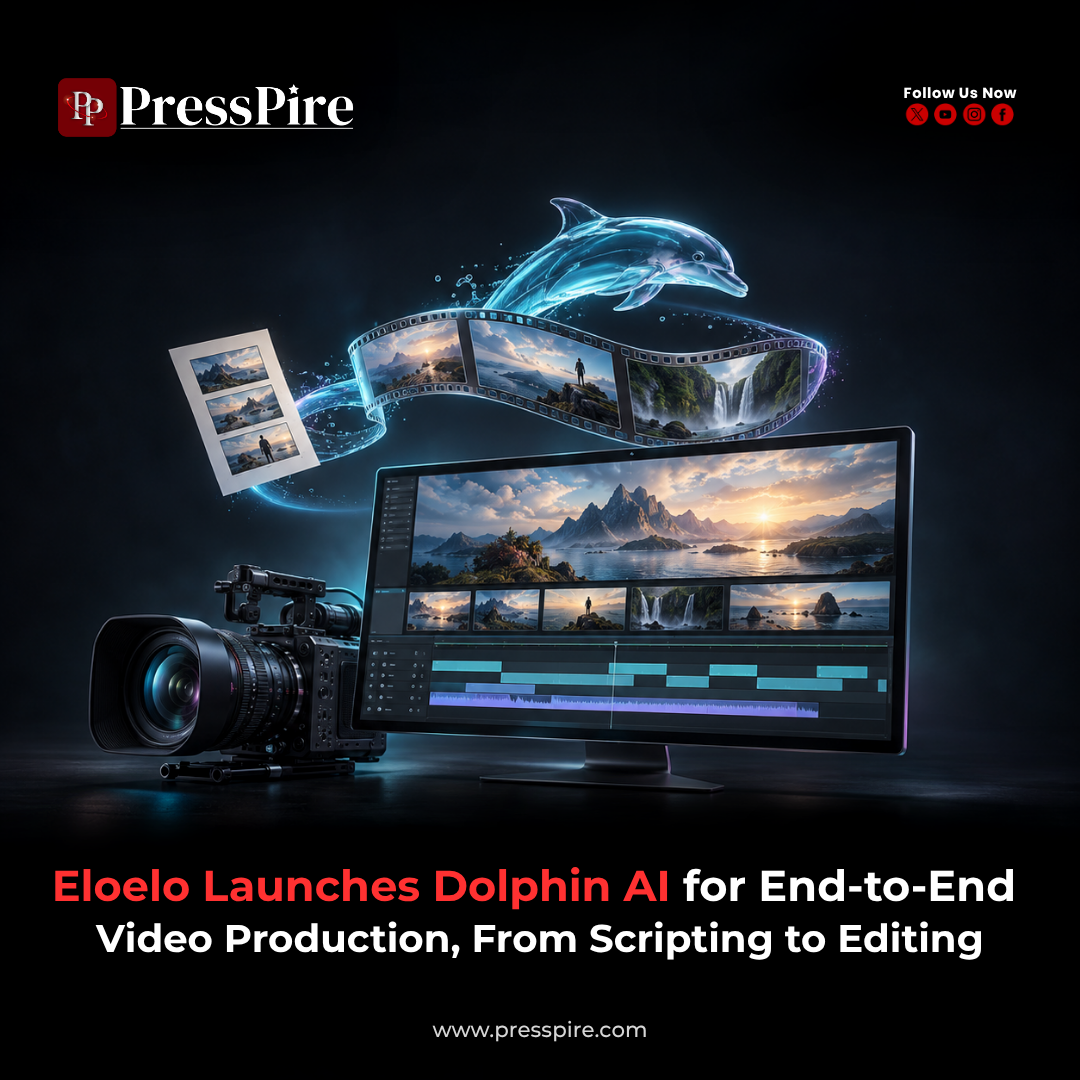
Eloelo Launches Dolphin AI for Video Production, From Scripting to Editing
The Indian entertainment technology company is opening its AI production platform to creators, filmmakers, brands and studios, with tools for planning, generating and editing videos.
Dolphin AI, a video production platform from Eloelo Group, aims to bring scripting, shot planning, visual generation, audio and editing into a connected workspace. The company unveiled the product on 29 September 2026 at FICCI FRAMES in Mumbai, where founder and CEO Saurabh Pandey introduced it during his keynote.
Developed initially for Eloelo’s own content operations, the platform is now being offered to external creators and production teams. Its central promise is to help users build a coherent video while maintaining the characters, settings and creative choices established at the start.
What Is Dolphin AI?
Eloelo describes Dolphin AI as an agentic AI studio. In practical terms, that means software designed to organise several production tasks around a creator’s instructions.
A user supplies an idea or script, and the system helps break the project into shots and coordinate their creation. Editing and enhancement tools sit within the same environment.
This approach addresses a practical production problem: a finished video needs its visuals, dialogue, sound and sequence to work together. A collection of individually impressive scenes can still require substantial work before it tells a clear story.
Built From Eloelo’s Own Production Experience
According to Eloelo, the group has produced more than 5,000 original dramas through Story TV, while its teams test over 100,000 creative assets each month. These figures describe the company’s wider content operations; they do not mean Dolphin AI independently generated every drama or asset.
The company says that operating at this scale exposed difficulties in making AI video reliable across a complete production. It developed internal workflows to make revisions easier and preserve context as projects moved between stages.
For Eloelo, opening that technology to other businesses creates a potential product opportunity around tools originally built for its own teams. The commercial test will be whether those tools solve comparable problems for customers with different styles, budgets and production requirements.
How Dolphin AI Supports Video Creation
The platform offers several ways to approach a project, depending on how much guidance or detailed control the creator needs.
| Tool or interface | Intended role |
|---|---|
| Chat | Create and revise content using natural-language instructions |
| Templates | Start with a guided format for a particular type of video |
| Playground | Control and refine individual shots |
| Film Studio | Organise a script into a production containing multiple shots |
| Editing and enhancement tools | Refine generated material within the production environment |
These interfaces give users different entry points into the production process.
Dolphin’s public website promotes workflows for videos of up to 60 seconds from a single prompt, with voiceover and music. It also highlights templates for formats such as product advertising, podcasts and lip-sync videos.
For example, a small business could use a product-ad template to establish its initial format, then refine the presentation through instructions and editing. This illustrates a possible use of the advertised tools, rather than a measured result from a customer campaign.
Film Studio Turns Scripts Into a Production Plan
Film Studio is designed to interpret a script before generating its individual scenes. According to Eloelo’s launch announcement, it examines the story’s premise, tone, timeline and character development.
It also identifies recurring characters, locations and props, then prepares visual, voice and wardrobe assets that creators can review and lock for reuse.
That review stage matters. If a character is supposed to appear throughout a story, establishing the character’s appearance and voice early gives subsequent scenes a shared reference.
The practical aim is to reduce the amount of information a creator must repeatedly specify while keeping the project’s creative direction consistent.
Keeping Characters and Scenes Consistent
Continuity is a major part of Dolphin AI’s positioning. Eloelo says its planning systems are designed to preserve characters, voices, clothing, props, locations and visual style across shots.
Consider a short fictional scene in which a character enters a room, picks up an object and speaks. The audience expects the same person, clothing and object to remain recognisable when the camera angle changes.
When those details shift unexpectedly, an editor may need to regenerate material or adjust the sequence. Better continuity could reduce that rework, although the actual benefit will depend on the complexity of the scene and the quality of the output.
Multiple AI Models and Connections to Other Tools
Eloelo’s approach also involves coordinating different AI models. CTO Sagar Gaonkar has described the production system as a way to interpret creative intent, divide the work and use suitable models for individual tasks.
Dolphin AI supports the Model Context Protocol, or MCP, which lets compatible AI applications access external tools. Its documentation describes connections that allow an AI assistant to request images, videos and speech through Dolphin.
For teams already using compatible assistants, this could make media generation part of an existing workflow. The documentation also describes shared workspace credits and the ability to check a generation task’s cost.
These connections require a Dolphin account and the appropriate setup; compatibility should not be confused with automatic access for every user of an AI assistant.
What It Could Mean for Creators and Brands
For a brand, the potential value lies in being able to revise a message, explore a visual concept or produce another version of an advertisement with fewer disconnected production steps.
For an independent creator, a connected workspace could make it easier to manage a project that would otherwise require several tools. For a studio, the opportunity may lie in repeatable tasks across a larger production.
These are potential benefits of the workflow. The launch material does not establish a universal reduction in cost or production time.
Creative judgement also remains central. Teams still need to decide whether a script works, whether a scene communicates the intended message and whether the finished video meets their standards.
Access, Pricing and the Next Stage
At launch, Dolphin AI offered early access through a waitlist or invitation code.
Its public integration documentation describes credit-based billing, with generation costs varying by model, resolution and duration. That means the cost of a project depends on its production choices, including the number of versions generated. A simple clip and a project requiring repeated revisions may consume different amounts of credit.
The launch gives Eloelo a way to turn its production experience into software for a wider market. Adoption will depend on how reliably Dolphin AI carries a creator’s intent through planning, generation and editing—and how much work remains before the final video is ready to publish.
For more insights navigate: PressPire | Stories That Shape the Future
Read previous article here : sunfox-funding-series-a-cardiac-diagnostics-2/
Follow PressPire on Facebook | Instagram | LinkedIn | YouTube
PressPire | Stories That Shape the Future