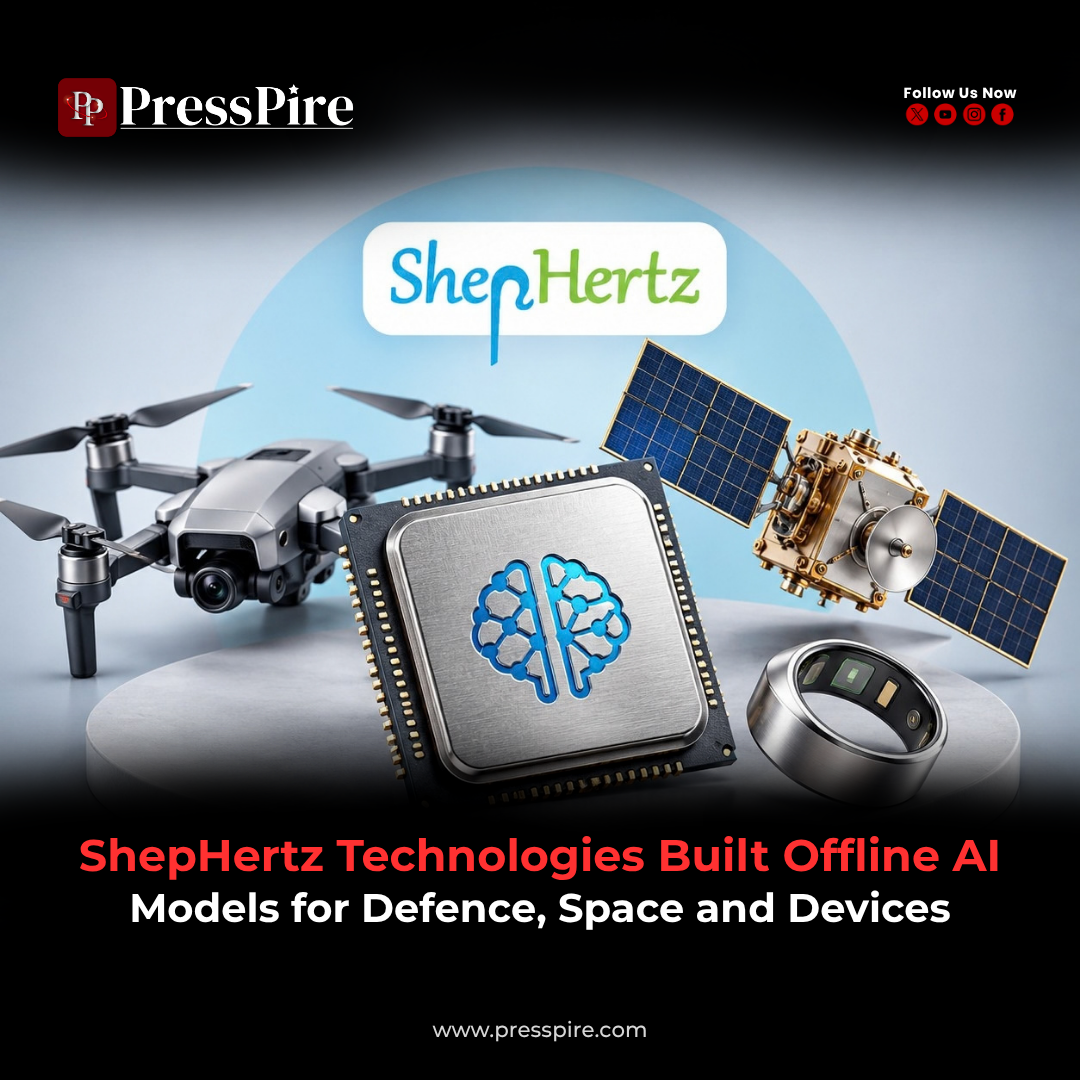
ShepHertz Unveils Offline AI Models for Defence, Space and Smart Devices
Tatva, Sanjaya and Drashta target machine commands, telemetry monitoring and image analysis without a cloud connection, with human approval built into consequential decisions.
ShepHertz Technologies has unveiled three India-built AI model families designed to operate without a cloud connection: Tatva, Sanjaya and Drashta. Announced at Drone Expo 2026 at Yashobhoomi in New Delhi, the models form part of the company’s AgentAnywhere platform and target machines working with limited computing resources or restricted connectivity.
The company’s announcement, dated 30 September 2026, covers applications across defence, space, industrial equipment and personal devices. Their development stages differ: Tatva Edge is in private preview, while Sanjaya and Drashta are being offered through design partnerships.
Why Offline AI Matters
The premise behind ShepHertz offline AI models is straightforward: useful processing should remain available when a device cannot reach a remote server. An isolated facility, a field device on an unreliable connection or a machine handling sensitive information may need its intelligence to run locally.
ShepHertz says Tatva is designed for modest hardware and air-gapped environments, where systems operate without a connection to outside networks. Its stated approach keeps the model and the information it processes on the device.
The potential benefit is greater control over where processing happens and less dependence on connectivity. Whether that translates into a practical advantage will depend on the task, the hardware and the model’s measured performance in the intended setting.
Three Model Families With Distinct Roles
| Model family | Main role | Current status |
|---|---|---|
| Tatva | Language-to-command processing on devices | Tatva Edge: private preview |
| Sanjaya | Critical telemetry and anomaly monitoring | Partner-scoped design engagements |
| Drashta | Satellite and aerial image analysis | Partner-scoped design engagements |
These roles and availability stages are described in the company’s launch and product documentation.
Tatva Translates Language Into Machine Commands
Tatva Edge is designed to convert an instruction in English, Hinglish or an Indian language into a command drawn from a machine’s permitted vocabulary. It can also return no action when a request is outside its scope.
According to ShepHertz, Tatva Edge and Tatva Nano are trained from scratch in India using openly licensed data with recorded licences. The company describes operation on Raspberry-Pi-class boards, laptops and other environments, while emphasising that integration with a particular machine requires work with the customer.
The purpose is to provide a controlled language interface for equipment. A machine receives a structured proposal that can be checked before an operator authorises a consequential action.
Sanjaya Focuses on Critical Telemetry
Sanjaya addresses telemetry: the streams of measurements and status information produced by equipment. ShepHertz positions it for monitoring critical systems and identifying anomalies that an operator can investigate.
Its product page describes engagements scoped to individual partners, with deployment inside the customer’s infrastructure and air-gapped operation where required. This reflects how closely telemetry work depends on a particular system, its operating conditions and the information available to its operators.
For potential customers, the practical question will be whether the model can identify useful warning signals while keeping false alerts manageable.
Drashta Analyses Satellite and Aerial Imagery
Drashta is the machine-vision family. ShepHertz says it processes satellite and aerial images offline, identifies objects such as aircraft and structures, and presents their type and location as structured findings for an analyst.
The intended workflow helps an analyst review findings across a large scene. The analyst remains responsible for confirming, rejecting or investigating them.
ShepHertz says imagery and results remain on infrastructure controlled by the customer. Drashta is currently offered through design partnerships, allowing work to be scoped to the operator’s requirements.
What the Defence and Space Applications Involve
For defence users, the company describes applications in equipment commands, fleet and subsystem health, and imagery review within restricted networks. Its documentation requires an identified person to approve consequential decisions and explicitly excludes these models from weapons-release functions.
For space operators, the proposed workflow combines command preparation at a ground station, telemetry monitoring and image analysis. The current spacecraft-command demonstration runs at a ground console; onboard operation is being developed with design partners.
ShepHertz explicitly states that no mission, operator or launch has used these models in flight. Its spacecraft consoles and launch demonstration are simulations. The space applications therefore describe development work and demonstrations, with operational validation still ahead.
Human Approval Is Part of the Architecture
Across its machine applications, ShepHertz describes a process in which a model proposes an action, a separate policy mechanism checks it, and an identified person approves consequential steps.
Proposals, checks and approvals are recorded in signed records that can be verified offline. This is intended to make it possible to review what was proposed, which rules were applied and who authorised the action.
The separation addresses a practical problem: producing a correctly formatted command does not guarantee that the command is appropriate. ShepHertz says Tatva does not replace a machine’s safety systems or sit in its real-time control loop.
The expo demonstrations included simulated drone operations, a humanoid assistant and a swarm handover. According to the company, the policy, approval and recording software behind them is real code.
Shuddhi Adds an Open-Source Data Tool
Alongside the model announcement, ShepHertz is opening parts of its supporting toolchain. Shuddhi, available on GitHub under the Apache 2.0 licence, prepares training text and creates a reproducible record of the resulting dataset.
Its documented functions include removing duplicates, filtering content, redacting certain forms of personal information and checking for overlap with evaluation data. It also records dataset identity and processing settings so a training run can be linked to the material used.
The repository makes a useful distinction: an attestation can identify a dataset’s contents, but cannot by itself establish how the data was obtained or whether its licensing information is correct. Those questions still depend on reliable source records.
The launch announcement also lists Model Hub, Agent Universal Gateway, Annotator and Nabhika OS as planned subsequent releases. Opening these tools does not itself mean that all three model families have publicly downloadable weights.
The Commercial Opportunity and the Next Test
ShepHertz was founded in 2010 and identifies Siddhartha Chandurkar as its founder and CEO. The company says it introduced its first commercial AI and machine-learning platform in 2012.
The commercial opportunity is clearest where a narrowly defined task, local processing and a controlled approval process are valuable together. Device manufacturers may want a language interface on their hardware; infrastructure operators may want assistance interpreting equipment data inside their own networks.
The next test will be performance in partner deployments. Useful evidence would include command accuracy, false-alert rates, image-detection quality, memory requirements, power consumption and reliability over extended operation. These measures would help customers assess whether the technology fits their equipment and workflows.
ShepHertz’s announcement sets out a specific proposition for Indian AI: smaller models performing defined jobs close to the machines that need them. Its progress from previews and simulations into validated deployments will determine the reach of that proposition.
For more insights navigate: PressPire | Stories That Shape the Future
Read previous article here : sravathi-ai-beauty-ingredient-research/
Follow PressPire on Facebook | Instagram | LinkedIn | YouTube
PressPire | Stories That Shape the Future