
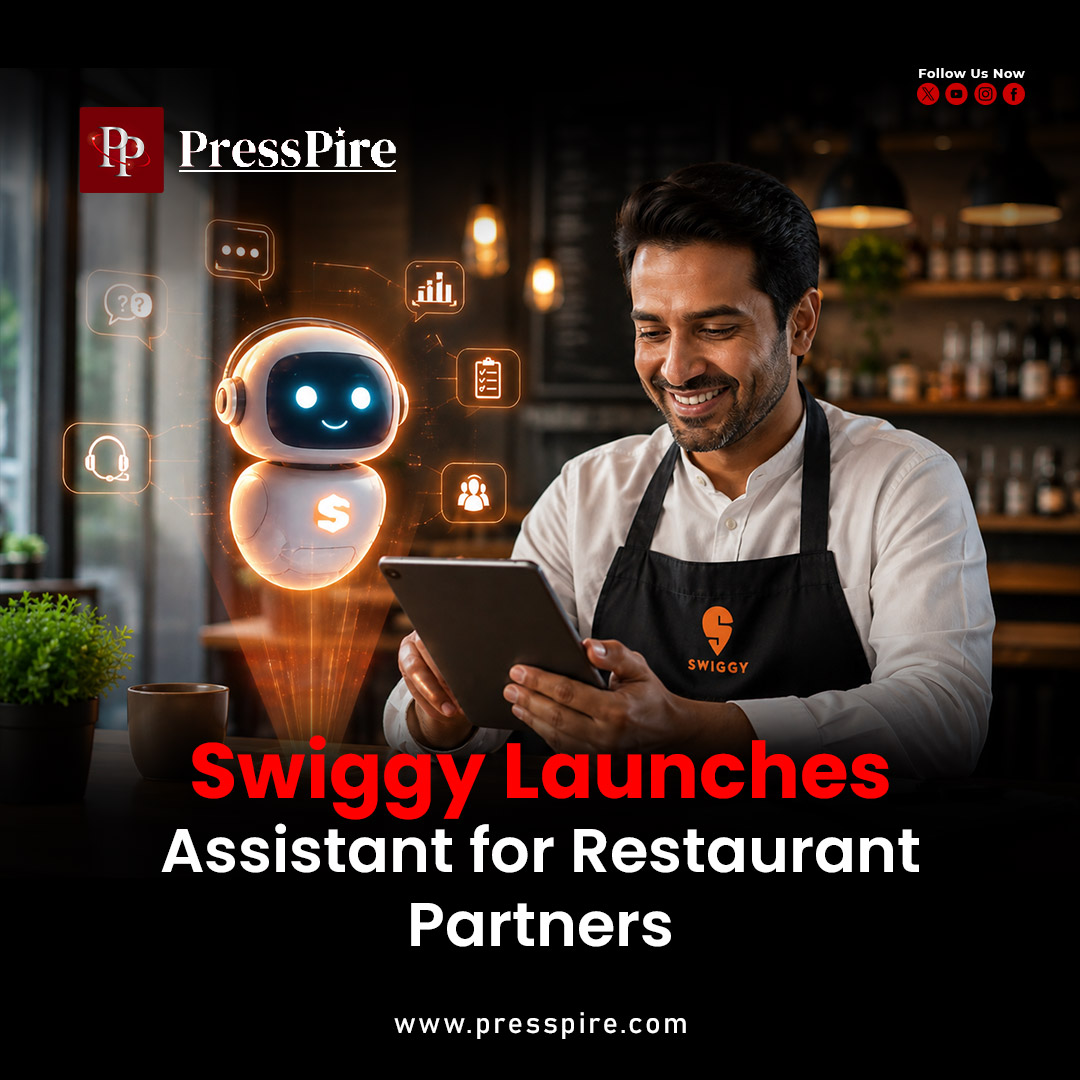
Swiggy Launches 24×7 AI Assistant for Restaurant Partners
Swiggy launches Guru, a 24×7 AI assistant for restaurant partners, offering business insights, campaign management, payout details and AI-powered support. Swiggy has launched Guru, a 24×7 Swiggy AI Assistant designed for restaurant partners. Available across more than 720 cities and supporting over 20 vernacular languages, Guru helps restaurants analyse sales, manage advertising and discount campaigns, understand payouts, improve menus and resolve operational queries through a conversational interface.
Swiggy AI Assistant Guru Enters Restaurant Operations
Running a restaurant today is about much more than preparing good food. Owners have to monitor orders, track sales, manage menus, respond to customers, study payouts, run promotions and make quick decisions while keeping the kitchen moving. For thousands of restaurant businesses operating on digital platforms, this constant multitasking can become as demanding as the food business itself.
Swiggy is now bringing artificial intelligence deeper into that everyday reality with Guru, a 24×7 Swiggy AI Assistant created specifically for its restaurant partners. Launched on August 17, 2026, Guru is designed to bring business insights, operational support and decision-making tools into one conversational interface.
The rollout covers more than 720 cities and is expected to reach over 2.7 lakh restaurant partners, ranging from neighbourhood restaurants and cloud kitchens to multi-outlet businesses. That scale makes the launch more than another AI feature. It signals a broader shift in how food-delivery platforms may become technology partners for the businesses operating on them.
Instead of forcing restaurant owners to navigate multiple dashboards and reports, Swiggy Guru AI allows them to ask questions and perform several tasks through conversational prompts. The objective is simple: make complex business information easier to understand and act upon.
Swiggy Guru AI Brings 24×7 Business Support
The most important feature of the Swiggy AI Assistant is its availability. Restaurants do not operate according to conventional office hours, and problems related to orders, campaigns, payouts or performance can arise at any time. Guru is designed to provide support around the clock, giving restaurant partners access to information when they need it.
The assistant can help partners understand business performance, resolve operational queries and receive actionable recommendations without waiting for conventional support channels. According to Swiggy, Guru can analyse sales, orders, average order value and more than 30 other metrics over time.
This matters because data is useful only when business owners can interpret it quickly. A restaurant may know that orders have fallen, for example, but understanding whether the problem is linked to menu performance, customer conversion, average order value or another stage of the sales funnel requires deeper analysis.
Guru attempts to simplify that process. Rather than presenting restaurant owners with another complicated dashboard, the Swiggy Guru AI approach is built around conversation. A partner can ask questions in natural language and receive insights that are intended to point towards possible actions.
For smaller restaurants without dedicated analysts or digital marketing teams, that accessibility could become particularly valuable.
How Swiggy AI Assistant Helps Restaurants
The Swiggy AI Assistant is not limited to answering questions. It is designed to help restaurant partners manage several important business functions directly through the conversational interface.
One of the key capabilities is campaign management. Restaurant partners can start, review and modify advertising and discount campaigns using chat prompts. This can reduce the friction involved in navigating multiple menus and settings when a restaurant wants to change a promotion or adjust its advertising activity.
Guru also provides detailed payout information. Restaurant partners can access payout annexures, tax reports and payout summaries, giving them a clearer view of the financial side of their Swiggy operations. For businesses that rely heavily on platform-based sales, understanding payouts is essential for tracking margins and planning expenses.
The assistant also analyses the sales funnel, including gross merchandise value and order performance. It can identify areas that may not be performing well and provide recommendations intended to improve them.
This combination of information and action is important. The value of AI in business is increasingly moving beyond simply generating answers. The more useful systems are those that connect insights with practical decisions.
Swiggy Guru AI Turns Data Into Decisions
Restaurants generate enormous amounts of operational data, but many owners do not have the time or expertise to examine every metric. Swiggy Guru AI is designed to turn that information into a more understandable business picture.
The platform evaluates key indicators such as sales, orders and average order value, alongside more than 30 other performance metrics tracked over time. This allows the assistant to identify patterns rather than looking at individual numbers in isolation.
For a restaurant owner, the difference can be meaningful. Knowing that sales are declining is one thing. Understanding which category is underperforming, whether order values are changing and where customers may be dropping out of the sales funnel can provide a clearer starting point for action.
Guru also provides menu-level insights. Partners can add menu items, generate descriptions and identify top-selling dishes by analysing category performance. These features connect AI directly with one of the most important parts of a restaurant’s digital presence: its menu.
The approach reflects a broader trend in business technology. Instead of expecting every small business owner to become a data analyst, AI tools are increasingly being designed to interpret information on their behalf and present it in a practical form.
AI for Restaurants Goes Beyond Sales
The potential of AI for restaurants extends beyond increasing order numbers. Restaurant owners need to balance customer preferences, menu quality, promotions, costs, payouts and operational efficiency. A useful AI assistant therefore needs to understand the business as a connected system.
Swiggy’s Guru moves in that direction by combining performance analysis, menu intelligence, campaign management and payout information within one experience. The goal is not simply to tell restaurants what happened but to help them understand what they can do next.
This is especially relevant for independent restaurants and smaller food businesses. Large restaurant chains may have finance teams, marketing specialists and data analysts. A neighbourhood restaurant may have an owner handling procurement in the morning, managing staff during lunch and checking online orders in the evening.
For such businesses, saving even a small amount of time on administrative work can matter. If an owner can ask an AI assistant about sales performance, modify a campaign or check payout information without moving between several tools, technology becomes part of the daily workflow rather than another system to learn.
Swiggy’s launch therefore highlights an important evolution in food-tech: platforms are increasingly competing not only on customer experience but also on the tools they provide to their business partners.
Swiggy AI Assistant Expands Regional Access
India’s restaurant ecosystem is deeply multilingual, and technology designed only around English can limit accessibility. Swiggy has addressed this challenge by making Guru available in more than 20 vernacular languages, including Hindi, Kannada and Telugu.
This regional-language approach could be one of the most significant aspects of the Swiggy AI Assistant. Restaurant owners do not necessarily need to be highly comfortable with English to understand their business data or interact with an AI system.
Conversational AI can reduce that barrier by allowing users to communicate in languages they are more comfortable using. For a platform serving restaurants across hundreds of cities, that can make advanced technology more inclusive.
The move also fits into Swiggy’s wider AI strategy. Earlier, the company had discussed using generative AI to support restaurant partners with onboarding, ratings, payouts and other self-service processes. More recently, Swiggy has expanded its AI ambitions into multilingual voice-led commerce and an AI ecosystem for developers and enterprises.
Guru can therefore be viewed as another step in a longer transition towards AI-native commerce.
What Swiggy Guru Means for Restaurant Partners
For restaurant partners, the success of Swiggy Guru will ultimately depend on whether it can translate technology into measurable business value. A sophisticated AI assistant is useful only when its recommendations are accurate, understandable and relevant to the realities of individual restaurants.
The opportunity, however, is significant. A restaurant owner could potentially use Guru to understand why sales changed, review campaign performance, examine payout details, improve menu descriptions and identify stronger-performing categories without depending on multiple tools.
The 24×7 model also changes expectations around digital support. Restaurant businesses frequently operate during evenings, weekends and holidays, when conventional support may not always be immediately available. An always-on assistant could provide a first layer of help at precisely those moments.
Swiggy Food Marketplace CEO Rohit Kapoor described the integration of AI into restaurant partners’ daily workflows as a natural next step, highlighting 24×7 support, faster query resolution and actionable performance insights as key objectives.
The bigger question is whether these capabilities can help restaurants improve profitability, not merely platform activity. That will become clearer as partners use the system at scale.
The Bigger AI Strategy Behind Swiggy Guru
Guru arrives at a time when Swiggy is expanding artificial intelligence across different parts of its ecosystem. The company has been experimenting with generative AI, conversational experiences and AI-powered commerce for several years.
In April 2026, Swiggy announced Builders Club, an ecosystem designed to give developers and enterprises access to APIs, MCP servers and transactional capabilities across Food, Instamart and Dineout. The programme is intended to enable builders to create AI agents, assistants and integrations capable of taking real-world actions.
Swiggy also announced a partnership with Sarvam to bring multilingual, voice-led commerce to Food Delivery, Instamart and Dineout. The system is designed to allow users to discover and order food and groceries using voice in their preferred language.
Seen in this context, Swiggy Guru AI is not an isolated product. It represents the business-partner side of a much larger AI strategy in which conversational systems increasingly sit between users, data and commerce.
The Future of AI for Restaurant Management
The launch of the Swiggy AI Assistant points towards a future where restaurant technology becomes more conversational, predictive and action-oriented. Instead of opening separate dashboards to understand sales, campaigns, menus and payouts, business owners may increasingly expect to ask one question and receive both an explanation and a recommended action.
For Swiggy, that could strengthen its relationship with restaurant partners by making the platform more valuable beyond order aggregation. For restaurants, the benefit could be faster decision-making, easier access to data and reduced dependence on complex digital tools.
But AI will not replace the fundamentals of the restaurant business. Food quality, consistency, pricing, service and customer trust will continue to determine long-term success. Technology can identify a weak category or suggest a menu improvement, but the restaurant owner still makes the final business decision.
That balance may define the next phase of AI in food technology. The most successful systems will not attempt to replace entrepreneurs. They will give them better information, faster answers and more time to focus on what they do best.
With Guru, Swiggy is betting that artificial intelligence can become exactly that: a digital business partner available whenever a restaurant needs it. As AI moves from experimentation into everyday commercial operations, the Swiggy AI Assistant could become an important example of how technology is reshaping India’s vast restaurant economy.
For more insights navigate: PressPire | Stories That Shape the Future
Read previous article here: https://presspire.com/redesign-health/
Follow PressPire on Facebook | Instagram | LinkedIn | YouTube
PressPire | Stories That Shape the Future