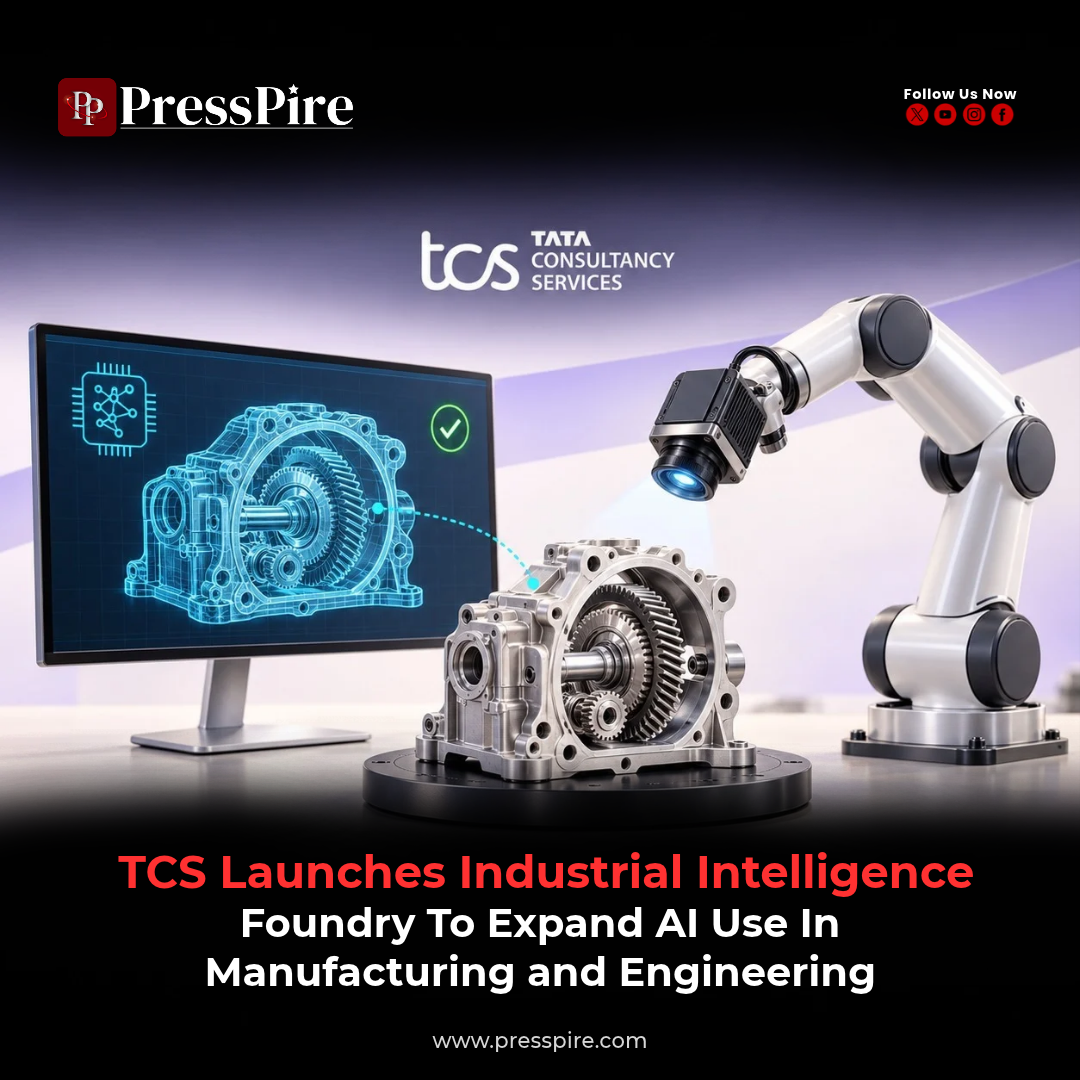
TCS Launches Industrial Intelligence Foundry to Scale AI in Manufacturing and Engineering
The offering brings industrial knowledge into AI applications, extending TCS’s work on smarter products, production systems and factory operations.
Tata Consultancy Services has announced the launch of its Industrial Intelligence Foundry, expanding its push to bring artificial intelligence into manufacturing and engineering. The announcement was issued on 15 October 2026.
The offering combines configurable AI agents, workflows and governance tools. TCS intends it to help industrial businesses apply AI across established operations and expand successful applications beyond individual experiments.
For manufacturers, the business question is practical: can AI help teams develop products faster, run equipment more reliably and improve production without compromising quality?
What the Industrial Intelligence Foundry Will Support
TCS identifies several areas where the offering can be applied:
| Business area | Intended application |
|---|---|
| Product engineering | Support design, validation and documentation |
| Manufacturing | Coordinate workflows and improve production |
| Equipment operations | Improve reliability and utilisation |
| Quality and compliance | Monitor performance and recommend actions |
| Field services | Support workforce decisions |
Target sectors include aerospace, mobility, semiconductors, medical devices, industrial electronics, utilities and energy.
These applications connect different stages of industrial work. A design decision can affect production; equipment performance can affect quality; service information can reveal where a product needs improvement.
Building AI Around Industrial Knowledge
In a separate introduction to the Foundry, TCS described three areas of focus: Product.AI, Process.AI and Production.AI. It also said the offering had been introduced at the NASSCOM Design & Engineering Summit 2026.
The company’s explanation emphasises combining engineering expertise with relevant data, ontologies and knowledge graphs. These are ways of organising information and the relationships between it so that AI can work with a more structured understanding of an industrial setting.
For example, a component is connected to a particular machine, a maintenance requirement and a production process. An AI application becomes more useful when it can consider those relationships.
This explains the emphasis on industry knowledge. A manufacturer needs recommendations that make sense for its equipment, materials and operating conditions.
What Productivity Gains Does TCS Expect?
TCS says the Foundry could shorten new-product introduction timelines by 25% and improve manufacturing productivity by 20–25%. It adds that productivity gains could exceed 40% as data and operating environments mature.
These are company claims about potential benefits. The announcement does not provide an independent benchmark or detailed calculation methodology.
For a prospective customer, the relevant question is how performance changes in its own operation. Faster development is valuable when the resulting product still meets its requirements; higher output matters when it can be maintained at an acceptable cost and quality level.
Why Connected Data Matters for AI in Manufacturing
The launch addresses a problem TCS has discussed in its wider work on digital factories: manufacturers often operate a mixture of older business software, factory systems and newer digital tools.
Information can remain separated between departments or sites. A promising pilot may therefore struggle to become useful across a whole business.
In its digital-factory analysis, TCS argues for connecting operational equipment, enterprise systems and processes, with measurable business goals guiding the work.
The practical implication is that adopting industrial AI involves more than selecting software. Teams must establish which information is available, whether it is reliable and how it reaches the people or systems that need to act on it.
How the Launch Fits TCS’s Earlier Engineering Labs
The Foundry announcement follows two industrial AI laboratory launches in India during 2026.
On 15 July, TCS announced its Autonomous Engineering Lab Powered by NVIDIA at the Global Axis campus in Bengaluru. The facility supports prototyping, simulation and validation before customers deploy solutions in mobility and manufacturing.
Its published areas of work include digital twins, AI vision, automated inspection and predictive maintenance. A digital twin provides a digital representation of a physical system that can support testing and analysis.
On 9 September, TCS announced its Industrial Autonomy & Engineering Lab – Lights-Out Factory at Sahyadri Park in Pune.
The Pune facility contains a robotic battery-pack assembly line. It combines factory controls, robotics, digital twins and operational information to demonstrate and test more autonomous production.
TCS describes the lab as a controlled environment where manufacturers can examine whether an approach is suitable for their production setting.
Together, these announcements suggest a broader strategy: pair industrial AI development with places where customers can examine how the technology behaves around physical equipment.
Human Oversight Remains Part of Industrial Autonomy
TCS’s wider industrial-autonomy framework describes a gradual shift from human-operated tools towards systems that can execute more work independently.
People continue to define objectives, set operating boundaries and handle exceptions. The framework also calls for clear rules covering which actions a system may take, when it must escalate a problem and who can override its behaviour.
For example, an AI system might identify an equipment issue and recommend a response. Whether it should automatically change production settings is a separate decision that depends on the permissions and limits established for that operation.
This distinction matters when evaluating autonomy. A system’s ability to generate a recommendation does not, by itself, establish that it should control a machine.
What Will Determine Commercial Adoption?
The likely commercial test is whether customers can demonstrate improvements that justify the work and cost of deployment.
Useful measures could include equipment downtime, defect rates, development time and the effort required to complete routine tasks. These are examples of evaluation criteria, rather than reported Foundry customer results.
The implementation also needs to remain useful as products, equipment and operating requirements change. That places importance on integration, staff training and ongoing support.
For TCS, the opportunity is to help manufacturers connect engineering knowledge with day-to-day decisions. Customer deployments will provide the clearest evidence of how effectively the Foundry delivers on that ambition.
For more insights navigate: PressPire | Stories That Shape the Future
Read previous article here : upasana-taku-mobikwik-founder-story-ipo/
Follow PressPire on Facebook | Instagram | LinkedIn | YouTube
PressPire | Stories That Shape the Future