
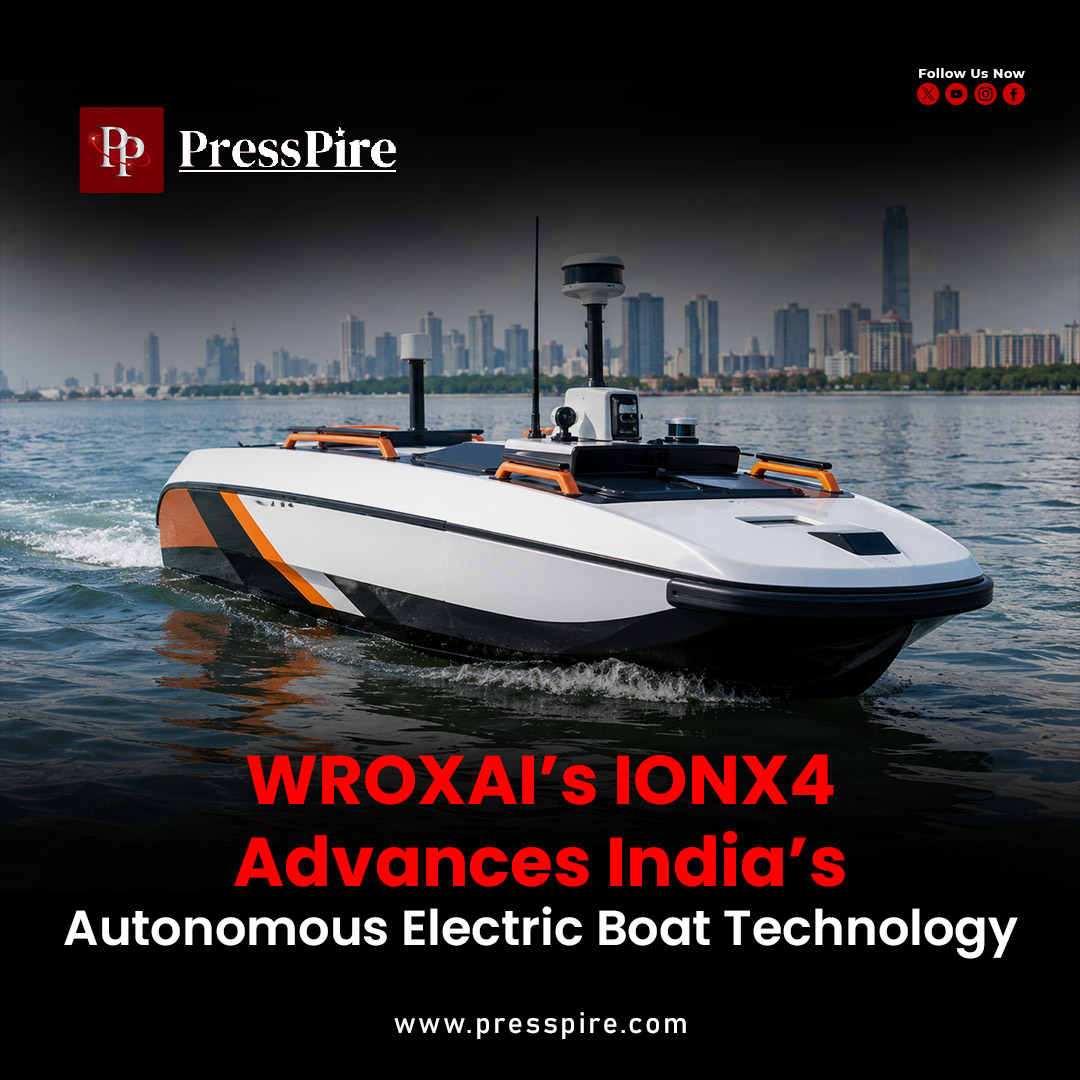
WROXAI IONX4 Advances India’s Autonomous Electric Boat Technology
WROXAI IONX4 is advancing India’s autonomous electric boat technology with AI navigation, electric propulsion and smart marine mobility. WROXAI IONX4 is an autonomous electric watercraft developed in India by Coimbatore-based deep-tech startup WROXAI. Combining electric propulsion with AI-driven navigation, obstacle avoidance and autonomous docking, IONX4 represents a new direction for sustainable marine mobility across tourism, transportation and other maritime applications.
WROXAI IONX4 and India’s Marine Technology
India’s technology story has traditionally been associated with software, automobiles, aerospace and digital infrastructure. But a new generation of deep-tech startups is beginning to take innovation into another environment the water. At the centre of this emerging movement is WROXAI IONX4, an autonomous electric watercraft developed by Coimbatore-based WROXAI. The company is building what it describes as electric driverless boats, positioning itself at the intersection of artificial intelligence, electric mobility and marine technology.
The significance of IONX4 extends beyond the vessel itself. Autonomous marine mobility requires a combination of sensing, navigation, propulsion, decision-making and safety systems that must work together in real time. WROXAI’s approach demonstrates how Indian deep-tech companies are beginning to explore this complex engineering space, while also addressing the growing demand for cleaner and smarter transportation on waterways.
The Vision Behind WROXAI IONX4
The story behind WROXAI IONX4 began with student innovation. WROXAI founder and CEO Kailash Saravanan has traced the company’s roots to projects developed during his engineering years at Kumaraguru College of Technology. The team’s early experiments included the ADTB Robot during the COVID-19 pandemic, followed by projects such as the S-Vision Robot and an Autonomous Travel Robot. These experiences eventually evolved into a broader ambition around autonomous mobility.
That journey is important because IONX4 is not simply an electric boat with automated controls added later. It represents a longer-term attempt to develop autonomous mobility systems from an Indian engineering base. WROXAI has identified tourism, transportation and other maritime applications as potential markets, while its technology roadmap also includes retrofitting existing vessels with autonomous capabilities.
How WROXAI IONX4 Uses AI
At the heart of WROXAI IONX4 is its AI PILOT system, which acts as the intelligence layer responsible for autonomous navigation. According to WROXAI’s product material, the system is designed to navigate, avoid obstacles and dock autonomously using sensors and real-time decision-making. The company has also presented AI PILOT as a technology that could potentially be retrofitted onto different types of vessels, including yachts, cruise boats and ferries.
This is where autonomous boat technology becomes particularly challenging. Unlike a vehicle travelling on a predictable road network, a boat operates in an environment where routes can change, water conditions vary and obstacles may appear unexpectedly. An autonomous marine system therefore needs to continuously interpret its surroundings and adjust its course. By combining artificial intelligence with sensor-based navigation, WROXAI is attempting to create a marine mobility system capable of making those decisions without continuous human steering.
WROXAI IONX4 and Electric Mobility
The electric architecture of WROXAI IONX4 adds another important dimension to the project. WROXAI’s product specifications describe IONX4 as a fully electric autonomous personal watercraft with a stated speed of up to 8 knots, capacity for three people and a runtime of up to six hours.
Electric propulsion can offer important advantages for marine applications, particularly where noise, emissions and operating efficiency matter. For tourism operators, lakes, resorts and controlled waterways, quieter electric vessels could create a different passenger experience while supporting cleaner mobility. The opportunity becomes even broader when autonomous operation is considered alongside electric propulsion. Together, the technologies could enable new models of water-based transportation where vessels can be monitored, managed and operated with significantly less dependence on conventional controls.
WROXAI IONX4 Enters Real-World Testing
For an autonomous vessel, laboratory demonstrations are only the beginning. The real test is whether the technology can perform reliably on actual waterways. WROXAI moved toward that stage with the development of its IONX4 TESTBAY-X1 facility in Coimbatore. The company announced the inauguration of the dedicated testing facility in November 2025, describing it as a platform to validate watercraft performance, optimise navigation and improve the safety of its autonomous marine technology.
The development of a dedicated testing environment is significant because autonomous systems improve through repeated testing and validation. Every real-world test can expose new variables involving navigation, water conditions, obstacle detection and vessel behaviour. For WROXAI, the testing infrastructure provides an opportunity to move IONX4 from an engineering concept toward a technology that can eventually support commercial marine applications.
WROXAI IONX4 Gains Industry Recognition
The progress of WROXAI IONX4 has also attracted attention from institutions operating within India’s maritime and innovation ecosystem. Cochin Shipyard Limited has supported WROXAI through its USHUS startup initiative, while IIM Kozhikode’s IIMK LIVE has also been part of the support ecosystem. In July 2025, Cochin Shipyard announced that WROXAI was among the 16 startups participating in its USHUS SANGAMAM initiative, which showcases deep-tech innovations in the maritime sector.
This institutional backing matters because maritime technology often requires considerably more than software expertise. Prototyping, vessel engineering, testing, safety validation and commercial deployment can demand access to specialised infrastructure and industry knowledge. Partnerships with established maritime organisations can therefore help startups bridge the gap between promising prototypes and practical applications.
Why WROXAI IONX4 Matters for India
The rise of WROXAI IONX4 comes at an important moment for India’s maritime ambitions. The country has thousands of kilometres of coastline, extensive inland waterways, major ports and a growing tourism sector. Yet marine transportation has not received the same level of technology-driven transformation seen in road mobility.
Autonomous electric boats could eventually create opportunities across several controlled environments. Tourist destinations could use autonomous vessels for sightseeing. Resorts could deploy electric watercraft for leisure experiences. Smart-city projects could explore automated lake transportation. Larger vessels could potentially use autonomous systems for navigation assistance or fleet monitoring. WROXAI’s broader strategy of retrofitting existing boats could be especially relevant because it suggests that autonomous technology does not necessarily require every vessel to be built from scratch.
The Future of Autonomous Boats in India
The future of autonomous boat technology in India will depend on much more than technical demonstrations. Safety standards, regulatory approvals, passenger trust, communication infrastructure and reliable sensing systems will all influence commercial adoption. Autonomous boats also need to operate predictably around swimmers, other vessels, docks and changing environmental conditions.
This makes testing and gradual deployment essential. WROXAI’s work provides an example of how an Indian deep-tech startup can approach the problem incrementally — beginning with autonomous watercraft, building testing capabilities and exploring partnerships across the maritime ecosystem. The company’s technology could eventually have applications beyond personal watercraft if autonomous navigation and AI PILOT can be adapted effectively to larger vessels.
WROXAI IONX4 and India’s Blue Economy
India’s blue economy is increasingly becoming an area where technology can create new value. Maritime transportation, tourism, fisheries, logistics, defence and coastal infrastructure all require smarter and more sustainable systems. WROXAI IONX4 fits into this wider transition by bringing together electric mobility and autonomous navigation in a compact watercraft platform.
Cochin Shipyard’s USHUS programme itself reflects the growing institutional focus on maritime startups. CSL has earmarked a ₹50 crore corpus for the initiative and reported that ₹6.9 crore had already been invested in 17 startups by July 2025. Such programmes demonstrate that India’s maritime innovation ecosystem is gradually moving toward dedicated support for deep-tech ventures.
For WROXAI, this ecosystem could provide an important foundation as it works to develop commercially viable autonomous marine technology.
What WROXAI IONX4 Means for the Future
The larger story behind WROXAI IONX4 is not simply about building a driverless boat. It is about testing whether India can create sophisticated autonomous marine systems for a global market. From its beginnings in student engineering projects to its work on autonomous watercraft, WROXAI represents the type of deep-tech entrepreneurship that can push Indian innovation into less explored industries.
IONX4 brings together several technologies that are likely to shape future transportation — artificial intelligence, autonomous navigation, electric propulsion and smart sensing. Its journey is still developing, and widespread autonomous marine adoption will require continued testing, regulation and commercial validation. Yet the direction is significant.
As India expands its focus on electric mobility and builds a stronger blue-economy ecosystem, projects such as WROXAI IONX4 offer a glimpse of what the next generation of water transportation could look like: quieter, cleaner, increasingly intelligent and less dependent on conventional human operation.
The achievement is therefore bigger than one watercraft. WROXAI IONX4 is helping place autonomous electric boat technology on India’s deep-tech map and showing that the future of mobility may not only travel on roads or through the skies, but across the water as well.
For more insights navigate: PressPire | Stories That Shape the Future
Read previous article here: https://presspire.com/manav-sardana/
Follow PressPire on Facebook | Instagram | LinkedIn | YouTube
PressPire | Stories That Shape the Future