
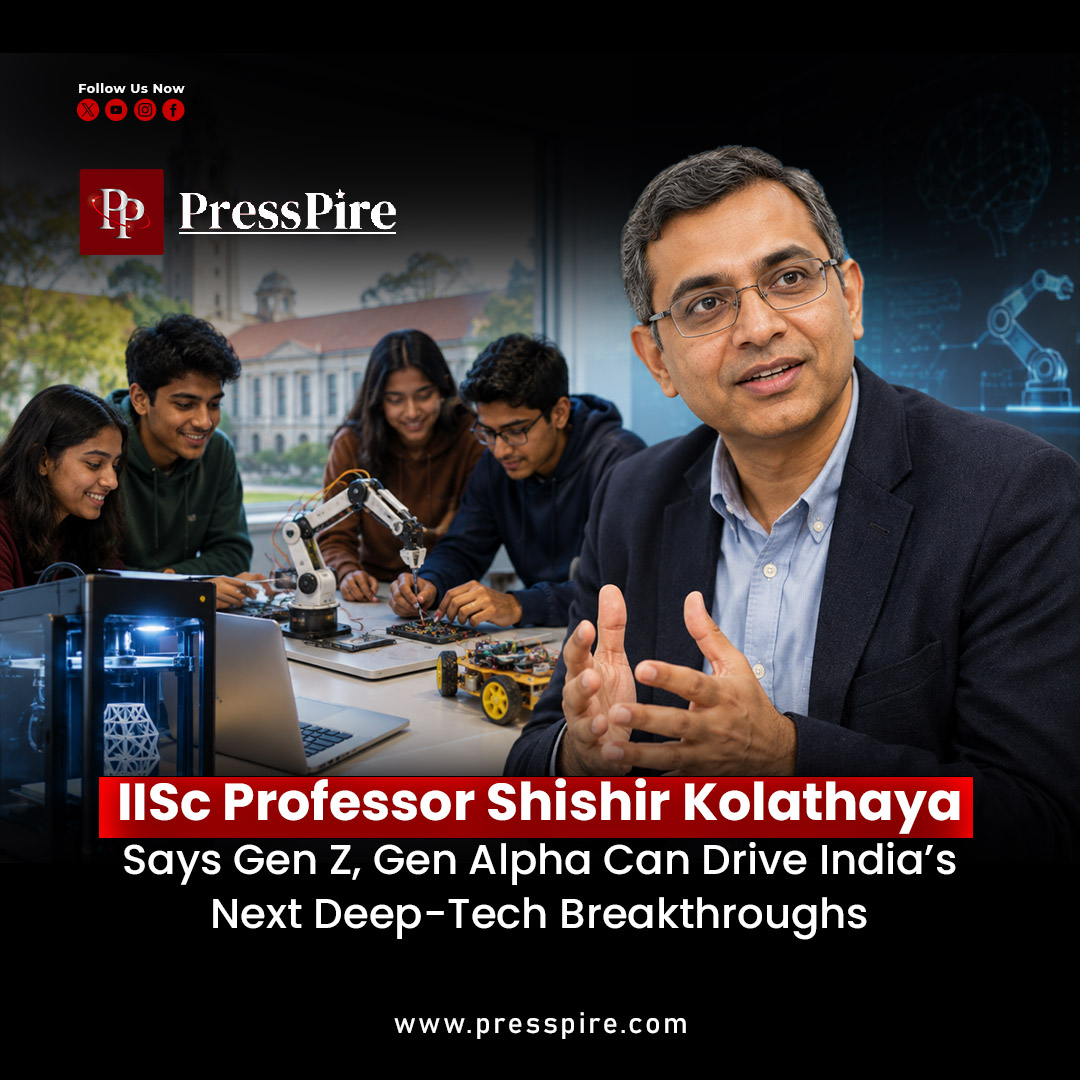
IISc Professor Shishir Kolathaya Says Gen Z, Gen Alpha Can Drive India’s Next Deep-Tech Breakthroughs
IISc Professor Shishir Kolathaya highlights how Gen Z and Gen Alpha can drive India’s next deep-tech breakthroughs through AI, robotics and innovation. IISc Professor Shishir Kolathaya’s work in robotics, machine learning and cyber-physical systems reflects the technologies that could shape India’s deep-tech future. His perspective on younger generations highlights the growing role of Gen Z and Gen Alpha in building, experimenting with and commercialising advanced technologies.
Shishir Kolathaya and India’s Deep-Tech Future
India’s next major technology breakthrough may not come only from established technology companies or large research laboratories. It could emerge from a university laboratory, a student project or the imagination of a young engineer experimenting with artificial intelligence and robotics. This is the larger opportunity surrounding the work and ideas associated with Shishir Kolathaya, Assistant Professor at the Indian Institute of Science (IISc), whose research sits at the intersection of robotics, machine learning, safety-critical control and cyber-physical systems.
As India moves from being primarily a technology-services economy towards becoming a creator of advanced technologies, the role of younger generations becomes increasingly important. Gen Z is entering universities, laboratories and startups with an instinctive familiarity with digital tools, while Gen Alpha is growing up around AI, connected devices and increasingly intelligent machines. The opportunity is to convert that familiarity into scientific curiosity, engineering capability and responsible innovation. For India, that could become one of the strongest foundations for the next wave of deep-tech innovation.
Shishir Kolathaya’s Journey into Robotics and AI
The professional journey of Shishir Kolathaya reflects the multidisciplinary nature of modern deep technology. He earned his B.Tech. in Electrical and Electronics Engineering from the National Institute of Technology Karnataka, followed by an M.S. in Electrical Engineering from Texas A&M University and a Ph.D. in Mechanical Engineering from the Georgia Institute of Technology. His academic path eventually brought him to IISc, where he became associated with the Robert Bosch Centre for Cyber-Physical Systems and the Department of Computer Science and Automation.
His research interests include hybrid robotic systems, safety-critical control and applications of learning theory to legged locomotion. He also heads the Stochastic Robotics Lab, where researchers work on learning-based controllers for quadruped robots. This combination of mechanical engineering, electrical engineering, control theory and machine learning demonstrates why deep tech cannot be confined to a single discipline. The machines of tomorrow will require engineers who can understand both physical systems and intelligent software.
Gen Z Deep-Tech Talent Is Rising as said by Shishir Kolathaya
For Gen Z, technology is not a distant concept introduced through textbooks. Smartphones, cloud computing, artificial intelligence, online learning and digital collaboration have been part of everyday life. That natural familiarity gives this generation a unique starting point for deep-tech exploration. But digital fluency alone is not enough. The real transformation happens when curiosity develops into experimentation, and experimentation develops into engineering capability.
This is where the philosophy behind Gen Z deep-tech becomes significant for India. Young people need opportunities to move beyond consuming technology and start building it. Robotics competitions, research internships, coding laboratories, university innovation centres and startup incubators can provide the environment in which students learn by solving real problems. Research at IISc already demonstrates how machine learning can be applied to complex physical challenges, including robotic locomotion and autonomous systems.
The next generation of Indian innovators could therefore become more than users of AI. They could become designers of intelligent machines, developers of safety systems and founders of companies built around original scientific research.
Gen Alpha Innovation Could Start Early: Shishir Kolathaya
The conversation becomes even more interesting when it moves towards Gen Alpha innovation. This generation is growing up at a time when artificial intelligence is becoming embedded in education, entertainment, communication and everyday devices. Their exposure to technology begins much earlier than it did for previous generations. The challenge for educators is to ensure that early exposure becomes meaningful learning rather than passive consumption.
Gen Alpha does not necessarily need to begin with advanced equations or complicated laboratory equipment. Curiosity can start with simple questions: How does a robot balance? How does an autonomous machine know where to move? Why does an AI system make a particular decision? What happens when a machine encounters something it has never seen before? Such questions can eventually lead towards mathematics, physics, programming and engineering.
For India, nurturing this curiosity could create a long-term pipeline of scientific talent. Deep-tech innovation often takes years of research before it becomes a commercial product, making early investment in scientific thinking particularly valuable.
Robotics and AI Are Changing the Game: Shishir Kolathaya
Robotics offers one of the clearest examples of where robotics and AI are converging. A robot may have mechanical components, sensors, motors and computing hardware, but intelligence determines how effectively it responds to changing environments. This is why machine learning and reinforcement learning have become increasingly relevant to robotic systems.
IISc research involving Shishir Kolathaya has explored learning-based approaches to robotic locomotion. In work involving the quadrupedal robot Stoch, researchers used deep reinforcement learning to generate walking behaviours in simulation and then transfer those behaviours to physical hardware. The research highlighted challenges such as high-dimensional state spaces, hardware limitations and the transfer of learned behaviour from simulation to real-world machines.
For young engineers, such research offers an important lesson: the future of AI is not restricted to chatbots and software applications. Intelligent systems will increasingly interact with the physical world through robots, autonomous vehicles, industrial machines and cyber-physical infrastructure.
Why India Needs Young Deep-Tech Builders: Shishir Kolathaya
India has built enormous strength in software, digital services and technology entrepreneurship. The next challenge is moving further up the value chain by developing technologies that require years of research, specialised hardware, scientific expertise and intellectual property. This is the space where India deep-tech could become a defining growth opportunity.
Young innovators can play an important role because they are often willing to experiment with emerging technologies without being constrained by established assumptions. However, experimentation must be supported by strong institutions. Deep-tech founders need access to laboratories, researchers, funding, testing infrastructure, intellectual property support and industry partnerships.
The establishment of the Wadhwani-IISc Innovation Centre in 2026 reflects this broader institutional push. IISc said the centre was created to strengthen deep-tech research, translational innovation, startup incubation and industry collaboration, reinforcing the importance of connecting scientific research with real-world applications.
The combination of young talent and strong research institutions could therefore become one of India’s biggest competitive advantages.
IISc and the Deep-Tech Innovation Ecosystem: Shishir Kolathaya
IISc occupies an important position in India’s research ecosystem, particularly because its work spans fundamental science, engineering, technology and increasingly commercial applications. Its Robert Bosch Centre for Cyber-Physical Systems brings together researchers working across areas where computing interacts directly with the physical world. Shishir Kolathaya is among its core faculty members, with research interests closely connected to intelligent robotic systems.
The significance of this ecosystem goes beyond individual research papers. It provides students with an environment where difficult problems can be approached through experimentation. A young researcher working on robotics, for instance, may need to understand mechanical design, control systems, machine learning, sensors and software simultaneously.
That multidisciplinary approach is precisely what the deep-tech economy demands. Tomorrow’s breakthroughs are unlikely to fit neatly into traditional academic categories. Artificial intelligence will merge with biology, robotics with materials science, computing with quantum technologies and software with advanced manufacturing. Preparing Gen Z and Gen Alpha for that world requires education systems that encourage connections between disciplines.
Building Skills Beyond the Classroom: Shishir Kolathaya
If India wants younger generations to lead the next deep-tech wave, education must move beyond memorisation. Gen Z deep-tech talent needs opportunities to build, fail, test and rebuild. A student who designs a small robot and watches it fail to walk may learn more about engineering than one who simply memorises the principles of locomotion.
The same principle can be extended to artificial intelligence. Students should not only learn how to use AI tools; they should understand how algorithms learn, where models fail, how data influences decisions and why safety matters. These questions are particularly important when AI moves from screens into physical machines.
The work of Shishir Kolathaya highlights this relationship between learning and real-world systems. His research includes safety-critical control, where reliability becomes essential because failures in physical systems can have serious consequences.
For the next generation, therefore, technical skill must be matched by problem-solving ability, scientific reasoning, ethics and a willingness to learn continuously.
The Road Ahead for India’s Deep-Tech Future, Shishir Kolathaya
India’s deep-tech future will not be built overnight. Unlike many consumer applications, advanced robotics, autonomous systems and other frontier technologies often require long research cycles, expensive experimentation and specialised talent. But that long horizon can also become an advantage if India continues building institutions that connect students, researchers, entrepreneurs and industry.
The emergence of Gen Z and Gen Alpha into this ecosystem could accelerate that journey. Their familiarity with digital technology gives them a natural entry point, while research environments can provide the deeper scientific foundations required to turn ideas into inventions.
The message associated with Shishir Kolathaya’s field of work is therefore larger than robotics alone. It is about creating an environment where young minds can ask difficult questions and develop the technical confidence to pursue them. If India succeeds in creating that environment, the next generation could move from adopting global technologies to creating technologies that influence the global economy.
Lessons from Shishir Kolathaya
The story of Shishir Kolathaya and his work at IISc offers several lessons for India’s emerging technology generation. First, deep-tech innovation is multidisciplinary and requires knowledge across engineering, computing and science. Second, artificial intelligence becomes even more powerful when combined with physical systems and real-world applications. Third, young innovators need institutions that give them access to research, mentorship and experimentation. Finally, technological progress must be accompanied by safety, responsibility and long-term thinking.
India has already demonstrated that its young population can transform industries. The next opportunity is to channel that energy towards scientific and technological breakthroughs. Gen Z can bring experimentation, digital fluency and entrepreneurial ambition, while Gen Alpha may bring an even earlier familiarity with intelligent technologies.
The question is no longer whether young Indians can participate in the deep-tech revolution. The bigger question is whether India can give them the laboratories, education, mentorship and opportunities required to lead it.
With institutions such as IISc building the research foundation and educators and researchers such as Shishir Kolathaya contributing to advanced fields such as robotics, machine learning and cyber-physical systems, the possibility is becoming increasingly tangible.
India’s next breakthrough may be sitting in a classroom today, asking a simple question about how a machine learns to walk. The answer could eventually become a technology that changes the world.
For more insights navigate: PressPire | Stories That Shape the Future
Read previous article here: https://presspire.com/addverb/
Follow PressPire on Facebook | Instagram | LinkedIn | YouTube
PressPire | Stories That Shape the Future