Goa AI Policy 2026: Landmark Plan to Train 50,000 Graduates in AI Skills by 2030
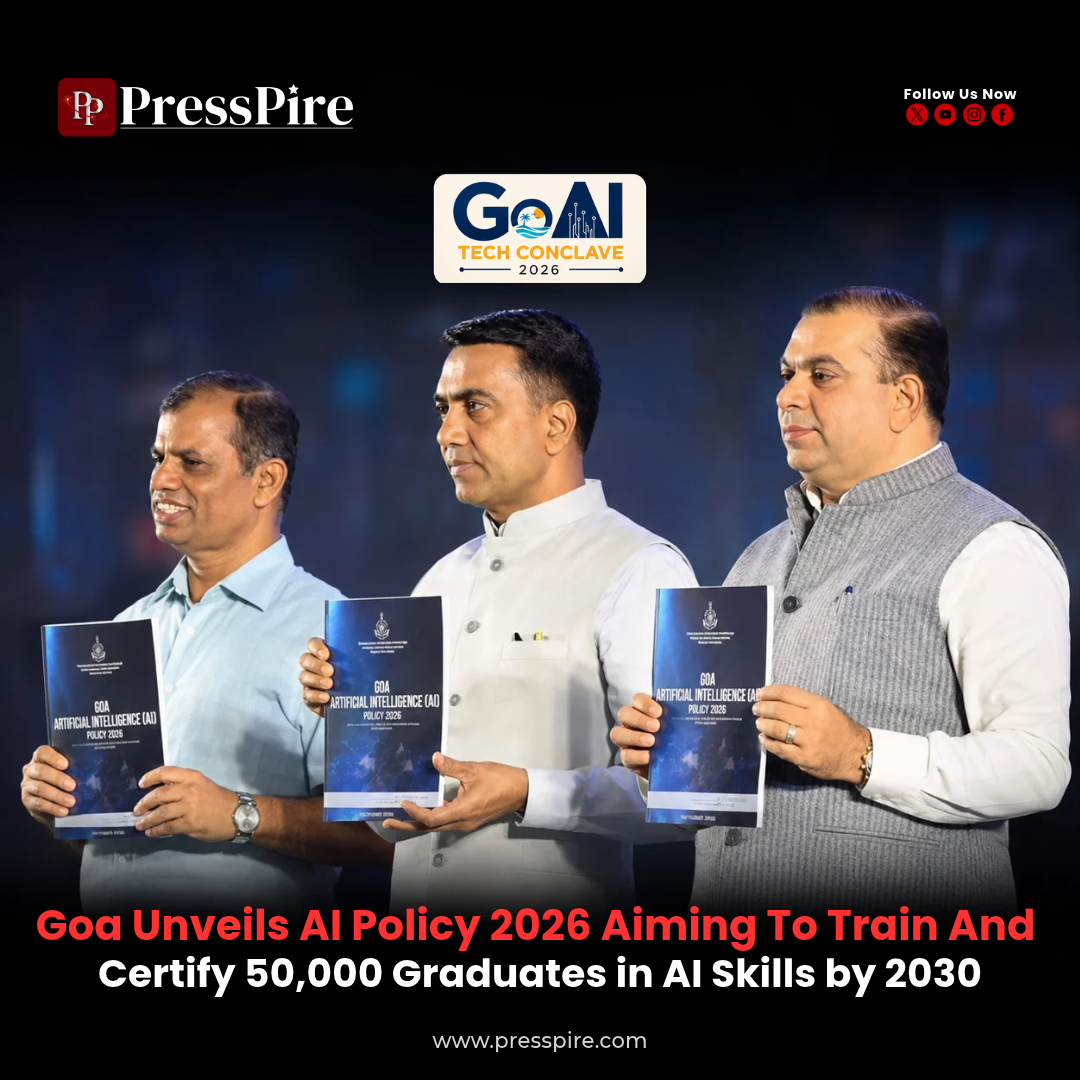
Goa AI Policy 2026 sets an ambitious direction for the state’s technology development: building a workforce equipped to use artificial intelligence, with a target of training and certifying 50,000 AI-skilled graduates by 2030.
Unveiled on October 22 at the Goa AI Tech Conclave, the policy combines education, entrepreneurship, research and public-service priorities. The Cabinet subsequently approved five implementation schemes in November, giving the initiative a more concrete operational framework.
For students and local businesses, its significance lies in the proposed connections between training, practical experience and access to technology. Delivering those connections will determine how much the policy changes employment opportunities and everyday business activity.
Goa AI Policy 2026 Puts Skills at the Centre
The government has placed training and certification at the heart of its AI ambitions. The wider programme reaches school and college students, working professionals, job seekers, teachers and public officials.
Reported participation targets include at least 25% women, 30% people under 30 and 15% participants from tier-2 and tier-3 talukas. These groups can overlap; the percentages describe different inclusion goals.
The state is also seeking training providers capable of building demonstrable skills, with pathways from basic AI literacy to advanced engineering and generative media work.
For learners, the practical value will depend on the work they can produce: completing a project, evaluating an AI-generated result or applying a tool to a real workplace problem.
AI Education to Begin in Schools
Under Goa AI Policy 2026, AI fundamentals are proposed for Classes VI–XII from the 2027–28 academic year, subject to curriculum approvals, teacher readiness and review.
The school plan includes:
- AI laboratories in up to 50 government schools.
- An initial emphasis on 20 rural schools, followed by expansion to 30 urban or semi-urban schools.
- Training for 500 teachers and an AI Coach Network of 100 experts.
- Age-appropriate learning covering responsible AI and media literacy.
A three-level certification framework—foundational, practitioner and specialist—is intended to provide progression through different levels of capability.
This approach could help students build familiarity gradually. Its educational value will depend on well-prepared teachers, working equipment and opportunities to practise throughout the academic year.
Funding Priorities Reflect the Focus on Training
The funding structure of Goa AI Policy 2026 gives the largest share to skills and capacity building.
| Priority | Share of policy allocation |
|---|---|
| AI skilling and capacity building | 60% |
| AI startup promotion and support | 20% |
| AI infrastructure development | 20% |
The Cabinet’s implementation package includes ₹10 crore sanctioned for 2026–27. Separately, the IT department’s November announcement refers to ₹250 crore allocated under the Innovation Fund.
These figures describe different funding provisions. Their practical impact will become clearer through scheme budgets, disbursements and published delivery milestones.
Five Schemes Under Goa AI Policy 2026
The approved package translates the policy’s priorities into five programmes:
| Scheme | Main purpose |
|---|---|
| AI Ready Goa | Expand AI learning, certification and training capacity. |
| Udyam AI | Help micro, small and medium enterprises assess and adopt AI. |
| Goa AI Startup and Innovation Promotion | Support incubation, prototypes, innovation challenges and enterprise development. |
| Konkani AI and Research Excellence | Advance research and tools for the Konkani language. |
| Goa AI Infrastructure and Compute Access | Improve access to computing resources and shared facilities. |
Together, these programmes address the relationship between talent, enterprise demand and the resources needed to develop useful applications.
Practical Support for Small Businesses and Startups
Goa AI Policy 2026 links workforce development with support for businesses that could use those skills.
Udyam AI aims to assist at least 200 MSMEs annually. Proposed support includes readiness assessments, advisory services, access to tools and computing resources, deployment assistance and training.
The startup programme includes incubation, prototyping, hackathons and government challenge statements. A proposed Goa AI Lab would provide shared space for development and experimentation.
For example, a small hospitality company might explore tools for organising customer enquiries, while a local retailer could test demand analysis. These are possible applications, not announced outcomes. Useful projects will need to demonstrate benefits against their cost and operational complexity.
Research Partnerships and Konkani Language Technology
Through Goa AI Policy 2026, the state is also connecting technology development with local research and language needs.
At the conclave, the government signed a memorandum of understanding with BITS Pilani Goa to establish an AI Centre of Excellence. It also launched a state-level hackathon focused on governance and public-service challenges.
Work on a Konkani large language model involves collaboration with BHASHINI, alongside efforts to collect language data from citizens, students and experts.
Local-language tools could make digital services easier to use for people who prefer Konkani. Their usefulness will depend on language coverage, accuracy and testing with the communities expected to use them.
Responsible AI and Public Accountability
Goa AI Policy 2026 emphasises privacy, transparency, fairness, human oversight and accountability.
These principles matter when AI supports decisions or services that affect citizens. In practice, responsible implementation should make it possible to identify errors, understand who is accountable and obtain human review when needed.
An advisory council chaired by the Chief Minister is expected to oversee implementation, monitor progress and recommend updates.
That oversight creates an opportunity to assess both the pace of adoption and the quality of the systems being introduced.
Measuring Progress Towards 2030
The success of Goa AI Policy 2026 will depend on sustained delivery across institutions, businesses and government departments.
Useful measures of progress would include completed certifications, independently assessed skills, operational school laboratories, active teacher participation and the results of supported business projects.
Employment and internship outcomes would also help show whether training is translating into opportunity. Published data on participation across gender, geography and educational background would make the inclusion goals easier to evaluate.
The policy provides a three-year framework for 2026–29, while its main skilling target extends to 2030. Maintaining continuity across that period will require regular coordination and updates as technology changes.
If implemented consistently, Goa AI Policy 2026 could widen access to technical learning and strengthen the state’s capacity to develop locally useful AI. Its lasting contribution will be measured through the capabilities people gain and the problems they become able to solve.
For more insights navigate: PressPire | Stories That Shape the Future
Read previous article here : adani-energy-solutions-bengal-renewable-power-deal/
Follow PressPire on Facebook | Instagram | LinkedIn | YouTube
PressPire | Stories That Shape the Future