
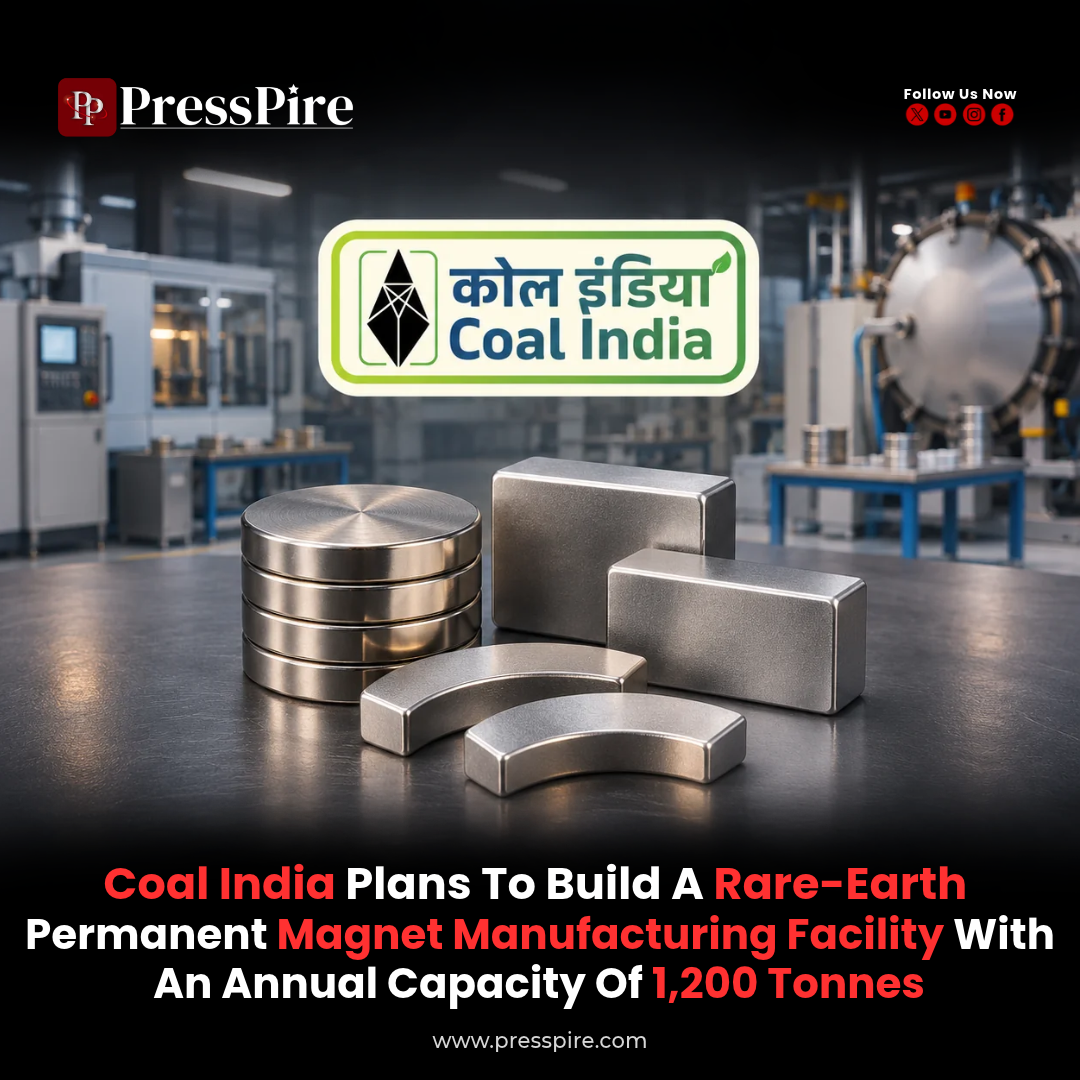
The proposed facility would produce magnets used in electric vehicles, renewable energy and advanced manufacturing, adding capacity in a strategically important industrial segment.
Coal India plans to establish a rare-earth permanent magnet manufacturing facility with an annual capacity of 1,200 tonnes, following a letter of intent from the Ministry of Heavy Industries.
In its stock-exchange disclosure dated 19 November 2026, the state-owned coal producer said it was leading a consortium with the Non-Ferrous Materials Technology Development Centre, or NFTDC. The consortium has been declared the second-ranked, or L2, bidder under the government’s magnet manufacturing scheme and proposes to implement the project through a special purpose vehicle.
The development gives the company a route into manufacturing components used across several technology and energy industries. Its significance will depend on converting the proposed capacity into reliable commercial production.
Project details at a glance
| Item | Disclosed position |
|---|---|
| Lead consortium member | Coal India Limited |
| Consortium partner | NFTDC |
| Government authority | Ministry of Heavy Industries |
| Letter of intent | Dated 19 November 2026 |
| Bid position | L2 |
| Proposed product | Sintered neodymium-iron-boron permanent magnets |
| Planned annual capacity | 1,200 tonnes, or 1,200 TPA |
| Implementation structure | Special purpose vehicle |
| Disclosed execution period | Seven years: two years of pre-construction and five years of operation |
These details describe the proposed project. The capacity figure represents annual manufacturing capability; production volumes will depend on commissioning, plant utilisation and customer demand.
Why Coal India is entering rare-earth magnet manufacturing
The commercial opportunity comes from industries that need powerful, compact magnetic components. Rare-earth permanent magnets are used in electric vehicles, wind turbines, electronics, aerospace and defence equipment.
In its November 2025 scheme announcement, the government projected that Indian consumption of these magnets would double by 2030 compared with 2025. That forecast provides a demand backdrop for new manufacturing investment, although individual projects will still need customers and competitive production costs.
For the coal producer, the proposal represents an expansion into specialised industrial manufacturing. Building that business will require capabilities in materials processing, product quality and customer qualification alongside project development.
How the facility fits India’s national programme
The Union Cabinet approved the magnet manufacturing scheme on 26 November 2025 with an outlay of ₹7,280 crore. It aims to establish 6,000 tonnes of integrated annual manufacturing capacity, with allocations envisaged for five beneficiaries.
The 1,200-tonne capacity proposed by Coal India equals 20% of that national scheme target.
The Ministry of Heavy Industries reported receiving 20 bids in August 2026. Under the programme, each beneficiary can receive a capacity allocation of up to 1,200 tonnes annually.
The ₹7,280 crore amount is the budget for the wider government programme. The company’s disclosure does not identify the investment required for its individual facility.
What the proposed plant would manufacture
The project focuses on sintered neodymium-iron-boron magnets, commonly abbreviated as NdFeB. These are a major category of rare-earth permanent magnets, valued for their magnetic strength relative to their size and weight.
The manufacturing chain involves several stages. Rare-earth oxides are converted into metals, those metals are made into alloys, and the alloys are processed into finished magnets.
The government’s scheme supports this integrated progression from oxide to finished product. That makes the proposal relevant to an industrial capability gap: turning processed mineral inputs into components that equipment manufacturers can use.
For buyers, usable output means magnets that meet the required performance, dimensions and consistency. Manufacturing capacity becomes commercially valuable when those requirements can be met repeatedly.
Raw-material supply will be an important dependency
For Coal India, securing suitable inputs will be part of making the proposed facility viable. A magnet plant needs dependable material supply as well as manufacturing equipment.
The government’s scheme notification identifies a gap in India’s industrial-scale conversion of rare-earth oxides into metals, alloys and magnets. It also provides for limited supplies of neodymium-praseodymium oxide from IREL to the three lowest-bidding beneficiaries, with additional requirements to be arranged separately.
This means domestic magnet manufacturing and complete raw-material self-sufficiency are different milestones. A locally operated facility can strengthen the supply chain while still needing carefully planned sourcing arrangements.
Long-term input availability, material quality and purchase costs will therefore influence production continuity and pricing.
Understanding the seven-year execution period
Coal India’s filing specifies a seven-year period comprising two years of pre-construction and five years of operation.
The wider government scheme describes its seven-year structure as a two-year gestation period for establishing facilities, followed by five years of incentive disbursement linked to magnet sales.
These descriptions explain the programme’s implementation and operating phases. The filing does not provide a firm calendar date for commercial production.
The next stages will involve meeting the scheme’s conditions and progressing towards an operating plant. The published tender provides for post-letter-of-intent formalities, including performance security and the formation of an SPV where applicable, before a letter of award is issued.
Investment and location details remain to be disclosed
The 19 November announcement from Coal India sets out the capacity, consortium structure, product and execution period. It does not disclose the proposed location, detailed project cost or ownership percentages in the future SPV.
Those details will help establish how the venture is financed and implemented. Site selection, for example, will affect access to utilities, transport and industrial infrastructure.
The disclosure also does not identify customer contracts or provide revenue and profit projections for the magnet business. The announcement therefore supports an assessment of the project’s intended scale, while its financial contribution will depend on subsequent investment decisions and commercial execution.
Turning planned capacity into a sustainable business
Coal India will ultimately need to demonstrate that the facility can produce magnets at the quality, consistency and cost required by industrial buyers.
The central commercial drivers will include:
- Plant utilisation: How much of the installed capacity generates saleable output.
- Input costs: The price and availability of rare-earth materials and other manufacturing inputs.
- Product qualification: Whether customers approve the magnets for their intended applications.
- Supply reliability: Whether orders can be delivered consistently and on schedule.
These factors will determine how effectively the proposed capacity becomes a functioning business. Government support can help establish manufacturing capability, while sustained sales require a competitive product.
The milestones that will define progress
The proposed project places Coal India within India’s effort to expand domestic rare-earth magnet manufacturing. Its planned scale is substantial within the government programme, but the immediate achievement is the letter of intent.
Further disclosures on the SPV, investment, site, technology arrangements and material sourcing will make the project easier to assess. Commissioning and customer-qualified production will then show whether it can deliver the intended industrial contribution.
A successfully executed facility could give Indian equipment manufacturers another source of critical magnetic components and expand the country’s capacity to turn mineral inputs into higher-value products.
For more insights navigate: PressPire | Stories That Shape the Future
Read previous article here : ai-medical-scribe-eka-care-nvidia-offline/
Follow PressPire on Facebook | Instagram | LinkedIn | YouTube
PressPire | Stories That Shape the Future