
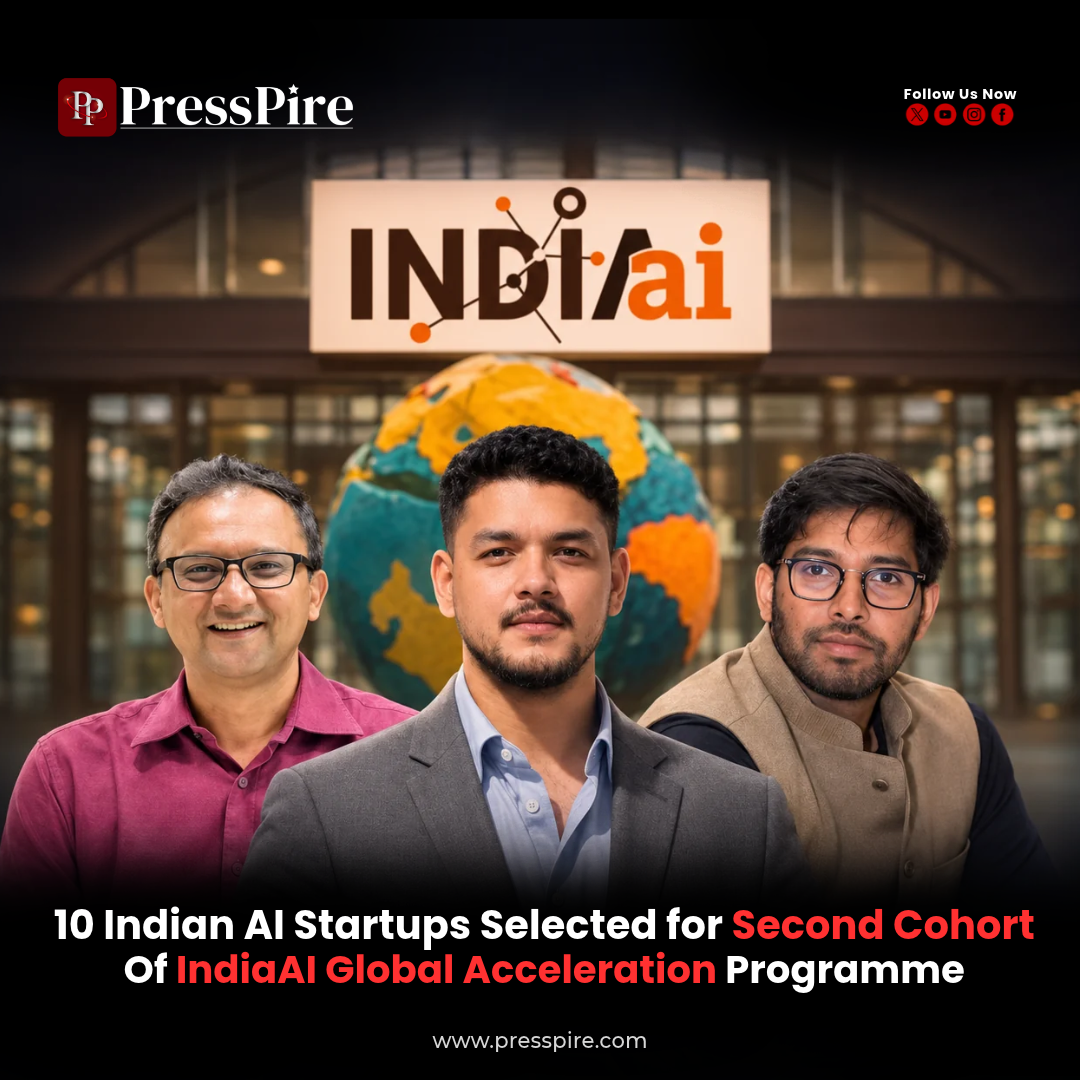
10 Indian AI Startups Join IndiaAI Global Acceleration Programme’s Second Cohort
The cohort brings together companies working on healthcare, manufacturing, climate compliance and space monitoring, with support from HEC Paris and Station F.
Ten Indian AI startups were selected for the second cohort of the IndiaAI Startups Global Acceleration Programme, according to a government announcement published on April 17, 2026.
The initiative connects participating companies with mentoring, business networks and opportunities to explore European markets. It combines online preparation with a residency in Paris, giving founders a structured setting to develop their international expansion plans.
The selection followed a multi-stage evaluation process. Subsequent announcements from IndiaAI and HEC Paris confirmed that the second cohort had entered the Paris phase of the programme.
Which Indian AI Startups Were Selected?
The government’s published roster and subsequent partner announcements identify the following ten companies:
| Startup | Stated product focus |
|---|---|
| AI Health Highway India | AI-assisted smart stethoscope for heart and lung screening. |
| Awiros | Computer vision technology for intelligence and automation in physical environments. |
| Cognecto | AI-based infrastructure intelligence. |
| Flaunt | Multimodal AI agents for beauty and fashion trends and short-form video marketing. |
| GreenFi.ai — Climateforce Technologies | AI software for environmental, social and governance risk management and compliance. |
| Infiheal Healthtech | Healo, a multilingual mental-health AI companion incorporating human oversight. |
| InLustro Learning | Job simulations assessing the readiness of people and AI agents for workplace tasks. |
| PredCo | AI-supported manufacturing compliance covering people, processes and products. |
| SkyServe — Hyspace Technologies | AI infrastructure for Earth and space monitoring. |
| Daten & Wissen | Vision AI agents and vision-language models for camera-based enterprise intelligence using edge processing. |
Taken together, these product descriptions suggest a strong emphasis on applying AI to particular industry problems. The businesses address different buyers and workflows, which makes sector-specific advice especially relevant to their expansion plans.
How the Global Acceleration Programme Works
The announced format includes three weeks of online preparation followed by a three-month residency in Paris.
Online preparation
For the selected Indian AI startups, the preparation stage provides an opportunity to sharpen market-entry plans before the onsite programme.
Official programme guidance describes roadmap meetings, individual expert mentoring and group workshops. Areas of support include refining business models, identifying customer needs, developing sales strategies and preparing investor pitches.
This preparation has a practical purpose: founders can identify the customers and partners they need to meet, then use their time in France around those priorities.
Paris residency
The residency gives Indian AI startups access to Station F and the networks associated with the HEC Paris incubator.
The programme’s onsite design focuses on market development, engagement with local corporate partners and building a business presence in France and wider European markets. The intention is to help teams test their commercial assumptions through direct contact with potential customers and other business stakeholders.
What HEC Paris and Station F Bring to the Programme
HEC Paris outlined personalised mentoring across product development, market-entry strategy and fundraising in its second-cohort announcement.
It also described opportunities to connect with European companies, potential clients, partners and international investor networks. Station F provides the Paris base for that engagement, while the HEC incubator contributes experts and business-development support.
For Indian AI startups, the potential benefit is access to people who understand the market they are trying to enter. A relevant introduction can help a founder discover who makes purchasing decisions, what evidence a buyer expects and how a proposed product fits an organisation’s existing work.
Those conversations can also reveal where a product needs adjustment before a company commits more resources to expansion.
Why the Cohort’s Sector Mix Matters
The range of Indian AI startups selected suggests that the programme is supporting several routes to commercial adoption.
A useful way to assess this diversity is through the different questions each business must answer. A customer considering a workplace tool may focus on integration and usability. An industrial buyer may want evidence that a system works reliably in its operating environment.
These differences matter when designing a sales strategy. Product demonstrations, pricing and implementation support may need to change from one sector to another. Advice tailored to those requirements can help founders prioritise their expansion work.
The cohort’s value will therefore depend partly on how well its mentoring and introductions match those different needs.
How the Initiative Fits Into the IndiaAI Mission
The programme sits under the Startup Financing Pillar of the IndiaAI Mission, which operates under the Ministry of Electronics and Information Technology.
Its stated purpose includes helping Indian AI startups build international connections and reach global markets. The partnership with HEC Paris and Station F forms part of that effort to connect domestic innovation with overseas business opportunities.
The international programme adds a market-access component to that mission. Alongside developing their products, participating founders receive support aimed at building relationships with overseas customers and partners.
What Has Been Confirmed About Participation?
Following the selection announcement, IndiaAI published an update identifying the second cohort as participating in Paris. HEC Paris also announced the cohort and its planned support activities.
These updates confirm that the selected Indian AI startups progressed beyond the announcement stage into participation in the international programme.
The publicly described support centres on mentoring, corporate engagement and investor access. Specific commercial results, such as new investment or customer contracts, would need to be assessed through separate company or programme announcements.
What Would Demonstrate Commercial Progress?
For the participating Indian AI startups, useful measures of progress would include customer trials, paid deployments, repeat business and partnerships that continue beyond the residency.
Tracking these results over time would help show whether the programme’s introductions and mentoring translate into a lasting business presence. The quality of those relationships will matter beyond the time spent in Paris.
The commercial task for each founder remains specific: identify a customer problem, demonstrate that the product solves it and build a repeatable way to serve that market.
For more insights navigate: PressPire | Stories That Shape the Future
Read previous article here : indigenous-dilution-refrigerator-amaravati/
Follow PressPire on Facebook | Instagram | LinkedIn | YouTube
PressPire | Stories That Shape the Future