
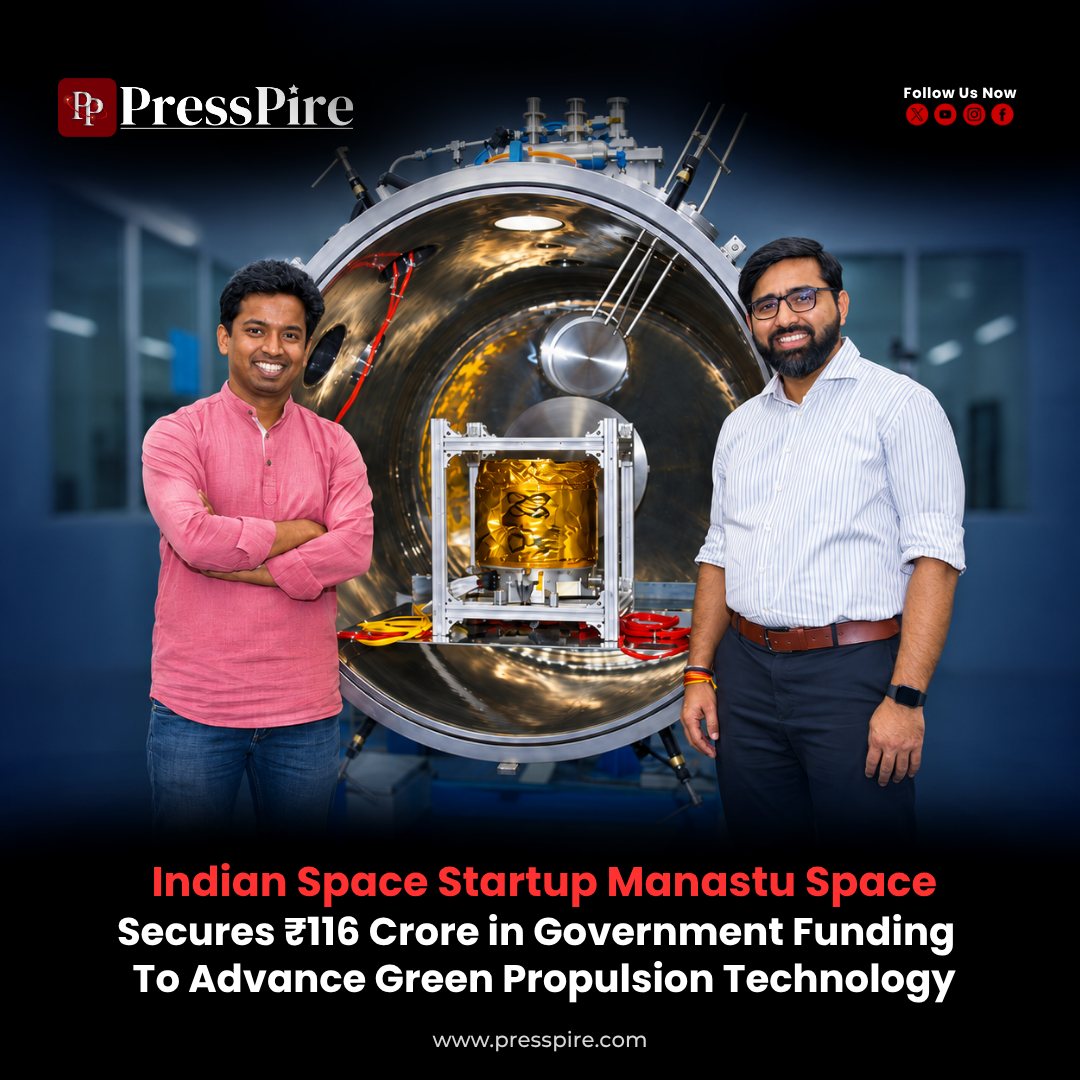
Manastu Space Secures ₹116 Crore Government Support for Green Propulsion Systems
The financing agreement supports a ₹277.63 crore project to develop and validate indigenous propulsion technology for satellites and launch-vehicle applications.
Manastu Space has secured a ₹116 crore financing commitment from the Technology Development Board under the Department of Science and Technology to advance its indigenous green propulsion technology.
The agreement, announced by the government on October 26, 2026, falls under the Research Development and Innovation Fund. It supports a project with a total cost of ₹277.63 crore, focused on developing propulsion systems for satellites and launch-vehicle applications.
The financial support will take the form of optionally convertible debt. The programme aims to advance the technology from Technology Readiness Level 6 to Level 9, moving through further development, integration and validation towards successful operational use.
Manastu Space Funding: Key Details
| Particular | Announced Details |
|---|---|
| Company | Manastu Space Technologies Private Limited |
| Location | Navi Mumbai, Maharashtra |
| Government financing commitment | ₹116 crore |
| Total project cost | ₹277.63 crore |
| Supporting agency | Technology Development Board, Department of Science and Technology |
| Funding programme | Research Development and Innovation Fund |
| Financing instrument | Optionally convertible debt |
| Technology | Hydrogen peroxide-based green propulsion |
| Planned thrust range | 5 millinewtons to 300 newtons |
| Development objective | Advance from TRL-6 to TRL-9 |
| Announcement date | October 26, 2026 |
How the ₹116 Crore Financing Will Work
The agreement provides financial backing for a technology development programme that requires continued engineering and testing.
Optionally convertible debt is a financing instrument that may be converted into equity under agreed conditions. The announcement does not disclose detailed repayment or conversion terms, nor does it confirm that the entire amount has already been disbursed.
The distinction between the financing commitment and the total project cost is important. ₹116 crore is the government-backed support announced for the project; ₹277.63 crore is the overall project cost.
The RDI Fund is designed to support private-sector research and technology development through financing instruments such as long-term loans and equity. Its published framework excludes grant funding.
What Manastu Space Is Developing
Manastu Space is developing an integrated propulsion system using a hydrogen peroxide-based propellant with additives, together with compatible engines, catalysts and propellant-delivery systems.
Propulsion enables a spacecraft to change its motion. Depending on the system and mission, this can support orbital adjustments, positioning, collision-avoidance manoeuvres and controlled disposal at the end of a satellite’s operating life.
ISRO’s description of Manastu’s earlier VYOM-2U payload identifies its propellant technology as an effort to provide a safer, higher-performing alternative to hydrazine for space applications.
The development programme covers more than the propellant itself. It includes engines, feed systems that deliver propellant to the thrusters, and a ceramic catalyst designed to operate at very high temperatures.
These components must work together reliably throughout a mission.
A Propulsion Range for Different Spacecraft Requirements
The funded project covers thrust levels from 5 millinewtons to 300 newtons. This represents a family of propulsion capabilities intended to address different spacecraft requirements.
Small thrusters can support precise adjustments, while higher-thrust systems serve applications requiring greater changes in spacecraft motion.
Manastu’s published product portfolio includes propulsion systems for small satellites and a 300-newton thruster intended for applications such as launch-vehicle upper stages and orbital-transfer spacecraft.
Developing a wider range requires each configuration to be tested for its intended operating conditions. Successful performance by one demonstration system provides a foundation for that work, while additional designs still require their own engineering and validation.
What Moving From TRL-6 to TRL-9 Means
Technology Readiness Levels provide a way to describe how mature a technology is.
At TRL-6, a representative system or prototype has demonstrated its capabilities in a relevant environment. TRL-9 describes a system proven through successful mission operations.
For Manastu Space, the programme’s stated objective therefore extends beyond laboratory development. It involves progressing towards systems that can perform reliably during actual missions.
The planned work includes further engineering, integration, testing and validation. These steps help establish whether the technology can meet the performance and reliability requirements of its intended users.
The TRL-9 target remains an objective of the funded programme.
Manastu Has Already Tested Propulsion Technology in Orbit
Manastu Space has an existing flight demonstration on which to build.
Its VYOM-2U propulsion system travelled aboard ISRO’s POEM-4 platform, launched with the PSLV-C60 mission on December 30, 2024. POEM uses a rocket’s spent fourth stage as a platform for experiments in orbit.
According to Manastu, VYOM-2U completed more than 700 seconds of cumulative firing, including a 360-second continuous burn and more than 20 restarts.
ISRO subsequently reported in March 2025 that all POEM-4 payloads had completed their intended experiments.
The demonstration provides evidence of the technology operating in space. The new financing programme supports further development across the broader propulsion range described in the agreement.
The Startup Behind the Technology
Manastu Space was founded in 2017 by Tushar Jadhav and Ashtesh Kumar, both IIT Bombay alumni.
The company focuses on propulsion technology intended to make spacecraft manoeuvres safer and more practical. Its stated applications include orbit adjustments, formation control, collision avoidance and end-of-life deorbiting.
For satellite operators, reliable propulsion affects how effectively a spacecraft can carry out its mission and respond to changing conditions in orbit.
Developing these systems domestically could also give Indian spacecraft manufacturers more options when sourcing critical components.
Separate Support for an Iodine-Based Thruster
Manastu has also been selected for a separate propulsion development programme.
On October 29, 2026, IN-SPACe announced that it had offered the company ₹22.08 crore under the Technology Adoption Fund to develop an iodine-based Hall-effect thruster for small satellites.
That project covers an integrated system comprising a thruster, power-processing unit, and modular iodine feed and tank system.
The IN-SPACe funding offer is separate from the ₹116 crore RDI financing agreement, which focuses on the hydrogen peroxide-based propulsion programme.
What the Government Support Could Enable
The ₹116 crore commitment gives Manastu financial backing for the sustained development needed to turn an existing technology base into a broader propulsion offering.
For India’s space sector, the potential value lies in greater domestic capability in engines, propellants, catalysts and integrated spacecraft systems.
Realising that value will depend on completing the planned tests, demonstrating dependable mission performance and meeting customers’ technical requirements. The agreement supports that development process; wider deployment remains the next objective.
For more insights navigate: PressPire | Stories That Shape the Future
Read previous article here : reliance-biscuit-push-britannia-ceo/
Follow PressPire on Facebook | Instagram | LinkedIn | YouTube
PressPire | Stories That Shape the Future