
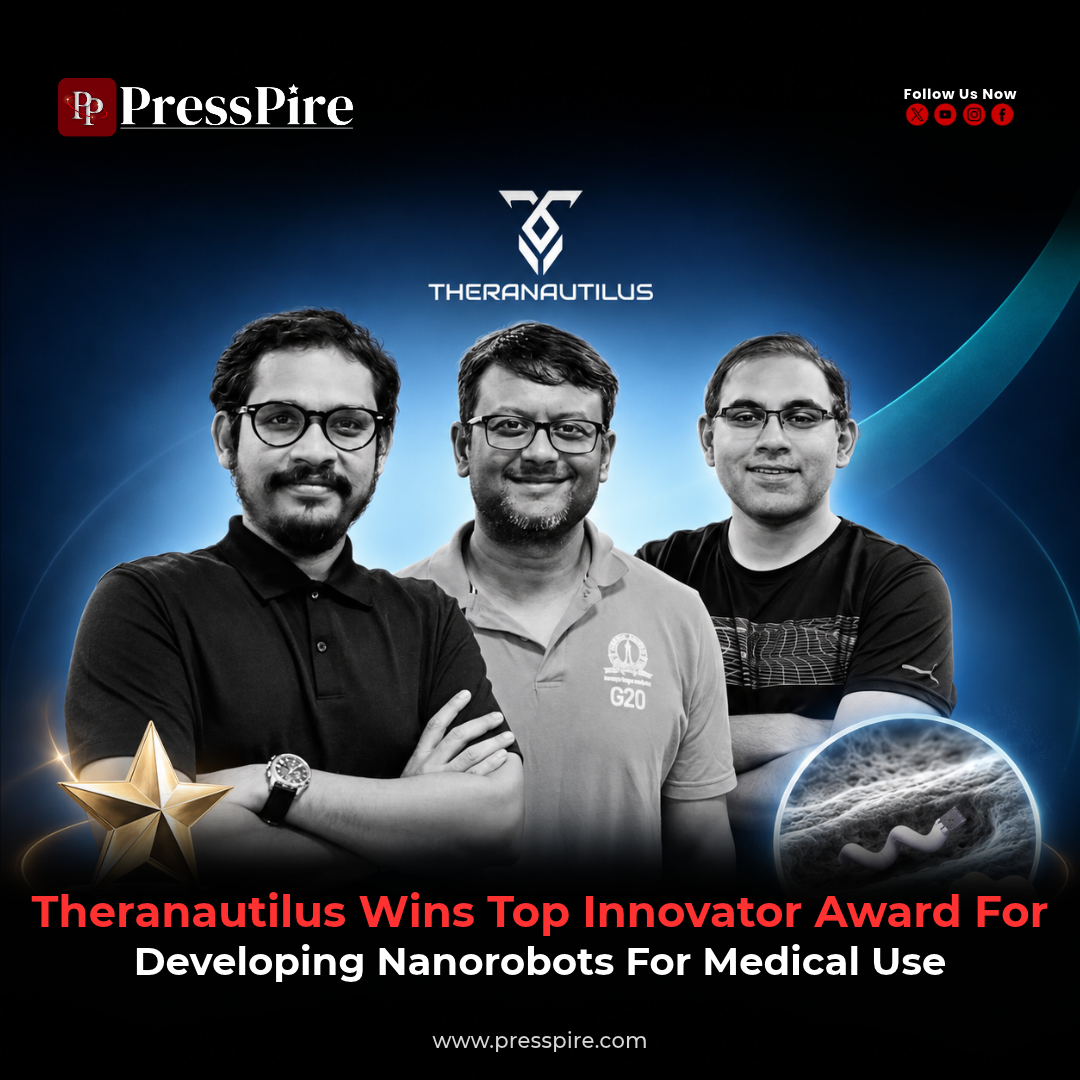
Theranautilus Wins Top Innovator Award for Developing Medical Nanorobots
The Bengaluru startup, built on IISc research, is developing magnetically controlled nanorobots for dental care and has outlined plans for human trials.
Theranautilus has won the Top Innovator award at The Economic Times Startup Awards 2026 for its work on microscopic robots designed for targeted medical applications.
The Bengaluru company is initially focusing on oral healthcare, including tooth sensitivity and research into improving root canal treatment. Its approach uses magnetic fields to control tiny structures inside spaces that are difficult to reach with conventional instruments.
The award result was reported on 27 August 2026. In a subsequent interview published on 18 September 2026, the company outlined plans to begin human trials of its dental technology in November–December.
The recognition highlights an Indian research venture working to move a medical technology from laboratory studies towards clinical evaluation.
Theranautilus at a Glance
| Detail | Information |
|---|---|
| Company | Theranautilus |
| Headquarters | Bengaluru, Karnataka |
| Founded | 2020 |
| Founders | Ambarish Ghosh, Peddi Shanmukh Srinivas and Debayan Dasgupta |
| Research connection | Indian Institute of Science, Bengaluru |
| Award | Top Innovator, ET Startup Awards 2026 |
| Initial development focus | Dental applications of magnetic nanorobotics |
The Founders Behind Theranautilus
Theranautilus brings together expertise in dentistry, physics and nanotechnology.
Co-founder and CEO Peddi Shanmukh Srinivas is a trained dental surgeon. His clinical background helps connect the engineering work with problems encountered in dental practice.
Ambarish Ghosh, a professor at IISc’s Centre for Nano Science and Engineering, and Debayan Dasgupta, a researcher and former IISc doctoral student, contribute expertise in developing and controlling microscopic structures.
The company emerged from work on magnetic nanoparticles at IISc. Its development involves the materials used to make the nanorobots, the equipment that guides them and the procedures through which a clinician could eventually use them.
What the Medical Nanorobots Are Designed to Do
Theranautilus describes its work as including instruments for making nanorobots, deploying them in biological systems and controlling their movement remotely.
The central idea is to move a tiny structure to a specific location and give it a defined task. Depending on the application, that could involve carrying material into a narrow channel or producing a local effect.
In the published dental research, magnetic fields provide this control. The approach allows researchers to investigate treatment inside microscopic spaces within teeth.
Different applications use different designs. The company’s work on sensitivity involves bioceramic particles, while earlier root canal research used helical structures.
CalBots and the Approach to Tooth Sensitivity
One of the venture’s best-documented developments is CalBots, created by researchers at IISc in collaboration with Theranautilus.
These magnetic particles carry a calcium-based bioceramic formulation. The researchers designed them to enter dentinal tubules, the microscopic channels within dentine, which lies beneath the tooth’s enamel.
When these channels become exposed, external stimuli can trigger sensitivity.
The proposed approach guides CalBots deeper into the channels, where they help form cement-like plugs. The aim is to seal the exposed pathways and reduce the movement of fluid associated with sensitivity.
IISc’s account of the work describes particles approximately 400 nanometres in size. Their small dimensions and response to a magnetic field are central to reaching the intended location.
What the Published Research Demonstrated
A study published in Advanced Science in July 2025 examined this approach using extracted human teeth and animal experiments.
In the tooth samples, the researchers demonstrated the formation of plugs hundreds of micrometres inside dentinal tubules. The study also reported reduced dentine permeability after treatment.
Experiments in mice assessed behaviour associated with tooth sensitivity, including responses to cold water. The researchers reported recovery in the treated animals.
These findings support further clinical investigation. Experiments on extracted human teeth are laboratory studies; they do not establish how well the procedure works in people receiving dental treatment.
Questions for human evaluation include safety, the degree and duration of symptom relief, and how consistently the procedure can be performed.
A Separate Application in Root Canal Research
Earlier research examined whether magnetically controlled nanorobots could reach bacteria deep inside dentinal tubules.
In work described by IISc in 2022, researchers used helical structures made from silicon dioxide with an iron coating. A magnetic field controlled their movement through extracted tooth samples.
The team also demonstrated that magnetic manipulation could generate local heat around the structures to kill nearby bacteria.
The potential application is to improve access to bacteria that remain in difficult-to-reach spaces during root canal treatment. This work addresses a different problem from the CalBots approach to sealing exposed tubules.
Its clinical usefulness will depend on further development and evidence from treatment in patients.
Human Trials Are the Next Announced Milestone
In the September 2026 interview with The Economic Times, Srinivas said the company planned to begin human trials in Bengaluru during November–December 2026.
The initial study was expected to involve approximately 30 patients, followed by a larger trial involving 300 patients across multiple centres.
Those figures describe the company’s announced development plan. They should not be treated as completed enrolment or published clinical results.
For the business, human studies represent a significant step towards establishing whether its research can become a practical dental intervention.
Funding and the Route to Commercialisation
Theranautilus has attracted investment to support that transition.
In November 2024, transaction adviser Aritra Partners announced that the company had secured $1.2 million in seed funding. The round was led by pi Ventures, with participation from Golden Sparrow Ventures and angel investors.
Pi Ventures described the investment as supporting development towards clinical use, including refinement of the delivery mechanism.
The Economic Times subsequently reported that the startup intended to commercialise its technology through licensing partnerships with pharmaceutical, healthcare and medical-device companies.
That approach could provide access to established partners’ capabilities. Its value will depend on the evidence supporting each application and the terms of any agreements ultimately secured.
What the Award Means for the Startup
The Top Innovator recognition brings attention to a business built around scientific research and specialised hardware.
In explaining the selection, jury member Abhiraj Singh Bhal highlighted the company’s research foundation and peer-reviewed work.
The longer-term opportunity extends beyond dentistry. Theranautilus and its investors have discussed possible applications in areas such as targeted drug delivery and cancer-related care. These remain development ambitions, with each requiring its own supporting evidence.
For now, the clearest next milestone is the dental programme. Progress through clinical evaluation will show how effectively the company can translate its laboratory work into a treatment that clinicians can use reliably.
For more insights navigate: PressPire | Stories That Shape the Future
Read previous article here : fssai-notices-nestle-hul-product-claims/
Follow PressPire on Facebook | Instagram | LinkedIn | YouTube
PressPire | Stories That Shape the Future