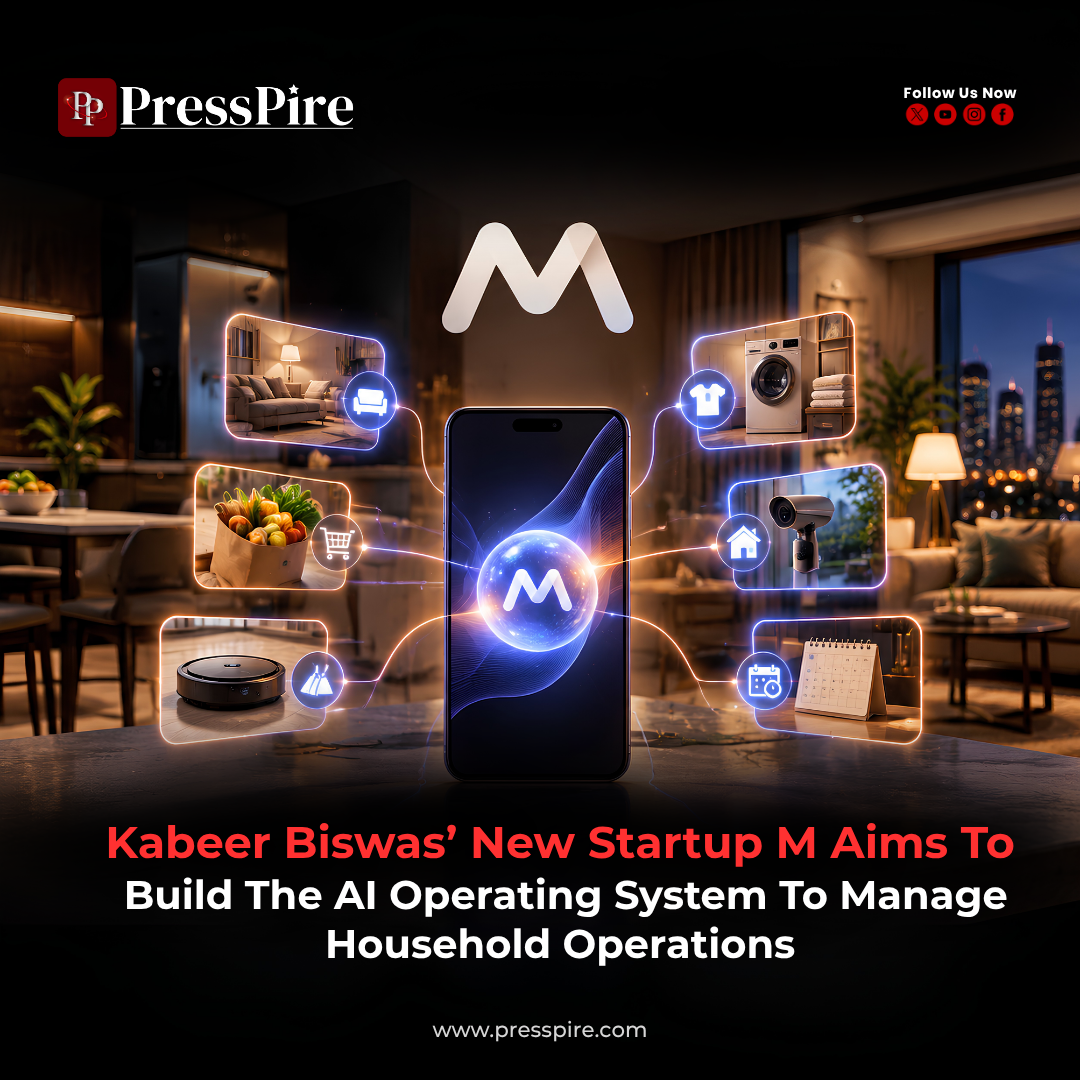
Kabeer Biswas’ New Startup M Aims to Build an AI Operating System for the Home
Kabeer Biswas’ startup M is taking artificial intelligence into household management, beginning with the kitchen. Its public website promotes a service covering meal planning, deliveries, staff coordination and payments.
The wider ambition is to build an AI operating system for the home: a service that helps coordinate recurring domestic activities and reduces the number of decisions household members need to manage themselves.
In a June 29, 2026 interview with Moneycontrol, Biswas described plans to expand beyond kitchens and connect household workflows with consumer services. That broader vision remains distinct from the kitchen-focused offering currently presented on M’s website.
What Is Kabeer Biswas’ Startup M
M is a consumer AI venture co-founded by Kabeer Biswas and Kartik Mishra. According to YourStory’s reporting, the business was incorporated in 2025 as Curious Digital Private Limited.
Biswas is known for co-founding Dunzo, which began as a service for outsourcing local errands and later expanded into delivery. His new venture returns to the question of how technology can make everyday household tasks easier to manage.
M’s own description focuses on relieving customers of kitchen coordination. The company wants household members to be able to pass routine requests to the service instead of organising every step themselves.
Why Household Management Is an AI Opportunity
Running a home involves a continuous flow of small decisions. Someone needs to decide what to cook, check which ingredients are available, communicate changes and follow up when something is missing.
Those tasks can interrupt the day even when individual actions take only a few minutes. A useful household assistant would need to understand how the decisions connect, including which instructions are recurring and which apply only once.
India’s Time Use Survey 2024 provides context for the scale of domestic work. Women aged 15–59 who participated in unpaid domestic services spent an average of approximately 305 minutes a day on those activities. The figure covers domestic work broadly; any time savings from M would require separate measurement.
The business opportunity is therefore about reducing the effort required to keep a household organised. Whether customers experience that benefit depends on how reliably the service handles their actual routines.
How M’s Kitchen Service Has Been Described
Moneycontrol’s June report described a WhatsApp-based service that begins by mapping a household’s routines, food preferences, preferred grocery brands and staff language.
M then prepares meal plans, considers available ingredients and communicates with the cook. The report also noted that parts of the workflow still involved human intervention, with fuller automation a longer-term objective.
The practical attraction is continuity. A family should not have to explain the same preference every time it plans a meal or replenishes supplies.
For example, a household might want a regular breakfast routine but a different dinner plan when guests visit. A useful service would preserve the recurring instructions while allowing that temporary change. This illustrates the coordination problem, rather than confirming every feature M currently provides.
Why Language and Household Context Matter
A kitchen assistant needs to handle the way people actually communicate.
In public posts shared by M, its engineering team describes processing cooks’ voice notes that mix Indian languages, English, accents and household shorthand. The team also identifies order histories, brand preferences and informal instructions as important sources of context.
This creates a demanding product problem. A request may be brief because the speaker assumes the listener already knows the household’s habits. The system must determine what is being requested without losing those details.
Personalisation also needs to remain editable. A family may switch brands, change its routine or stop following an earlier preference. Remembering information is useful only when the service can keep that information current.
For M, these interactions could become an important part of product development: understanding how a particular home works well enough to reduce repeated explanations.
What an AI Operating System for the Home Would Mean
In this context, an operating system describes a coordinating service for household activity. It would connect requests, preferences, schedules and external services so that individual tasks fit into a wider routine.
Biswas’s reported expansion plans include connections with quick-commerce, food-delivery, e-commerce and payment services. These were described as future integration goals in the June interview.
A broader system could potentially connect meal planning with shopping requirements and delivery timing. Its usefulness would depend on completing the sequence accurately, including handling changes and explaining when a task remains unfinished.
The challenge is to give people a clear view of what has been requested, what has been approved and what has actually happened. A household needs dependable completion, especially when several people are involved.
M’s Reported Seed Funding
In April 2026, YourStory reported a ₹102 crore seed fundraising round, approximately US$11 million, based on regulatory filings.
The reported investor allocations were:
| Investor | Reported contribution |
|---|---|
| Peak XV Partners | ₹46.4 crore |
| Blume Ventures | ₹37.12 crore |
| CRED through Dreamplug Technologies | ₹18.56 crore |
The same April report stated that ₹83.53 crore had already been received, with the remaining capital expected to follow. These figures describe the round as reported at that time.
The backing provides resources for building the product and service operation. Commercial success will depend on whether households continue using it and whether the company can deliver that experience at a sustainable cost.
Early Adoption and Current Availability
Moneycontrol reported that M served approximately 150 Bengaluru households in June 2026. That is an early adoption snapshot, rather than a verified current customer total.
As of September 26, 2026, M’s public website invites visitors to join a waitlist. Its homepage continues to emphasise kitchen management.
This makes the company’s initial focus clear. The publicly presented service centres on a recurring household need, while the ambition to manage a wider range of domestic operations creates a possible path for expansion.
Trust and Control Will Influence Adoption
A household service becomes more useful as it understands the people using it. That also makes clarity about information handling important.
M’s privacy policy lists personal information such as names, contact details, location and identifiers. It describes uses including account administration, responding to requests and personalising the service, and provides a route for users to request review, correction or deletion of their data.
Beyond information handling, people will need a clear understanding of the decisions delegated to the service. Spending limits, changes to standing instructions and the ability to correct mistakes are practical considerations for any household automation product.
These are also questions of usability. People are more likely to rely on a service when they can understand its actions and regain control easily when plans change.
What Will Determine Whether M Succeeds
M will need to demonstrate that its service reduces the work of managing a home over time.
Useful measures would include how many tasks are completed successfully, how often users need to repeat instructions and how much human support is required behind the scenes. Customer retention and willingness to pay would help establish whether the convenience is valuable enough to sustain a business.
Expansion will bring another test: whether the product can adapt to households with different languages, routines, staffing arrangements and expectations without making onboarding excessively complicated.
Kabeer Biswas’ startup M offers a concrete example of consumer AI being applied to daily coordination. Its progress will depend on turning that ambition into a service people can trust with ordinary, recurring responsibilities.
For more insights navigate: PressPire | Stories That Shape the Future
Read previous article here: Ema AI Employees HR It Finance Automation
Follow PressPire on Facebook | Instagram | LinkedIn | YouTube
PressPire | Stories That Shape the Future