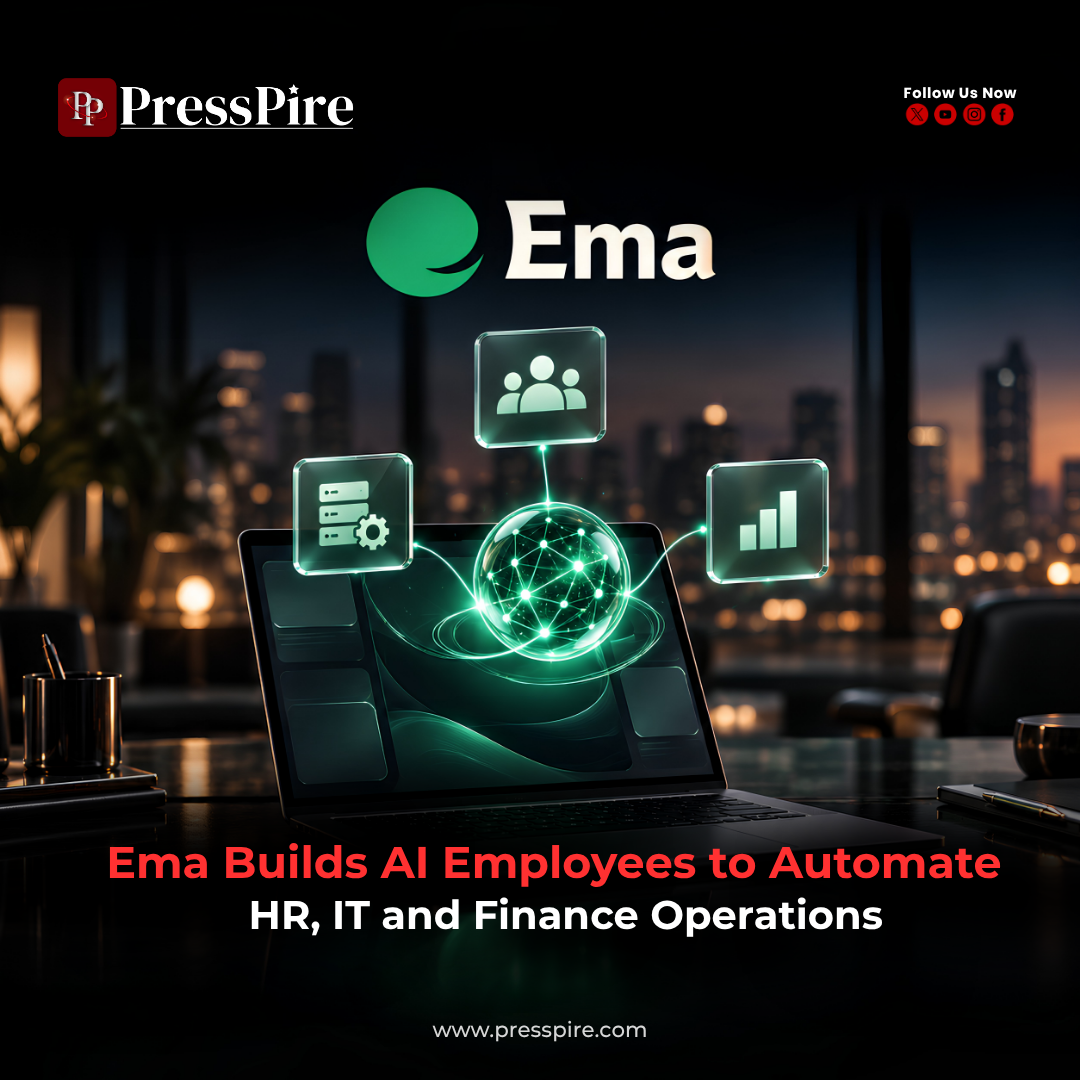
Ema Builds AI Employees to Automate HR, IT and Finance Operations
Ema AI employees are designed to help companies handle everyday work across human resources, IT and finance. The enterprise AI company markets software agents that can use organisational knowledge, connect with business applications and carry out configured workflows.
Its approach targets a familiar problem: employees often spend hours looking up policies, moving information between applications and following up on requests. Automating those handoffs could give teams more time for work that requires judgement, specialist expertise and personal interaction.
What Is Ema
Ema was founded in California in 2023. The company is led by founder and CEO Surojit Chatterjee, whose previous roles include chief product officer at Coinbase and senior product leadership at Google.
The company uses the term “AI employees” for applications built from cooperating AI agents. These agents can specialise in tasks such as extracting information from documents, checking rules, preparing responses and taking actions in connected systems.
For a business, the practical objective is to turn a request into a completed process while retaining control over the information and applications involved.
How Ema AI Employees Work
At the centre of the platform is Ema’s Generative Workflow Engine. According to the company, it coordinates specialised agents to work towards a defined goal, using relevant knowledge and tools.
A workflow can combine document processing, information retrieval, validation and execution. Human review can be included where the process requires approval or where an agent needs help handling a sensitive decision.
Ema also uses EmaFusion, its technology for combining multiple AI models. The company describes this as a way to improve accuracy and manage costs across different tasks. These are design objectives whose results depend on the workload and deployment
Consider an illustrative onboarding request. Completing it may involve checking employee details, coordinating payroll information, arranging system access and tracking outstanding steps. Ema’s employee experience offering is designed to connect these activities across departments.
Automating HR and Employee Support
Human resources teams handle a wide range of recurring questions and administrative processes. Ema positions its employee experience products across recruitment, onboarding, employee support, talent management and offboarding.
The company describes capabilities that include:
- Coordinating onboarding tasks across HR, IT and payroll.
- Answering employee questions using organisational policies and context.
- Providing personalised training and support after joining.
- Preparing and distributing documents during employee exits.
Its HR offering also accounts for differences in employee location, role and organisational policies. That context matters because the appropriate response to a workplace question can vary between teams and countries.
The potential value is easier access to services and less manual coordination. For example, an employee seeking a policy explanation should be able to reach the relevant information without repeatedly transferring the same question between departments.
Supporting IT Helpdesks and Routine Requests
Ema’s IT Helpdesk template classifies requests by category and priority, searches internal troubleshooting documentation and recommends either self-service steps or escalation.
Its documented categories cover password resets, software installation, hardware, network problems and access permissions. This gives IT teams a structured way to handle incoming requests and direct attention to the issues that need specialist support.
Actual execution depends on configuration. Ema’s documentation states that the default template recommends resolution steps or an escalation path. Actions such as resetting a password or provisioning software require the relevant tools to be connected.
This distinction helps explain how enterprise automation works in practice. The AI needs suitable documentation to guide its response, connected systems to perform actions and permissions that define what it can do.
Automating Finance Operations
Ema’s finance offering focuses on processes involving invoices, payments, collections and accounting records. The company says its agents can work across existing finance applications, email and business portals.
Its published capabilities include:
- Accounts payable: Extracting invoice information, matching it against purchase orders and receipts, and flagging duplicates or mismatches.
- Collections: Preparing follow-ups and connecting disputed invoices with relevant contracts and usage records.
- Financial close: Reconciling transactions, identifying differences and preparing journal entries for review.
- Evidence collection: Organising supporting documents for checks and approval processes.
Ema says high-impact actions can remain subject to human sign-off, with decisions and actions recorded for review.
For finance teams, the opportunity is to reduce repetitive checking and data movement while keeping clear responsibility for approvals. The value will depend on the quality of source records, the rules applied and how exceptions are handled.
Connecting Existing Enterprise Applications
Ema advertises more than 250 native integrations across areas including HR, finance, customer relationship management, ticketing and project management. It also provides options for custom connections.
These connections are central to the product’s usefulness. A workflow spanning several departments may need information from one application, an approval from another and an update to a third.
For example, an onboarding process can involve separate employee records, collaboration tools and identity systems. Connecting them creates the possibility of completing the process with fewer manual handoffs.
In practice, organisations still need to establish which records are authoritative, which data can be shared and which actions each workflow is permitted to perform.
New Hubs Introduce a Phased Rollout
In a product announcement dated September 3, 2026, Ema described department-focused hubs for HR, IT and finance. The post specified that HR and IT would come first, with Finance next.
That rollout sequence is relevant when evaluating the new hubs. Ema separately markets a finance operations suite, so the timing of the hub rollout should be distinguished from the broader finance capabilities described on its website.
The hubs reflect the company’s effort to organise AI employees around recognisable departmental work, making it easier for business teams to identify relevant applications.
Human Oversight and Access Controls
Workflows involving employee records, account access and financial information need clearly defined boundaries.
Ema says its platform supports role-based and attribute-based permissions, detection and redaction of personally identifiable information, audit trails and configurable human approval chains. It also offers on-premises and isolated deployment options.
These features give organisations ways to define who can use an AI employee, what information it can access and which actions require review.
A useful deployment therefore combines automation with explicit ownership. Teams need to know who maintains the workflow, who reviews exceptions and how mistakes are identified and corrected.
Funding and Enterprise Adoption
On September 23, 2026, Ema announced a $77 million Series B funding round led by Creaegis, with existing investors Accel, S32 and Prosus increasing their investments.
The company said the round brought its total funding to $140 million. It plans to use the capital to develop the platform, expand its commercial organisation and enter additional markets across Asia-Pacific, Europe, the Middle East and Africa.
Ema also points to enterprise deployments as evidence of adoption. In its Wipro customer case study, it reports more than 2.9 million queries handled annually, a 20% increase in employee satisfaction and a 50% reduction in HR operations costs. These are results reported by Ema for that specific deployment.
Such examples provide a basis for examining how AI can operate inside large organisations. Buyers would still need to assess performance against their own processes, data and service requirements.
What Ema’s Approach Means for Businesses
Ema’s strategy brings attention to the work that happens between enterprise applications: finding information, applying policies, requesting approvals and updating records.
For businesses, the strongest case for adoption will come from measurable improvements. Relevant measures include completed requests, resolution time, error rates, human review requirements and total operating cost.
The effect on employees will also depend on how companies redesign responsibilities. Reducing repetitive administration could create more time for complex support, relationship management and process improvement, but those benefits require deliberate implementation.
Ema AI employees offer one approach to coordinating this work. Their long-term value will depend on how consistently they complete useful tasks, respect organisational boundaries and support the people responsible for business outcomes.
For more insights navigate: PressPire | Stories That Shape the Future
Read previous article here: Maruti Suzuki Green Hydrogen Plant Manesar
Follow PressPire on Facebook | Instagram | LinkedIn | YouTube
PressPire | Stories That Shape the Future