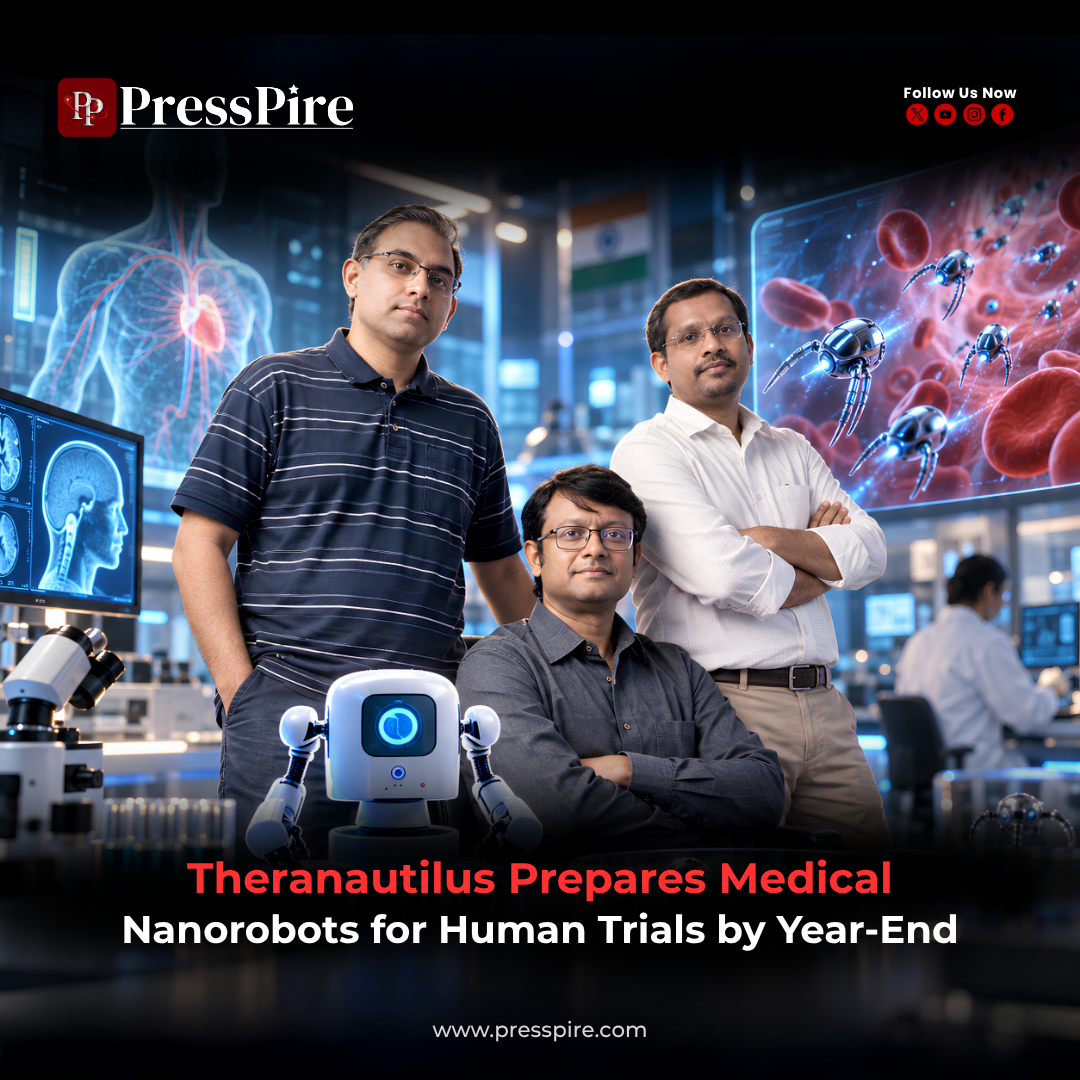
Theranautilus Prepares Medical Nanorobots for Human Trials by Year-End
Theranautilus Prepares Medical Nanorobots for Human Trials by Year-End, marking a significant development in India’s emerging field of medical nanotechnology. The Bengaluru-based deep-tech startup is working on microscopic robotic systems that could support future medical treatments through targeted interventions inside the human body.
Nanorobotics represents one of the most advanced areas of healthcare innovation, combining engineering, materials science, robotics, and medicine. These tiny machines are being researched for applications such as targeted drug delivery, precision treatment, and minimally invasive medical procedures.
Theranautilus’ progress highlights India’s growing capabilities in deep-tech healthcare research and the increasing role of startups in developing advanced medical technologies.
Theranautilus Prepares Medical Nanorobots for Advanced Healthcare Applications
Theranautilus Prepares Medical Nanorobots for Human Trials by Year-End as the company works toward bringing next-generation medical robotics closer to clinical applications.
Traditional medical treatments often involve delivering medicines throughout the body, which can sometimes affect healthy tissues along with targeted areas.
Nanorobotics aims to create systems that can deliver treatments more precisely by operating at microscopic levels.
Potential applications of medical nanorobots include:
- Targeted drug delivery
- Precision medicine
- Diagnostics
- Minimally invasive treatments
- Advanced therapeutic procedures
The ability to control tiny robotic systems inside biological environments could transform how certain medical conditions are diagnosed and treated in the future.
How Medical Nanorobots Work Inside the Human Body
Theranautilus Prepares Medical Nanorobots for Human Trials by Year-End as researchers continue exploring how microscopic robots can function safely within biological systems.
Medical nanorobots are designed to operate at extremely small scales, often comparable to biological structures.
These systems may use different mechanisms for movement and control, including:
Magnetic Control
External magnetic fields can be used to guide and control tiny robotic systems.
Targeted Movement
Nanorobots can be designed to move toward specific areas inside the body.
Precision Delivery
They may help deliver therapeutic materials directly to targeted locations.
Developing these technologies requires solving complex challenges related to movement, safety, and biological compatibility.
Theranautilus Represents India’s Growing Deep-Tech Healthcare Ecosystem
Theranautilus Prepares Medical Nanorobots for Human Trials by Year-End, reflecting the growth of India’s deep-tech startup ecosystem.
Unlike traditional software startups, deep-tech companies focus on solving complex scientific and engineering challenges.
These companies often work across areas such as:
- Biotechnology
- Robotics
- Artificial intelligence
- Advanced materials
- Healthcare technology
Theranautilus was founded by researchers associated with the Indian Institute of Science (IISc), Bengaluru, and focuses on developing nanorobotics-based healthcare solutions.
The company represents the increasing connection between academic research and commercial innovation in India.
From Laboratory Research to Medical Applications
Theranautilus Prepares Medical Nanorobots for Human Trials by Year-End as the company moves from research-focused development toward potential real-world healthcare applications.
Transforming a scientific concept into a medical product requires multiple stages, including:
Technology Development
Researchers must design robotic systems that can perform specific functions.
Safety Testing
Medical technologies require extensive evaluation to ensure they are safe for human use.
Clinical Validation
Human trials help determine effectiveness and practical applications.
Regulatory Approval
Healthcare products must meet regulatory standards before wider adoption.
The journey from laboratory research to patient use is complex and requires collaboration between scientists, doctors, and regulatory authorities.
Nanorobotics Could Change the Future of Precision Medicine
Theranautilus Prepares Medical Nanorobots for Human Trials by Year-End as precision medicine becomes an important focus area in healthcare innovation.
Precision medicine aims to provide treatments that are more specifically designed for individual patients and conditions.
Nanorobotics could support this approach by enabling:
Targeted Treatment
Medical interventions could potentially focus on specific areas instead of affecting the entire body.
Reduced Side Effects
More precise delivery methods may help minimise unintended effects.
Improved Treatment Efficiency
Direct interaction with targeted areas could improve therapeutic outcomes.
Researchers worldwide are exploring nanotechnology as a potential tool for improving healthcare delivery.
Challenges in Developing Medical Nanorobots
Theranautilus Prepares Medical Nanorobots for Human Trials by Year-End while working in one of the most challenging areas of medical technology.
Several challenges remain before nanorobots can become widely used in healthcare.
Safety Concerns
Researchers must ensure that nanorobots do not create harmful effects inside the body.
Control and Navigation
Accurately controlling microscopic robots in complex biological environments is technically difficult.
Manufacturing Challenges
Producing reliable nanorobots at scale requires advanced manufacturing capabilities.
Regulatory Requirements
Medical technologies must undergo strict evaluation before reaching patients.
Overcoming these challenges will be essential for the future development of medical nanorobotics.
India’s Role in Future Medical Robotics Innovation
Theranautilus Prepares Medical Nanorobots for Human Trials by Year-End, highlighting India’s expanding role in advanced healthcare technology.
India has seen increasing innovation in areas such as:
- Biotechnology
- Medical devices
- Artificial intelligence healthcare solutions
- Robotics
Research institutions and startups are working together to develop technologies that address complex healthcare challenges.
The growth of deep-tech companies indicates a shift toward innovation-driven healthcare solutions developed within India.
Theranautilus Prepares Medical Nanorobots for Human Trials and Future Healthcare Transformation
Theranautilus Prepares Medical Nanorobots for Human Trials by Year-End, representing a major step in India’s medical nanotechnology journey.
The development of microscopic robotic systems could open new possibilities in targeted treatment, diagnostics, and precision healthcare.
As research progresses, nanorobotics may become an important part of future medicine, combining engineering innovation with advanced medical science.
For more insights navigate: PressPire | Stories That Shape the Future
Read previous article here: https://presspire.com/starbucks-first-india-gcc-chennai/
Follow PressPire on Facebook | Instagram | LinkedIn | YouTube
PressPire | Stories That Shape the Future