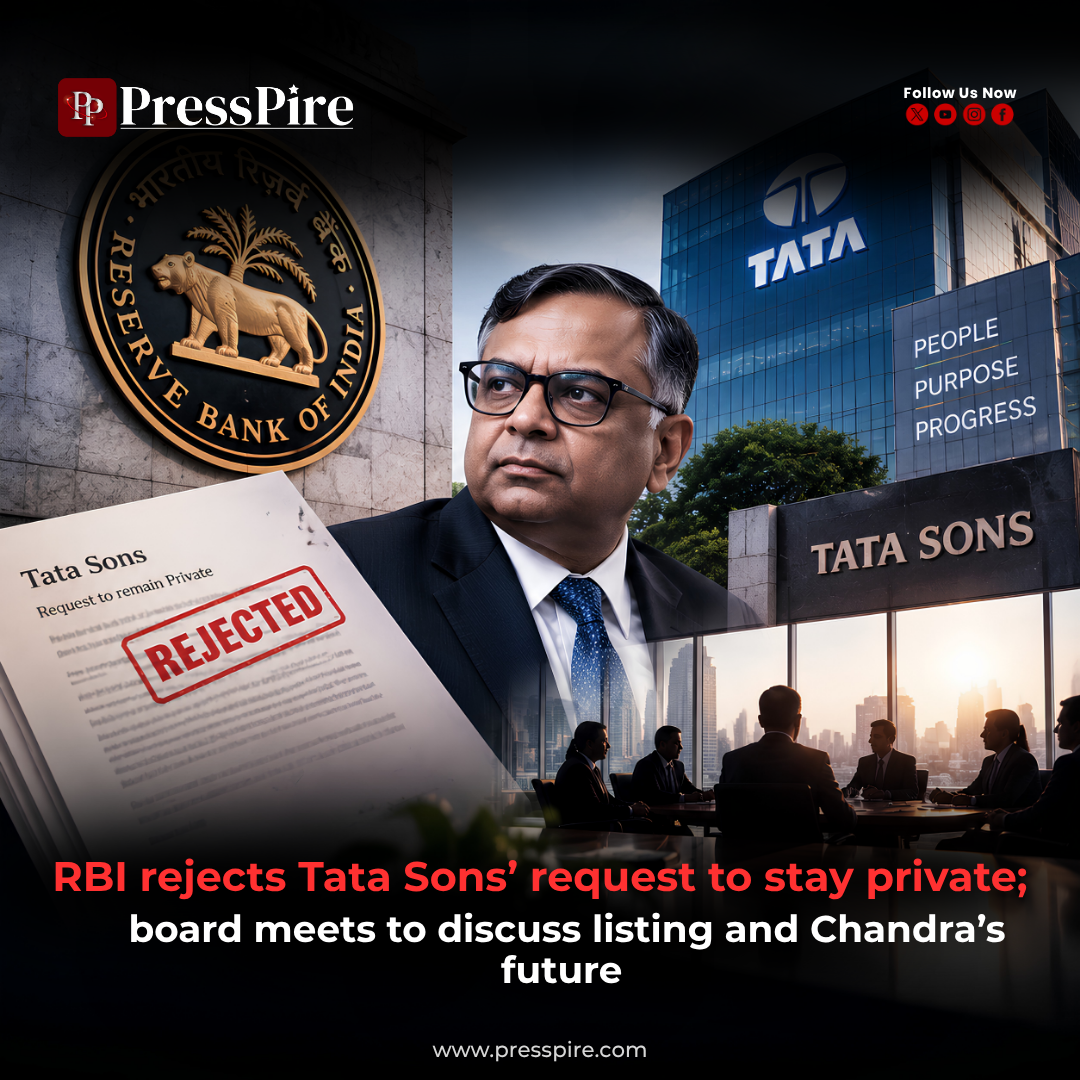
RBI Rejects Tata Sons’ Request to Stay Private; Board Meets to Discuss Listing and Chandra’s Future
RBI rejects Tata Sons’ request to stay private as the Tata Group’s holding company faces a major strategic decision regarding its future structure. The Reserve Bank of India’s decision has increased focus on whether Tata Sons will proceed with a public listing and how the company plans to address regulatory requirements.
Tata Sons is the principal investment holding company and promoter of the Tata Group, one of India’s largest business groups with operations across sectors including technology, automobiles, steel, aviation, consumer products, and financial services.
The development comes as company evaluates its options following its classification as an upper-layer non-banking financial company (NBFC) under the Reserve Bank of India’s regulatory framework.
Tata Sons Faces RBI Listing Requirement After Private Status Request Rejected
Tata Sons faces a significant corporate decision after the RBI rejected its request to remain outside the requirement for public listing.
The Reserve Bank of India introduced regulations for large non-banking financial companies, including requirements related to governance, transparency, and regulatory compliance.
Under these rules, certain upper-layer NBFCs are required to list their shares within a specified period.
Tata Sons was classified as an upper-layer NBFC because of the scale and nature of its financial activities as a holding company.
The company had sought exemption from the listing requirement, but the RBI decision means Tata Sons may need to consider steps toward becoming a publicly listed entity.
Tata Sons’ Potential Listing Could Become a Major Corporate Market Event
A potential Tata Sons listing would represent a significant development in India’s corporate market.
Company holds stakes in several major Tata Group companies, including:
- Tata Consultancy Services (TCS)
- Tata Motors
- Tata Steel
- Tata Consumer Products
- Tata Power
- Tata Electronics
As the holding company of the Tata Group, Company plays a central role in managing investments and strategic direction across the group.
A public listing could provide investors direct ownership exposure to the holding company and its portfolio of businesses.
Tata Sons Board Discusses Future Strategy and Leadership Direction
Tata Sons board discussions have also drawn attention toward the company’s future leadership plans.
N. Chandrasekaran, commonly known as Chandra, has served as chairman of Company since 2017 and has played a key role in guiding the group’s strategy.
During his tenure, Tata Group has focused on areas including:
Technology Expansion
The group has strengthened its presence in technology and digital businesses through companies such as TCS.
Semiconductor Ambitions
Tata has entered the semiconductor sector with plans related to chip manufacturing and electronics production.
Electric Mobility
Tata Motors has expanded its focus on electric vehicles and sustainable transportation.
New Manufacturing Investments
The group has increased investment in areas such as electronics, aviation, and infrastructure.
Leadership discussions are taking place as Company evaluates its next phase of growth.
Company Role in the Tata Group Ecosystem
Company has historically played the role of guiding the Tata Group’s strategic direction.
The company manages investments in various Tata businesses and provides oversight across the group.
The Tata Group operates through multiple companies across industries, including:
- Information technology
- Automotive
- Consumer goods
- Energy
- Infrastructure
- Financial services
- Manufacturing
The holding company structure allows Company to coordinate long-term strategies while maintaining individual operations across different businesses.
Why Tata Sons Listing Matters for Investors and Markets
A Tata Sons listing could attract significant interest because of the value of its underlying investments.
Investors often look at holding companies based on:
- Value of subsidiary investments
- Corporate governance structure
- Growth strategy
- Capital allocation approach
A listed Tata Sons entity would create a new publicly traded company connected to one of India’s largest business groups.
However, the listing process would involve decisions around valuation, regulatory compliance, shareholder structure, and market timing.
RBI Regulations Drive Changes Among Large Financial Companies
The Tata Sons development reflects broader changes in financial regulation.
The RBI has strengthened oversight of large NBFCs to improve governance standards and reduce risks in the financial system.
Upper-layer NBFC regulations focus on areas such as:
- Enhanced supervision
- Risk management
- Transparency requirements
- Corporate governance standards
Large financial institutions are required to align their structures with these regulatory expectations.
Tata Sons’ Future Strategy Amid Changing Business Landscape
Tata Sons is navigating a period of significant transformation as industries undergo rapid changes.
The group is investing in emerging sectors such as:
- Semiconductor manufacturing
- Artificial intelligence
- Digital technology
- Renewable energy
- Electric mobility
The company’s future decisions around listing and leadership will influence how the Tata Group approaches its next phase of growth.
Tata Sons Listing Decision Could Shape India’s Corporate Landscape
The RBI decision regarding Tata Sons’ private status has brought renewed attention to one of India’s most influential corporate institutions.
The company now faces important decisions related to regulatory compliance, ownership structure, and future governance.
As Tata Sons evaluates its options, the outcome could have implications for investors, financial markets, and the broader Indian corporate sector.
For more insights navigate: PressPire | Stories That Shape the Future
Read previous article here: https://presspire.com/prada-delays-india-retail-entry-kolhapuri/
Follow PressPire on Facebook | Instagram | LinkedIn | YouTube
PressPire | Stories That Shape the Future