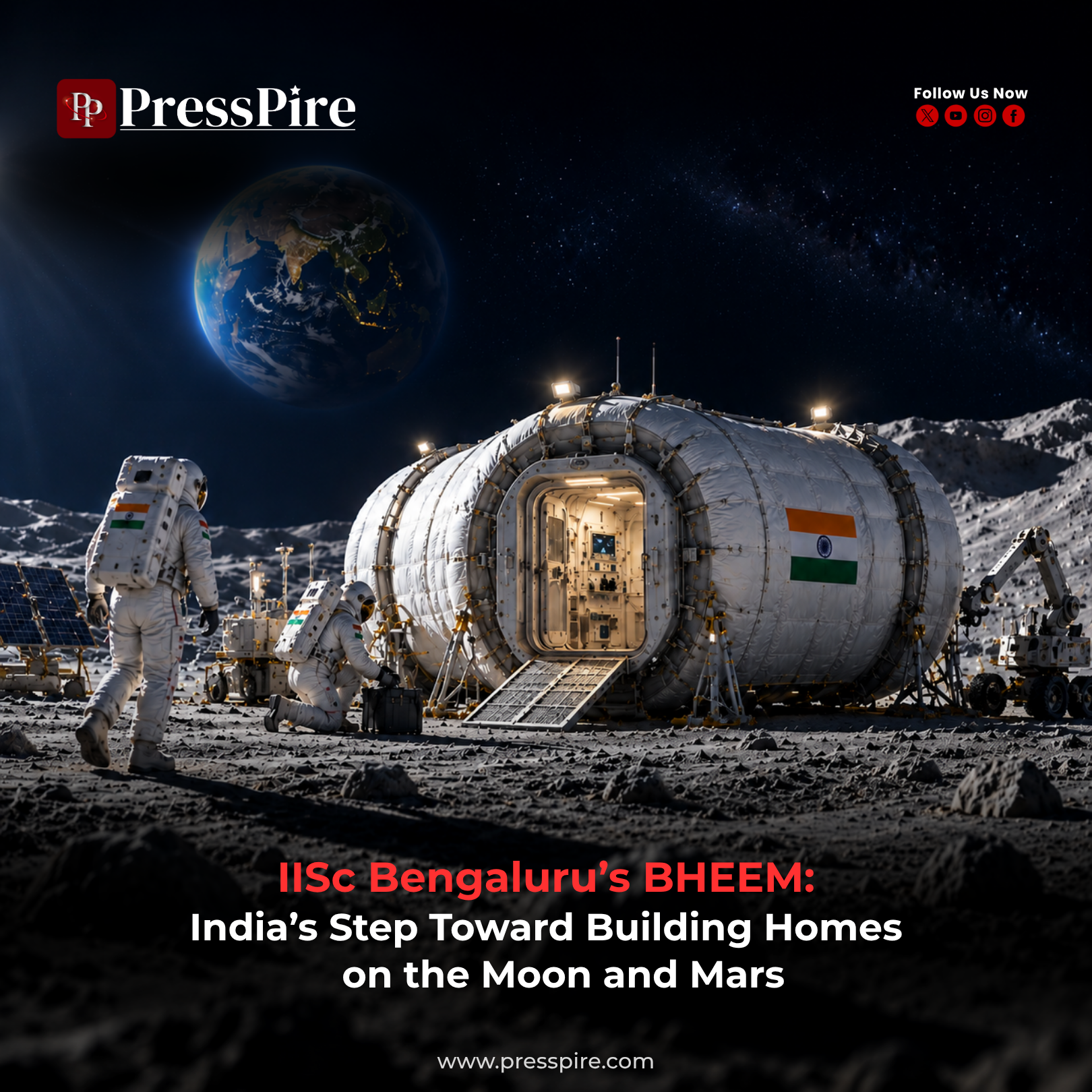
IISc Bengaluru’s BHEEM: India’s Step Toward Building Homes on the Moon and Mars
IISc Bengaluru’s BHEEM is exploring how future astronauts could build habitats on the Moon and Mars using locally available materials, marking an important step in India’s research toward long-duration space exploration. Developed by researchers at the Indian Institute of Science (IISc) Bengaluru, the project focuses on creating innovative solutions for extraterrestrial construction and sustainable living beyond Earth.
As space agencies around the world prepare for future lunar missions and possible human exploration of Mars, one of the biggest challenges is creating safe living environments away from Earth. Transporting every material required for construction from Earth would be extremely expensive and technically challenging.
This has led scientists to explore the concept of using resources available on other planetary bodies. By studying materials such as lunar soil and developing advanced construction techniques, researchers aim to understand how future space habitats could be created in extraterrestrial environments.
The BHEEM project reflects India’s growing contribution to future space technology research, combining engineering, materials science, and space exploration concepts.
IISc Bengaluru’s BHEEM Explores the Future of Extraterrestrial Habitats
IISc Bengaluru’s BHEEM focuses on developing technologies that could support future human settlements beyond Earth.
Building habitats on the Moon or Mars requires solutions that can withstand extreme environments. Unlike Earth, these locations do not have natural conditions suitable for human survival.
Future space habitats will need to provide:
- Protection from radiation
- Temperature control
- Structural strength
- Long-term durability
- Efficient use of available resources
The project explores ways to create construction methods that are practical for space missions where resources, transportation capacity, and human labour are limited.
The research aligns with a global effort to develop technologies that could support extended human presence in space.
IISc Bengaluru’s BHEEM Building Homes Beyond Earth: The Challenge of Moon and Mars Construction
Creating homes on the Moon and Mars presents unique engineering challenges.
On Earth, construction depends on easily available materials, established infrastructure, and human resources. In space environments, these advantages do not exist.
Future explorers may need to construct habitats using materials available directly on the Moon or Mars.
This approach is known as in-situ resource utilisation (ISRU), which focuses on using local resources instead of transporting everything from Earth.
For lunar missions, scientists are studying the possibilities of using lunar regolith, the layer of loose material covering the Moon’s surface.
On Mars, researchers are exploring available resources that could potentially support future construction processes.
Using local materials could reduce mission costs and improve the feasibility of long-term exploration.
Bio-Inspired Engineering Could Shape Future Space Structures
The BHEEM project explores concepts inspired by natural systems to develop efficient construction approaches.
Nature often creates structures that are strong, lightweight, and resource-efficient. Engineers study these designs to develop solutions that can perform effectively under challenging conditions.
Bio-inspired engineering can help researchers explore:
Lightweight Structures
Reducing material requirements is important because transporting materials from Earth increases mission complexity and cost.
Strong Construction Methods
Space habitats must withstand environmental challenges such as radiation, temperature changes, and surface conditions.
Sustainable Design
Future settlements will require systems that minimise waste and maximise available resources.
These principles could support the development of practical habitat designs for extraterrestrial environments.
IISc Bengaluru’s BHEEM India’s Growing Contribution to Future Space Technology Research
India’s space ambitions have expanded significantly through achievements in satellite technology, lunar exploration, and planetary missions.
While ISRO has led India’s major space missions, academic institutions such as IISc Bengaluru contribute through research in advanced technologies required for future exploration.
Space habitat development requires collaboration across multiple disciplines, including:
- Aerospace engineering
- Materials science
- Robotics
- Biotechnology
- Construction engineering
- Planetary research
Research initiatives like BHEEM demonstrate how universities and scientific institutions can contribute to solving complex challenges associated with future space missions.
IISc Bengaluru’s BHEEM Why Sustainable Habitats Are Important for Future Space Missions
Long-duration space missions require technologies that allow astronauts to remain independent from Earth for extended periods.
Future missions to the Moon and Mars will face several challenges:
Radiation Exposure
Space environments have higher radiation levels compared with Earth, requiring strong protective structures.
Limited Resources
Astronauts cannot depend on continuous supplies from Earth, making resource utilisation essential.
Harsh Environmental Conditions
Extreme temperatures and surface conditions require specially designed habitats.
Developing sustainable construction methods will be a key factor in enabling future human exploration.
IISc Bengaluru’s BHEEM Represents India’s Space Innovation Journey
IISc Bengaluru’s BHEEM highlights India’s expanding interest in technologies that could support future exploration beyond Earth.
The project represents a shift from traditional space missions focused mainly on satellites and scientific observation toward technologies required for human presence in space.
As global space programmes move toward longer missions, research on habitat construction, resource utilisation, and sustainable systems will become increasingly important.
India’s participation in this field demonstrates the country’s growing role in developing solutions for the future of space exploration.
The Future of Human Settlements on the Moon and Mars
The possibility of humans living beyond Earth depends on solving some of the most complex engineering problems ever attempted.
Creating habitats on the Moon and Mars will require innovation in materials, construction techniques, robotics, and resource management.
Projects exploring extraterrestrial construction provide valuable knowledge that could shape future missions and expand humanity’s ability to operate in space.
The development of technologies for off-world habitats represents a significant step toward a future where humans may establish a longer-term presence beyond Earth.
For more insights navigate: PressPire | Stories That Shape the Future
Read previous article here: https://presspire.com/upi-revolution-india-digital-payment-ecosystem/
Follow PressPire on Facebook | Instagram | LinkedIn | YouTube
PressPire | Stories That Shape the Future