
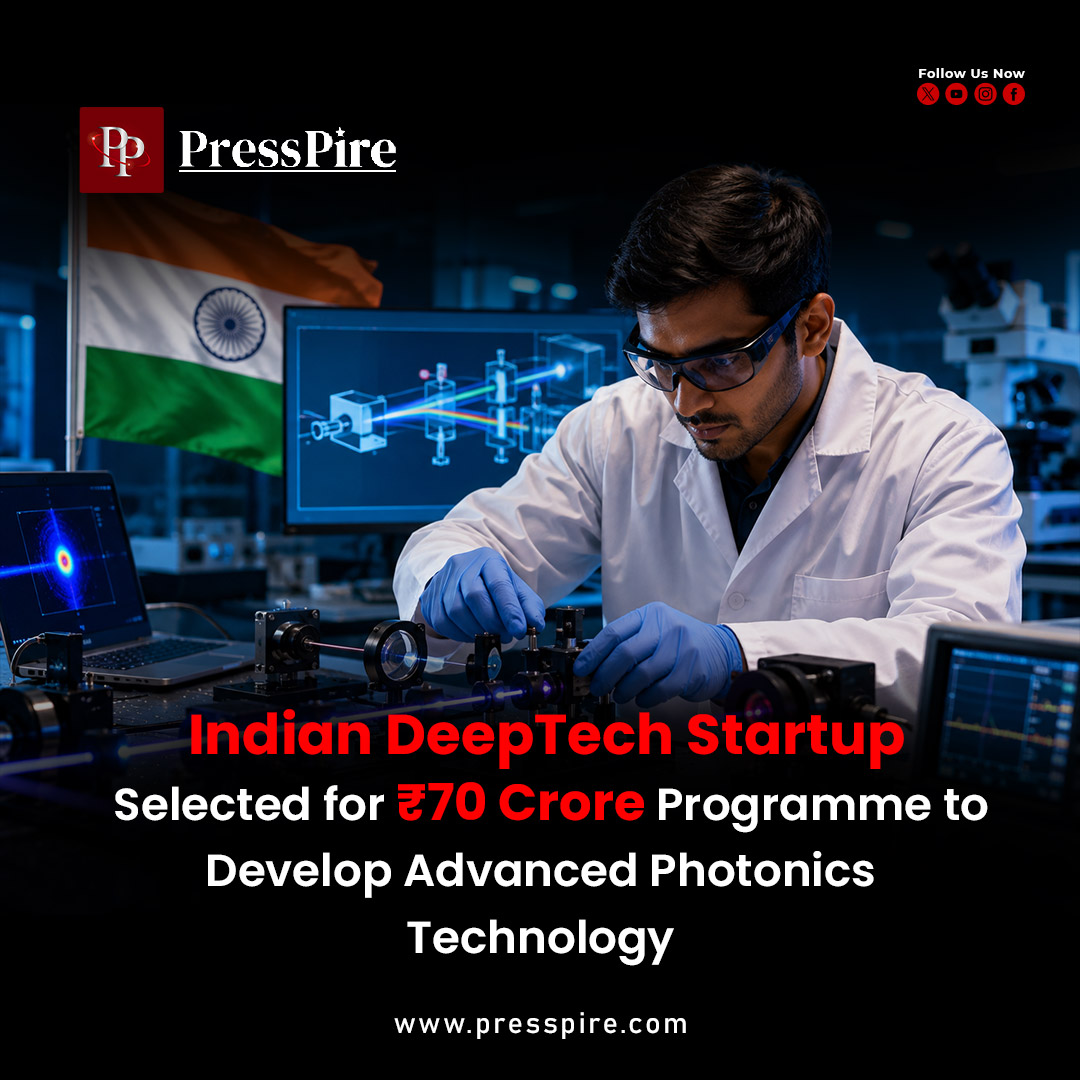
Olee.space Selected for ₹70 Crore Advanced Photonics Programme, Marking a New Chapter for India’s DeepTech Ambitions
India’s deeptech ecosystem is entering a phase where scientific research is increasingly being converted into strategic, production-ready technology, and the Olee.space Advanced Photonics Programme is an important example of this transition. Olee.space, an Indian advanced photonics and defence technology company, has been nominated as the Development-cum-Production Partner for a ₹70 crore Government of India programme focused on advancing strategic photonics technologies. The 24-month initiative is designed to take sophisticated optical technologies beyond research and development and move them through engineering, fabrication, system integration, testing, validation and production readiness.
The development is significant because photonics sits at the intersection of several technology-intensive industries. Optical technologies are increasingly important for communications, aerospace, defence, advanced manufacturing, sensing and other strategic applications. Building these capabilities domestically can help India strengthen its technology supply chains while reducing dependence on specialised foreign systems.
For Olee.space, the programme represents more than a development opportunity. It places the company at the centre of an effort to translate advanced photonics research into engineered and potentially scalable systems. For India’s broader startup ecosystem, it also highlights how deeptech companies can become important contributors to national technology programmes when scientific expertise is combined with engineering and manufacturing capabilities.
Table of Contents
Olee.space Advanced Photonics Programme Moves DeepTech From Research to Production
The central importance of the Olee.space Advanced Photonics Programme lies in its emphasis on the complete technology development cycle.
According to reports, the 24-month programme will cover research, technology development, engineering, fabrication, system integration, testing, validation and production readiness. Development is expected to progress against defined milestones and acceptance requirements.
This approach reflects one of the biggest challenges facing deeptech startups. Developing a promising technology in a laboratory is only the first step. Turning that technology into a dependable product requires precision engineering, repeatable manufacturing processes, extensive testing, reliable components and the ability to integrate multiple subsystems.
Photonics is particularly demanding in this regard. Optical systems often require extremely precise alignment and control. Performance can be affected by environmental conditions, component quality, vibration, temperature and manufacturing tolerances. Moving from a successful research prototype to a reliable production system therefore requires capabilities across several disciplines.
The programme’s development-cum-production structure is important because it creates a pathway that connects technological development with eventual production readiness. Instead of treating research and manufacturing as separate stages, the initiative brings them into a broader development framework.
For India, this model could become increasingly relevant as the country attempts to build a stronger domestic deeptech manufacturing base.
Why Advanced Photonics Is Becoming Strategically Important
Photonics is fundamentally concerned with the generation, control, transmission and detection of light. While the technology has existed for decades, advances in optical components, photonic architectures and precision engineering are opening new possibilities across multiple industries.
Telecommunications is one of the most familiar applications. Fibre-optic networks depend on photonics to transmit enormous volumes of information over long distances. As demand for data centres, cloud computing, artificial intelligence and high-speed connectivity grows, optical technologies are becoming even more important to digital infrastructure.
The role of photonics extends well beyond communications.
In aerospace, optical systems can support high-speed communication, sensing and navigation. In defence, advanced optical technologies can contribute to secure communication, precision sensing and other strategic systems. Industrial applications include advanced manufacturing, measurement, inspection and automation.
Photonics is also increasingly connected with emerging areas such as quantum technologies and next-generation computing.
This makes domestic expertise in photonics strategically valuable. A country that can design, manufacture and integrate advanced optical systems has the potential to participate in a much wider technology ecosystem.
The ₹70 crore programme therefore arrives at a time when India is seeking to strengthen capabilities in areas that could shape future technology competitiveness.
Olee.space and India’s Growing DeepTech Ecosystem
Olee.space has positioned itself around advanced photonics and defence technology, with a focus on developing optical systems and technologies for strategic applications. The company has highlighted areas including free-space optical communication and directed-energy technologies.
Its nomination as the Development-cum-Production Partner gives the company an opportunity to demonstrate how an Indian deeptech venture can move from research and technological experimentation toward large-scale engineering and production.
This is particularly relevant to India’s evolving startup landscape.
For much of the previous decade, India’s startup narrative was dominated by consumer internet businesses, fintech, e-commerce and software services. Deeptech is now adding a different dimension to the ecosystem.
Deeptech startups typically require longer development cycles, specialised talent, expensive equipment and significant investment before commercialisation. Their technologies can involve complex intellectual property and extensive validation. As a result, government programmes and strategic partnerships can play a meaningful role in helping such companies bridge the gap between invention and industrial deployment.
The Olee.space development illustrates this changing environment.
The company’s role in the programme is not limited to research. The development pathway includes engineering, fabrication, integration and testing. This means the initiative could help build capabilities that extend beyond a single technology demonstration.
It could also create opportunities for suppliers, engineers, component manufacturers and technology partners within the wider ecosystem.
Olee.space Advanced Photonics Programme Could Strengthen Domestic Manufacturing
One of the most important aspects of the Olee.space Advanced Photonics Programme is its focus on production readiness.
India has made significant progress in building capabilities across electronics, semiconductor manufacturing, aerospace and defence production. However, sophisticated optical technologies often depend on specialised components, precision manufacturing and highly controlled production environments.
Building these capabilities domestically is not simply about replacing imported products. It is about developing an ecosystem capable of designing, testing, manufacturing and improving advanced systems over time.
A successful programme can contribute to this process by creating demand for specialised engineering capabilities.
Precision optics, optical sources, photonic architectures, detectors, electronics, mechanical systems and software may all need to work together in an advanced optical platform. Developing these systems locally can encourage companies and research institutions to build expertise in complementary areas.
The result could be a broader industrial ecosystem rather than a standalone technology.
This is where the production element of the programme becomes particularly important. If technologies developed during the programme successfully progress toward repeatable manufacturing, India could gain experience that can later be applied across other photonics applications.
From Indian Research to Globally Competitive Technology
The long-term significance of the initiative may ultimately be measured by whether Indian photonics companies can compete internationally.
Photonics is a global industry. Companies around the world are developing technologies for telecommunications, aerospace, industrial automation, sensing and strategic applications. India has a large pool of engineers and scientists, but transforming that talent into globally competitive hardware requires sustained investment in product development and manufacturing.
Olee.space has described the programme as an important step in its ambition to develop globally competitive photonic technologies from India.
That ambition reflects a broader opportunity for Indian deeptech companies.
Instead of competing primarily on software development and IT services, Indian technology companies can increasingly participate in hardware-intensive industries where intellectual property, engineering and manufacturing determine competitive advantage.
Photonics could become one such field.
India’s ability to develop optical technologies for communications, aerospace and other strategic applications could create opportunities not only in the domestic market but also across international markets.
However, global competitiveness will require more than government-backed development programmes. Companies will need strong intellectual property, dependable supply chains, international certifications, competitive pricing, product reliability and the ability to scale production.
The ₹70 crore programme can provide an important foundation, but commercial execution will ultimately determine its broader impact.
What the Programme Means for India’s Strategic Technology Future
The selection of Olee.space comes at an important moment for India’s technology ambitions.
The country is increasingly focused on building domestic capabilities in strategically important technologies rather than relying entirely on imported systems. Photonics fits naturally into this strategy because optical technologies are relevant across communications, defence, aerospace, industrial technology and advanced infrastructure.
The programme’s structured 24-month development cycle also reflects the realities of deeptech innovation. Complex technologies require time for engineering, testing and validation. Moving directly from a research concept to commercial deployment is rarely possible.
A milestone-based development framework can help establish technical discipline while providing a clear pathway toward production readiness.
For startups, this can create an opportunity to prove that technologies developed by relatively young companies can meet demanding technical requirements.
For policymakers, it provides another example of how public programmes can help connect research capabilities with industrial development.
For investors, it demonstrates the potential of India’s deeptech ecosystem to participate in strategic technology markets.
And for the broader manufacturing ecosystem, it could create demand for specialised suppliers and technical talent.
A Significant Moment for India’s Photonics Ambitions
The Olee.space Advanced Photonics Programme is ultimately about more than a ₹70 crore technology initiative. It represents the growing importance of advanced optical systems in India’s technology and industrial strategy.
The programme brings together research, engineering, fabrication, integration, testing and production readiness under a single 24-month development pathway.
For Olee.space, the nomination provides an opportunity to take its photonics capabilities into a more advanced stage of development. For India, it offers a chance to strengthen domestic expertise in a field that could influence the future of communications, aerospace, defence, advanced manufacturing and strategic infrastructure.
The biggest opportunity lies in what comes after the programme.
If India can consistently convert deeptech research into reliable products, build domestic manufacturing capabilities and create companies capable of competing globally, initiatives such as this could become building blocks for a much stronger technology economy.
Photonics may not have the public visibility of artificial intelligence or consumer technology, but its importance is increasingly difficult to ignore. Much of the world’s future digital and strategic infrastructure will depend on technologies capable of moving, sensing and processing information through light.
With the Olee.space initiative, India is taking another step toward developing those capabilities at home.
The coming 24 months will therefore be closely watched not only by the Indian deeptech community, but also by investors, technology companies and strategic industries looking at India as an emerging source of advanced engineering and photonics innovation.
For more insights navigate: PressPire | Stories That Shape the Future
Read previous article here: Aheesa Targets $10 Million Funding as Indian Fabless Chip Startup Moves Toward FY27 Commercial Launch
Follow PressPire on Facebook | Instagram | LinkedIn | YouTube
PressPire | Stories That Shape the Future