
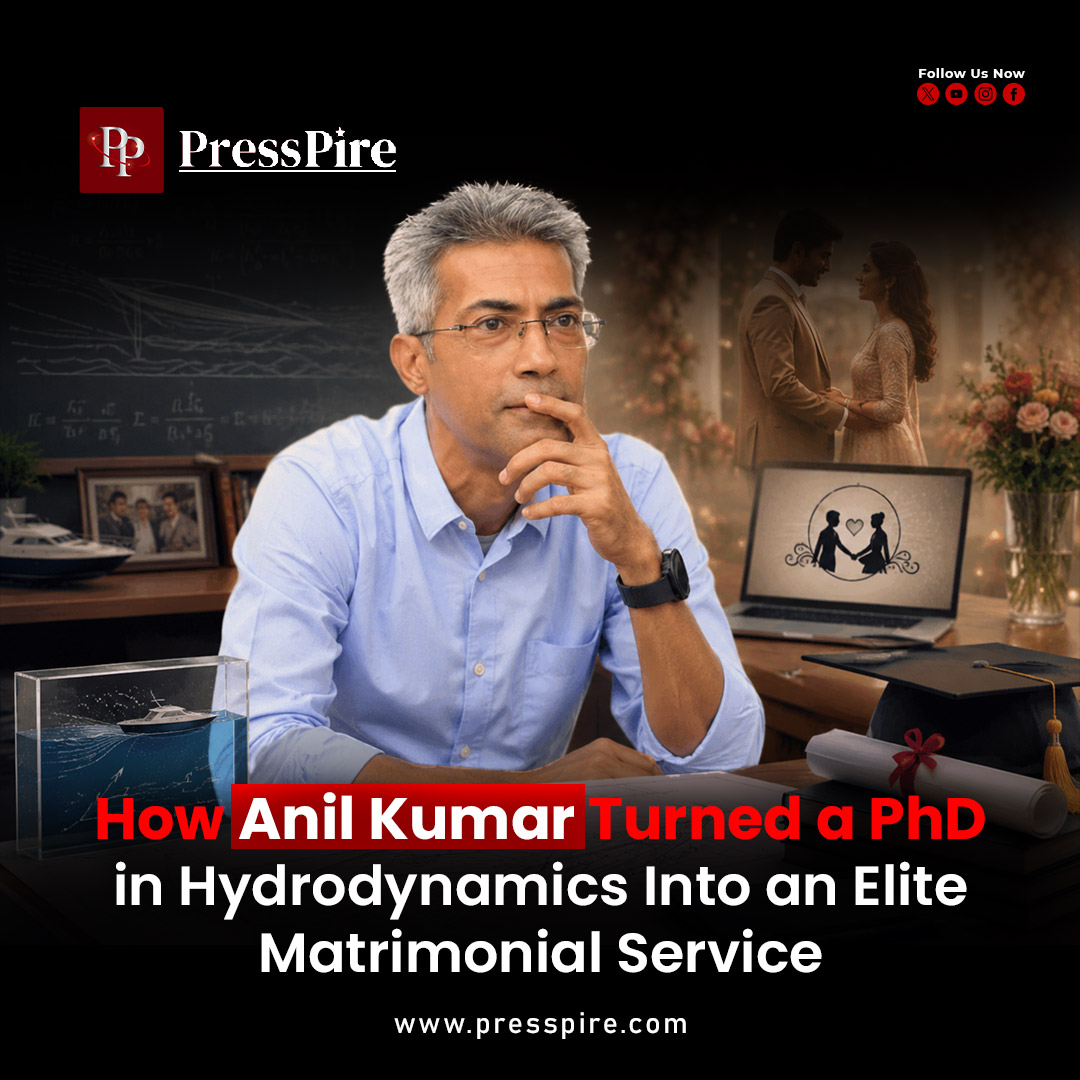
How Anil Kumar Turned a PhD in Hydrodynamics Into an Elite Matrimonial Service
Discover how Anil Kumar turned a PhD in hydrodynamics into Jodi365, an elite matrimonial service built around personalised matchmaking.
Anil Kumar transformed an unconventional career path from IIT Madras and a PhD in computational hydrodynamics into Jodi365, a personalised matrimonial service for Indian singles. After experiencing the limitations of conventional dating and matrimonial platforms himself, Kumar built a high-touch matchmaking model focused on quality, compatibility and human intervention.
Anil Kumar’s Unusual Beginning
Anil Kumar matrimonial service may sound like an unlikely destination for someone whose academic career began with engineering, research and computational hydrodynamics. But Kumar’s journey shows how deeply personal problems can become powerful entrepreneurial opportunities.
Kumar began with a very different ambition. He studied at IIT Madras before earning a master’s degree in mechanical engineering from the University of Iowa and a PhD in computational hydrodynamics from the University of Michigan. His professional journey later included research, marine-industry consulting and work in the investment ecosystem. He also earned an MBA from the University of Chicago Booth School of Business.
On paper, the path pointed towards engineering, research or finance. Instead, Kumar eventually entered one of the most personal and complicated areas of modern Indian life: finding a life partner.
That transition did not happen because he had always dreamed of becoming a matchmaker. In fact, Kumar describes himself as an “accidental matchmaker”. His entrepreneurial journey began after he personally experienced the shortcomings of online dating and matrimonial platforms.
The experience forced him to ask a simple question: if highly educated and accomplished people were struggling to find meaningful relationships online, was the problem with the people or with the system?
From Hydrodynamics to Matchmaking
The story of Anil Kumar matrimonial service is also a story about recognising a problem from the inside. Kumar spent years navigating online platforms while searching for a compatible partner. What he discovered was a frustrating gap between traditional matrimonial services and modern dating applications.
Traditional matrimonial websites often treated relationships like a catalogue. Users could search through profiles, apply filters and communicate, but the process could feel transactional. Dating applications, meanwhile, were designed around speed, attraction and constant discovery.
Kumar believed many serious, accomplished singles needed something different.
They did not necessarily want thousands of profiles. They wanted fewer, better possibilities—and someone capable of understanding the nuances behind their preferences.
That insight eventually led to the creation of Jodi365 in 2009 while Kumar was studying at Chicago Booth. The platform was conceived as a hybrid between matrimonial services and dating platforms, specifically for quality Indian singles. The University of Chicago Booth School of Business confirms that Kumar founded Jodi365 in 2009.
The idea was straightforward but ambitious: make matchmaking more thoughtful, personalised and compatible with the realities of educated Indian professionals living across the world.
The Problem Behind Jodi365
For Anil Kumar, the problem with matchmaking was never simply a lack of profiles. It was a lack of meaningful context.
Kumar had personally used major online platforms in both India and the United States. His experiences included relationships that appeared promising but eventually collapsed, lengthy conversations that ended badly and meetings where expectations did not match reality.
Those experiences revealed a larger issue. A profile could tell someone where another person lived, what they did professionally or what they looked like. But it could not necessarily explain how they communicated, what they expected from marriage, how flexible their preferences were or what kind of relationship they genuinely wanted.
That distinction became central to Jodi365.
According to reporting on Kumar’s journey, the platform initially collected far more information than conventional dating apps. Instead of relying primarily on age, location and photographs, it sought deeper information about users and their partner preferences. The company also introduced manual profile verification and technology-driven matching.
But Kumar eventually discovered another problem: information alone was not enough.
People could have detailed profiles and still struggle to act on them. The business therefore had to evolve from simply providing technology to providing judgement.
That became the turning point.
Anil Kumar Builds a Personalised Service
The biggest transformation in the Anil Kumar matrimonial service story came when Kumar stopped trying to build a matchmaking platform for everyone.
Initially, Jodi365 followed the familiar technology-startup philosophy: build a platform, attract users and scale. But user behaviour showed that a complicated onboarding process could discourage people rather than help them.
Kumar eventually decided that the real opportunity was not maximum scale. It was maximum impact for people who genuinely valued personalised assistance.
Jodi365 therefore moved towards a high-touch matchmaking model. Instead of leaving clients alone with a database of profiles, the company began taking a more active role in understanding them, screening potential matches and helping navigate difficult conversations.
This changed the nature of the business.
Kumar began comparing the service to executive search rather than conventional online matchmaking. The idea is similar to a headhunter finding the right executive: the intermediary understands the client, searches for suitable candidates, filters possibilities and helps both sides assess whether there is genuine potential.
For serious relationships, that human layer can matter enormously.
A person may say they want a particular profession, age, location or community. But when those preferences are discussed in depth, some may turn out to be flexible while others may be non-negotiable.
That is where a human matchmaker can add value that an algorithm alone may struggle to provide.
Why Elite Matchmaking Needed a Human Touch
Technology can identify patterns, but relationships are rarely just patterns.
The Anil Kumar matrimonial service model increasingly focused on conversations rather than clicks. Clients could discuss expectations, priorities, deal-breakers and personal circumstances in detail. Kumar’s signature involvement reportedly includes onboarding conversations that can last for two hours or more.
The approach is particularly relevant for professionals who have demanding careers and limited time. For them, browsing hundreds of profiles may create more noise than clarity.
A personalised matchmaking service attempts to reverse that equation.
Instead of asking clients to find the right person among thousands, the service works to understand the client first and then identify a smaller pool of potentially compatible people.
It is a subtle but important shift from searching for a match to curating a match.
Kumar’s own academic and professional background may have contributed to this analytical approach. Hydrodynamics is fundamentally about understanding complex systems and how different forces interact. Matchmaking is obviously not fluid mechanics, but the broader mindset of analysing variables, identifying relationships and looking for workable outcomes appears naturally suited to a problem involving human compatibility.
Yet Kumar’s journey also demonstrates the limits of pure analysis. Relationships cannot be solved through equations. They require empathy, communication and an understanding of human behaviour.
The Business Model Behind Jodi365
The elite matrimonial service built by Anil Kumar also operates on a business model very different from free dating applications.
Jodi365’s high-touch approach places a financial value on personalised attention. According to recent reporting, its service begins with a minimum retainer of ₹1 lakh, with an additional success fee when an engagement date is set. Its signature tier involving Kumar personally starts at ₹5 lakh.
The pricing reflects the company’s positioning.
Jodi365 is not attempting to compete with mass-market matrimonial websites on the number of profiles available. Instead, it competes on curation, discretion, personal involvement and the quality of potential matches.
This is an important entrepreneurial lesson.
Not every business needs millions of customers to create value. Sometimes, the opportunity lies in serving a smaller group exceptionally well.
Kumar’s decision to move towards a premium service also demonstrates the importance of listening to the market. The original technology-heavy model offered scalability, but the company’s experience suggested that its customers valued human intervention more than unlimited choice.
In other words, the pivot was not a rejection of technology. It was a recognition that technology should support the service rather than become the service itself.
Anil Kumar’s Lessons From Failure
One of the most human aspects of Anil Kumar’s story is that he did not build a matchmaking company from a position of perfect personal success.
His own relationships included difficult experiences. Most notably, after meeting his future wife through an MBA networking event and eventually marrying, Kumar later went through a divorce. That experience gave him another perspective on relationships, particularly the realities faced by people entering the search after marriage has already ended.
That personal history matters because matchmaking is ultimately an emotional business.
Clients may arrive with unrealistic expectations, past disappointments, fears or deeply held assumptions about what their future partner should be. A good intermediary must sometimes challenge those assumptions rather than simply agree with them.
Kumar’s story therefore moves beyond the conventional startup narrative of growth, funding and technology.
It is about learning from failure and using that experience to understand customers more deeply.
His career also demonstrates that entrepreneurial opportunities do not always emerge from a person’s original field. A PhD in computational hydrodynamics did not directly prepare Kumar to become a matchmaker. But the discipline of solving complicated problems, questioning assumptions and working through uncertainty proved valuable in an entirely different industry.
The Future of Indian Matchmaking
Indian matchmaking is changing as younger professionals gain greater independence in choosing their partners.
Families remain involved, but the decision increasingly belongs to the individuals getting married. At the same time, divorce and remarriage have become less hidden conversations, while global careers have expanded the geographic boundaries of the Indian marriage market.
That creates space for a new generation of matchmaking services.
The future may not belong entirely to traditional matrimonial websites or entirely to dating apps. Instead, there could be a growing middle ground where technology handles discovery and verification while human experts handle interpretation, communication and compatibility.
Jodi365’s evolution reflects exactly that possibility.
Kumar himself has remained cautious about predicting what younger generations will ultimately want from matchmaking. His approach is less about claiming to have every answer and more about adapting as social expectations change.
That humility may be one of the more important lessons from his journey.
The matchmaking industry is dealing with something that technology alone cannot completely standardise: human choice.
What Entrepreneurs Can Learn From Anil Kumar
The Anil Kumar matrimonial service story offers a powerful lesson in unconventional entrepreneurship.
First, a founder’s original qualification does not have to determine the industry they eventually transform. Kumar went from IIT Madras and a PhD in computational hydrodynamics to building a personalised matchmaking business.
Second, personal frustration can become a powerful source of business insight. Kumar did not begin with a theoretical market thesis. He experienced the problem himself and recognised that others were experiencing it too.
Third, scale is not always the ultimate goal. Jodi365’s evolution shows how a business can discover that premium, high-touch service creates more value than mass-market reach.
Finally, the story demonstrates that entrepreneurship is often about knowing when to change direction.
Anil Kumar did not abandon technology. He changed the role technology played in his business.
His journey from computational hydrodynamics to elite matchmaking may seem unusual, but that is precisely what makes it compelling. The same person who once worked on complex engineering problems eventually turned his attention to one of life’s most complex questions: who should we build a life with?
Jodi365 represents the answer he continues to develop a matchmaking model where algorithms can assist, but human understanding remains at the centre.
For more insights navigate: PressPire | Stories That Shape the Future
Read previous article here: https://presspire.com/bakingo-fa-gifts/
Follow PressPire on Facebook | Instagram | LinkedIn | YouTube
PressPire | Stories That Shape the Future