
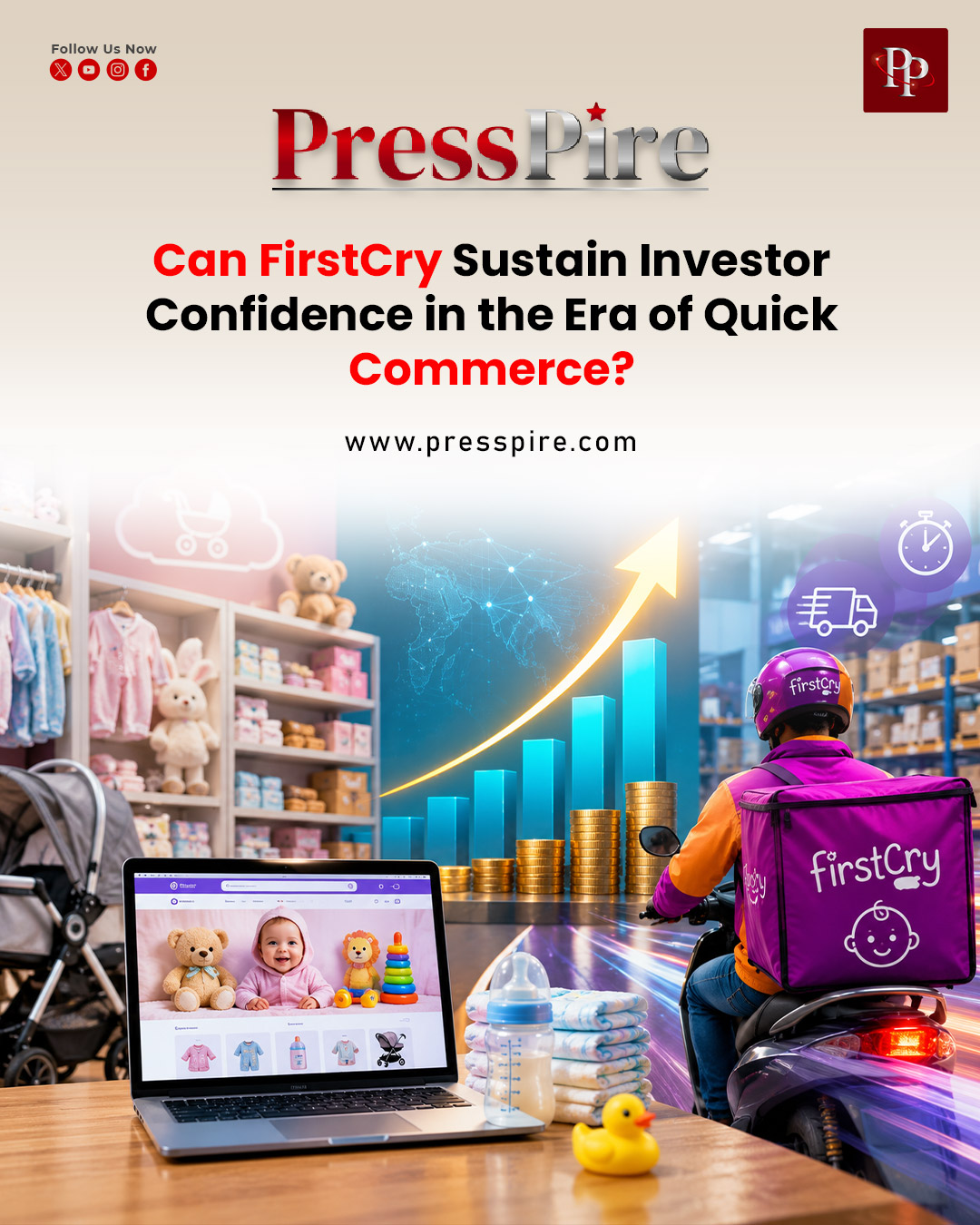
Can FirstCry sustain investor confidence as quick commerce reshapes India’s baby products market? Explore growth, competition, profitability, and future strategy.
Can FirstCry Sustain Investor Confidence in the Era of Quick Commerce?
India’s digital retail industry is evolving faster than ever before, and no company understands this transformation better than FirstCry. Once celebrated as the country’s undisputed leader in the baby and kids products segment, FirstCry now finds itself navigating a marketplace where speed often matters as much as product quality. The rise of quick commerce platforms has fundamentally changed consumer expectations, raising an important question for investors and industry observers alike, can FirstCry sustain investor confidence in the era of quick commerce?
The company has spent more than a decade building trust among millions of parents through a specialised product portfolio, an omnichannel retail model, and deep brand partnerships. However, the emergence of rapid-delivery platforms promising essentials within minutes is changing purchasing behaviour across categories, including baby care. Investors are no longer evaluating businesses solely on revenue growth; they are increasingly looking at profitability, customer retention, operational efficiency, and long-term adaptability.
As India’s e-commerce sector enters its next phase of competition, FirstCry’s journey offers valuable insights into how specialised retailers can remain relevant despite disruptive market trends. The coming years may define not only the company’s market leadership but also whether it can continue rewarding shareholders in an increasingly competitive digital economy.
FirstCry Investor Confidence Faces a New Retail Reality
The conversation around FirstCry Investor Confidence has become increasingly important as India’s retail landscape undergoes a dramatic transformation. Quick commerce companies have expanded well beyond groceries, gradually entering categories such as personal care, healthcare products, baby essentials, and household goods. For many young parents, ordering diapers, baby food, wipes, or healthcare products with delivery in less than thirty minutes has become a preferred convenience. This behavioural shift presents both a challenge and an opportunity for FirstCry. Unlike general quick commerce platforms, FirstCry offers an extensive catalogue of baby and children’s products, expert recommendations, parenting resources, premium international brands, and specialised shopping experiences that are difficult to replicate. Nevertheless, investors recognise that convenience is becoming one of the strongest purchase drivers in urban India. Maintaining investor confidence therefore depends on FirstCry’s ability to integrate faster fulfilment, improve supply chain efficiency, and continue delivering value without compromising profitability. The company’s strategic response to these changing consumer expectations will significantly influence how markets assess its long-term growth potential.
FirstCry Investor Confidence Depends on Omnichannel Strength
One of FirstCry’s biggest competitive advantages remains its carefully developed omnichannel ecosystem, which combines digital commerce with a nationwide network of physical stores. This hybrid model allows customers to browse products online, experience them offline, seek expert guidance, and complete purchases through whichever channel suits them best. For new parents making high-value purchases such as strollers, car seats, cribs, or feeding equipment, the ability to physically inspect products remains extremely valuable. This differentiates FirstCry from many quick commerce platforms that primarily focus on speed rather than customer engagement. FirstCry Investor Confidence is strengthened by this unique retail strategy because it reduces dependence on a single sales channel while improving customer acquisition and retention. Physical stores also function as fulfilment centres, enabling faster deliveries and enhancing inventory management. As India’s retail market becomes increasingly integrated, businesses capable of combining technology, logistics, and physical presence are likely to create stronger long-term value. Investors understand that sustainable competitive advantages are built through ecosystems rather than isolated delivery models, making FirstCry’s omnichannel strategy a critical pillar of future growth.
FirstCry Investor Confidence and the Profitability Challenge
Revenue growth alone is no longer enough to satisfy investors. Public markets today place greater emphasis on sustainable profitability, disciplined spending, and predictable earnings. This makes FirstCry Investor Confidence closely tied to the company’s financial performance rather than merely its expansion plans. Like many technology-driven retailers, FirstCry has historically invested heavily in customer acquisition, technology infrastructure, warehousing, logistics, and offline expansion. While these investments have strengthened market leadership, investors increasingly expect operational efficiencies to translate into stronger margins. At the same time, quick commerce competitors continue spending aggressively to attract customers through discounts and rapid delivery services, creating pricing pressure across multiple categories. FirstCry therefore faces the delicate task of balancing growth with financial discipline. Improving inventory turnover, optimising fulfilment costs, expanding private-label offerings, and increasing repeat purchases could significantly enhance profitability. Investors typically reward companies that demonstrate clear pathways towards sustainable earnings while maintaining healthy revenue growth. The company’s financial execution over the coming years may ultimately determine whether investor confidence continues strengthening or begins to weaken amid rising competition.
FirstCry Investor Confidence Amid Rising Competition
Competition within India’s digital commerce ecosystem has never been more intense. Besides traditional e-commerce leaders, specialised retailers now compete against quick commerce companies, direct-to-consumer brands, social commerce platforms, and global marketplaces. Every player seeks a larger share of India’s rapidly growing consumer spending. Despite this crowded environment, FirstCry Investor Confidence continues to benefit from one important factor—specialisation. Parents purchasing products for infants and young children often prioritise authenticity, product safety, trusted brands, and expert recommendations over mere speed of delivery. This behavioural difference provides FirstCry with an opportunity to reinforce its positioning as a trusted parenting destination rather than simply another online retailer. The company also enjoys long-standing relationships with domestic and international brands, allowing it to offer product selections unavailable on many competing platforms. However, maintaining this advantage requires constant innovation, improved customer experiences, stronger technology integration, personalised shopping journeys, and expanded value-added services. Investors closely monitor whether FirstCry can continue differentiating itself as competitors become increasingly sophisticated in attracting consumers across multiple retail categories.
FirstCry Investor Confidence Through Customer Loyalty
Customer loyalty remains one of the strongest drivers of FirstCry Investor Confidence because the company serves families through multiple stages of childhood. Unlike businesses focused on one-time purchases, FirstCry benefits from recurring demand as parents continuously purchase diapers, clothing, toys, educational products, nutrition items, healthcare essentials, and school-related supplies. This naturally creates opportunities for higher customer lifetime value. Building emotional relationships with parents through educational content, parenting advice, loyalty programmes, personalised recommendations, and trusted customer service further strengthens retention. In today’s competitive digital economy, acquiring customers is expensive, making repeat business significantly more valuable than constant acquisition. FirstCry’s deep understanding of parenting needs allows it to personalise shopping experiences more effectively than many general marketplaces. As artificial intelligence and data analytics become increasingly integrated into retail operations, the company has additional opportunities to improve product recommendations, optimise inventory planning, and enhance customer engagement. Investors generally view businesses with strong customer loyalty more favourably because predictable repeat purchases contribute to stable long-term revenue growth and greater resilience during periods of economic uncertainty.
FirstCry Investor Confidence and Future Growth Strategy
Looking ahead, sustaining FirstCry Investor Confidence will require strategic execution rather than reliance on historical success. India’s young population, rising disposable incomes, increasing internet penetration, expanding middle class, and growing awareness of premium baby products continue to create favourable long-term market opportunities. However, capturing this demand requires constant adaptation. FirstCry can strengthen its competitive position by investing further in faster delivery capabilities, expanding private-label products, leveraging artificial intelligence for customer personalisation, enhancing mobile commerce experiences, increasing regional market penetration, and building stronger partnerships with healthcare professionals and parenting communities. International expansion may also provide additional growth opportunities if executed carefully. Investors will particularly focus on whether management successfully balances innovation with capital discipline while maintaining operational excellence. Companies that adapt proactively to changing consumer behaviour typically outperform those that react after disruption has already reshaped the market. FirstCry possesses the brand recognition, infrastructure, customer trust, and category expertise needed to remain a significant player, but future leadership will ultimately depend on execution rather than legacy achievements.
Why FirstCry Investor Confidence Still Matters
The debate surrounding FirstCry Investor Confidence reflects a much broader transformation taking place across India’s retail economy. Quick commerce has undoubtedly redefined consumer expectations by making convenience an everyday standard rather than a premium service. Yet speed alone does not build enduring businesses. Trust, product expertise, customer relationships, operational efficiency, and sustainable financial performance continue to determine long-term success.
FirstCry enters this new competitive era with several advantages that newer entrants continue striving to build—strong brand recognition, a loyal customer base, an extensive omnichannel network, specialised product expertise, and years of experience serving Indian families. At the same time, investors expect more than market leadership; they seek evidence that the company can maintain profitability while responding effectively to evolving consumer behaviour.
The coming years will test FirstCry’s ability to innovate without losing focus on financial discipline. If the company successfully combines rapid fulfilment, technology-driven personalisation, operational efficiency, and customer trust, it can reinforce its leadership position while sustaining investor confidence. In an increasingly competitive retail landscape, adaptability not size alone will determine which companies continue creating long-term value for customers, shareholders, and the broader Indian e-commerce ecosystem.
For more insights navigate: PressPire | Stories That Shape the Future
Read previous article here: https://presspire.com/ather-fundraising/
Follow PressPire on Facebook | Instagram | LinkedIn | YouTube
PressPire | Stories That Shape the Future