
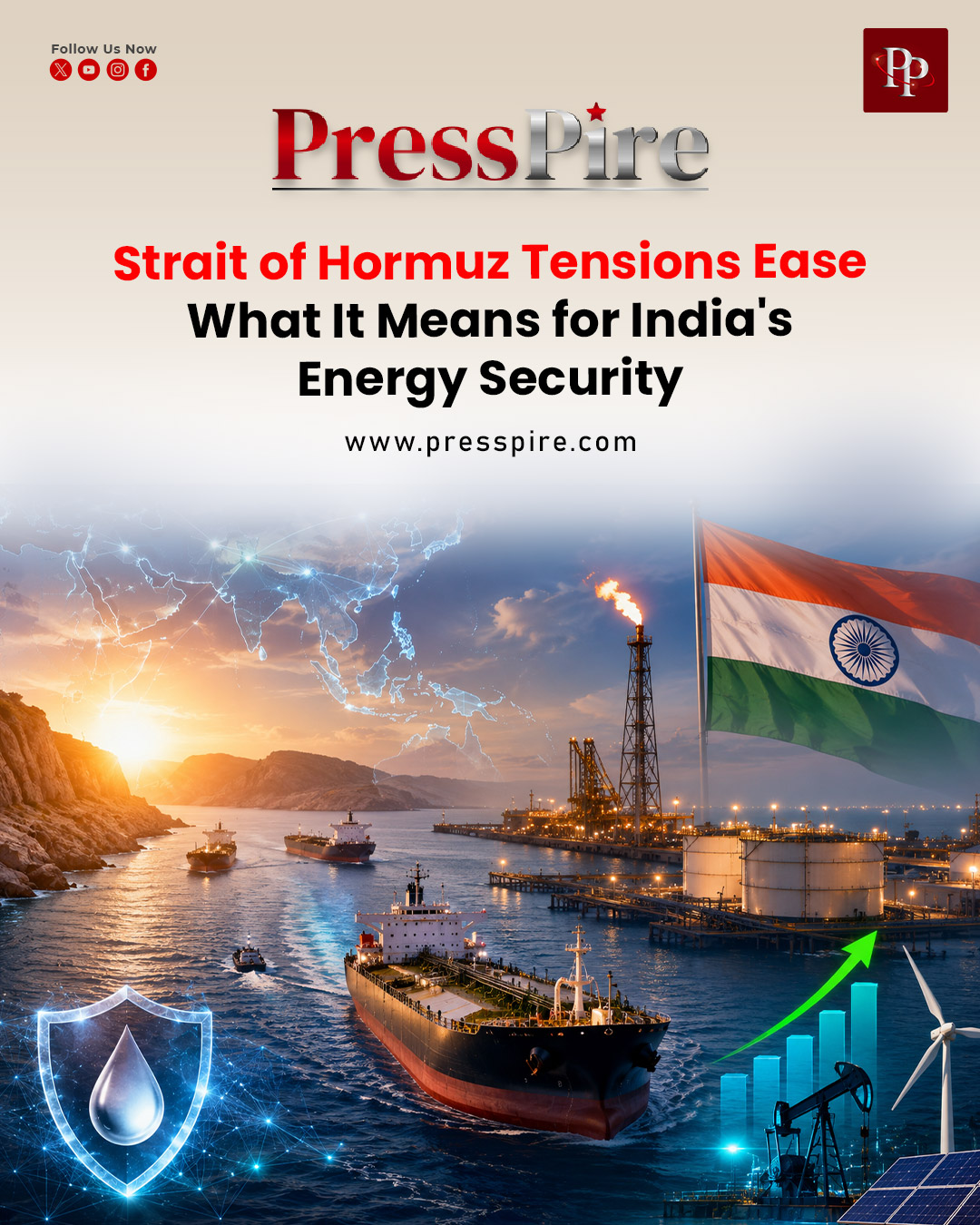
Strait of Hormuz Tensions Ease: What It Means for India’s Energy Security
The easing of Strait of Hormuz tensions has brought temporary relief to global energy markets and India, one of the world’s largest oil importers. While lower shipping risks and stable crude prices benefit India’s economy, experts warn that long-term energy security still depends on diversification, strategic reserves, and renewable energy investments.
Strait of Hormuz Tensions Ease: What It Means for India’s Energy Security
After months of geopolitical uncertainty in the Middle East, signs of easing tensions around the Strait of Hormuz have offered welcome relief to global energy markets. For India, which imports nearly 85% of its crude oil requirements, stability in this narrow maritime passage is more than an international diplomatic issue it is a matter of economic security.
The Strait of Hormuz remains one of the world’s most strategically significant waterways. Nearly one-fifth of global oil trade and a substantial share of liquefied natural gas (LNG) shipments pass through this narrow channel connecting the Persian Gulf with the Arabian Sea. Any disruption immediately affects crude oil prices, freight costs, insurance premiums, and global inflation.
Recent diplomatic engagements and reduced military activity have improved market sentiment, although analysts caution that the region remains vulnerable to sudden escalations. Even as temporary calm returns, India continues to evaluate its long-term energy strategy to reduce dependence on geopolitical hotspots.
For consumers, businesses, and policymakers alike, the easing of Strait of Hormuz tensions presents both an opportunity and a reminder of the importance of energy resilience.
Why the Strait of Hormuz Matters for India’s Energy Security
The Strait of Hormuz is often called the world’s most important energy chokepoint for good reason.
Around 20% of globally traded crude oil and a significant volume of LNG travel through this narrow sea passage every day. Major oil exporters including Saudi Arabia, Iraq, Kuwait, the UAE, Qatar, and Iran rely on this route to transport energy supplies to Asia.
India receives a major share of its crude oil imports from Gulf nations. According to strategic studies, more than two-thirds of India’s crude imports either directly or indirectly depend on uninterrupted shipping through the Strait of Hormuz.
Whenever tensions rise in the region, oil prices typically surge because traders anticipate supply disruptions. Shipping companies also increase freight charges, while insurers raise premiums for tankers entering conflict-prone waters.
This creates a cascading effect:
- Higher petrol and diesel prices
- Increased inflation
- Rising transportation costs
- Pressure on government finances
- Higher import bills
Even if oil supply is not interrupted, market uncertainty alone can significantly increase energy costs.
Fortunately, the latest diplomatic progress has reduced immediate fears of large-scale supply disruptions, helping stabilize global crude prices and improve investor confidence.
Strait of Hormuz Tensions Ease: Impact on India’s Oil Imports
The easing of Strait of Hormuz tensions is already generating positive signals across global energy markets.
Lower geopolitical risk reduces speculative pressure on crude oil prices. Shipping companies face fewer operational risks, while insurance costs for energy cargoes may gradually decline.
For India, this means:
- Greater certainty in crude oil procurement
- Lower transportation expenses
- Reduced pressure on fuel prices
- Improved fiscal planning
Stable oil prices are particularly important because energy imports account for a significant portion of India’s trade deficit.
When crude prices remain manageable, the Indian Rupee experiences less pressure, inflation becomes easier to control, and industries dependent on petroleum products can better manage production costs.
Indian refiners such as IOC, BPCL, and HPCL also benefit from improved supply visibility, allowing them to optimize refinery operations and inventory planning.
However, experts stress that geopolitical stability in the Gulf remains fragile. Any renewed conflict could quickly reverse current market optimism. Therefore, India’s energy planners continue to prepare contingency measures despite the recent easing in tensions.
India’s Energy Security Strategy Beyond the Strait of Hormuz
While calmer conditions provide temporary relief, India recognizes that long-term energy security cannot depend on a single maritime route.
Over the past decade, New Delhi has steadily diversified its crude oil import sources.
Apart from Gulf suppliers, India has increased purchases from:
- Russia
- United States
- Brazil
- West African nations
- Latin American producers
Diversification reduces dependence on any one geopolitical region and provides greater bargaining power in international markets.
India has also invested heavily in its Strategic Petroleum Reserves (SPR), allowing emergency crude storage that can be used during supply disruptions.
Additionally, the government continues expanding renewable energy capacity through solar, wind, green hydrogen, and biofuels.
These investments align with India’s long-term objective of reducing fossil fuel dependence while maintaining economic growth.
Experts argue that future energy resilience will require a balanced approach combining:
- Diverse oil suppliers
- Domestic renewable generation
- Strategic reserves
- Improved refinery capacity
- Enhanced maritime security
This multi-layered strategy makes India less vulnerable to future geopolitical shocks.
Global Oil Markets React to Improving Middle East Stability
International oil markets closely monitor developments around the Strait of Hormuz because even small disruptions can trigger significant price volatility.
Recent easing in regional tensions has improved market confidence, although traders remain cautious.
Oil prices respond not only to actual supply disruptions but also to expectations of future risks.
Several additional factors continue influencing energy markets:
- OPEC+ production decisions
- Global economic growth
- Chinese oil demand
- US strategic petroleum policies
- Shipping security in the Gulf
Because these variables interact simultaneously, energy markets remain highly sensitive to geopolitical developments.
Financial analysts believe that continued diplomatic engagement could support moderate crude prices in the coming months.
However, any renewed military confrontation could immediately reverse gains, pushing Brent crude sharply higher and increasing inflation worldwide.
India’s Maritime Security and Strategic Preparedness
Energy security extends beyond purchasing crude oil—it also involves protecting supply routes.
India has significantly strengthened naval surveillance in the Arabian Sea and Indian Ocean over recent years.
The Indian Navy regularly conducts maritime security operations aimed at protecting commercial shipping, preventing piracy, and ensuring uninterrupted trade.
Close coordination with international partners has improved maritime awareness across critical shipping lanes.
India is also investing in:
- Port modernization
- LNG infrastructure
- Pipeline expansion
- Coastal security
- Energy logistics
These initiatives reduce operational vulnerabilities and strengthen national preparedness against external disruptions.
Energy experts emphasize that infrastructure resilience is just as important as diplomatic engagement in ensuring uninterrupted fuel supplies.
The Road Ahead: Building a More Resilient Energy Future
The easing of Strait of Hormuz tensions offers welcome breathing space for India and the global economy.
Lower geopolitical uncertainty supports stable fuel prices, reduces import costs, and improves investor confidence. Consumers may also benefit if sustained stability keeps inflation under control.
However, recent events serve as a reminder that India’s heavy dependence on imported energy remains a strategic challenge.
Future resilience will require continued diversification of import sources, expansion of renewable energy, stronger strategic petroleum reserves, and enhanced maritime security.
India’s ambition of becoming a $5 trillion economy depends heavily on uninterrupted access to affordable energy. Achieving that goal means preparing not only for periods of stability but also for future geopolitical shocks.
While the Strait of Hormuz may appear calm today, the lessons learned from repeated regional tensions reinforce one important reality: true energy security comes from resilience, diversification, and long-term strategic planning—not temporary geopolitical relief.
For more insights navigate: PressPire | Stories That Shape the Future
Read previous article here: https://presspire.com/jio-ipo/
Follow PressPire on Facebook | Instagram | LinkedIn | YouTube
PressPire | Stories That Shape the Future